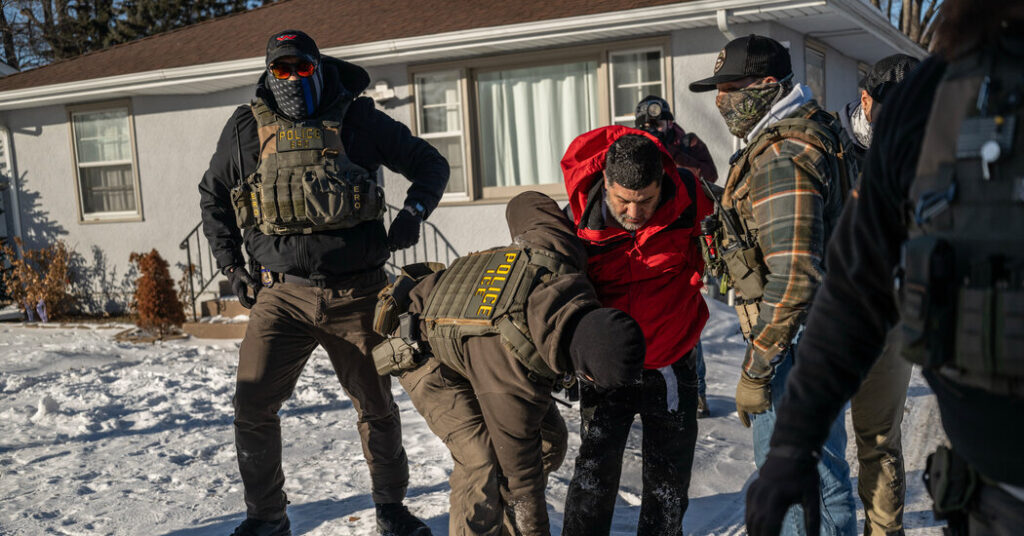
Lawyers for the Trump administration told a federal judge on Wednesday that the surge of federal agents in Minnesota was a legitimate exercise of law enforcement power, not an illegal attempt to coerce policy changes.
In a court filing, the administration again urged the judge to deny a request from state and city officials to block the deployment, which has led to thousands of arrests, three shootings and weeks of protests. The Minnesota officials have argued that the surge is a violation of state sovereignty under the 10th Amendment.
“The point — and the only point relevant for purposes of the 10th Amendment — is that federal law enforcement officers are in Minnesota enforcing validly enacted federal law,” the Trump administration’s lawyers wrote in their filing.
The federal government spoke dismissively of the legal theories put forward by the state government and the cities of Minneapolis and St. Paul, whose lawyers have described the deployment of 3,000 federal agents to Minnesota as unconstitutional and dangerous.
Brian Carter, a lawyer for the state, said in court on Monday that “it is personal animosity, it is retribution” that was motivating the Trump administration’s campaign in Minnesota. He also accused the administration of trying to strong-arm the state into changing policies that limit cooperation on civil immigration enforcement.
“The federal government is attempting to bend the state’s will to its own,” Mr. Carter said, “and that is not allowed under the Constitution.”
After that hearing, Judge Kate M. Menendez of the Federal District Court in Minnesota asked the Trump administration to more fully respond to the coercion claims before she ruled on the request to block the deployment, which the federal government has named Operation Metro Surge.
“Assuming plaintiffs are correct that the 10th Amendment provides them with the freedom to enact their sanctuary policies,” the Trump administration’s lawyers wrote, “then more federal officers may be needed in Minnesota to fill the gap. This is a natural consequence of plaintiffs’ policy decisions, not a punishment for them.”
During the hearing on Monday, Judge Menendez asked federal lawyers about a social media post by President Trump about Minnesota that said “THE DAY OF RECKONING & RETRIBUTION IS COMING!” She also asked about a letter sent over the weekend by Attorney General Pam Bondi to Gov. Tim Walz that outlined several policy demands for the state related to immigration enforcement, welfare programs and a request to hand over voter rolls.
In their filing on Wednesday, the Trump administration’s lawyers wrote that the president’s “singular statement is of little relevance,” describing his post as a “single and unclear reference to ‘retribution.’” And they said that “there is no hint of a quid pro quo in the attorney general’s letter; she does not offer plaintiffs a trade or commit to end Operation Metro Surge under any circumstances.”
Judge Menendez, who was nominated to the bench by President Joseph R. Biden Jr., has moved more slowly in considering the lawsuit than the state and local governments would have liked. Since filing the case on Jan. 12, the plaintiffs have repeatedly asked her to act immediately to temporarily block the campaign, but the judge has not yet issued a decision.
The lawsuit was filed days after a federal agent in Minneapolis shot and killed Renee Good, an American citizen. After the case was filed, agents shot two more people in the city. On Jan. 14, an agent shot and injured a Venezuelan man who officials said was in the country illegally and had resisted arrest. And on Saturday, agents shot and killed Alex Pretti, another American citizen.
Sara Lathrop, a lawyer for the city of Minneapolis, said in court on Monday that the events over the weekend showed that the “situation is absolutely untenable.”
While other states have brought 10th Amendment lawsuits against the federal government over the years, there are few direct parallels for the claims made in the Minnesota case. A similar lawsuit filed by Illinois officials this month has not yet been decided.
The Trump administration has argued that it is up to the president to decide how and where to deploy federal law enforcement. Brantley Mayers, a lawyer for the administration, described the request to block the surge as “a pretty staggering remedy” during the hearing on Monday.
Mr. Mayers noted that Congress had passed immigration laws and that Mr. Trump had campaigned on a promise to crack down on illegal immigration. He also pushed back against the state’s claims that political retribution or coercion was motivating the crackdown.
“There is nothing to back up this claim that we’re here for another reason,” Mr. Mayers said, insisting that immigration enforcement was the reason for the surge.
Judge Menendez has not indicated when she might rule.
Mitch Smith is a Chicago-based national correspondent for The Times, covering the Midwest and Great Plains.
The post Trump Administration Denies That Coercion Is at Heart of Minnesota ICE Surge appeared first on New York Times.