Federal officials said Border Patrol agents had been searching for a dangerous criminal when they fatally shot Alex Pretti on a Minneapolis sidewalk.
Four days later, that man still has not been arrested, said Tricia McLaughlin, a spokeswoman for the Department of Homeland Security.
Gregory Bovino, who headed Border Patrol operations in the city until he was reassigned this week, said Sunday that the target was an Ecuadorean named Jose Huerta-Chuma.
Mr. Bovino said that Mr. Huerta-Chuma had a significant criminal history. Court records indicate that Mr. Huerta-Chuma has had traffic violations and one misdemeanor related to domestic abuse, but has never been convicted of a felony.
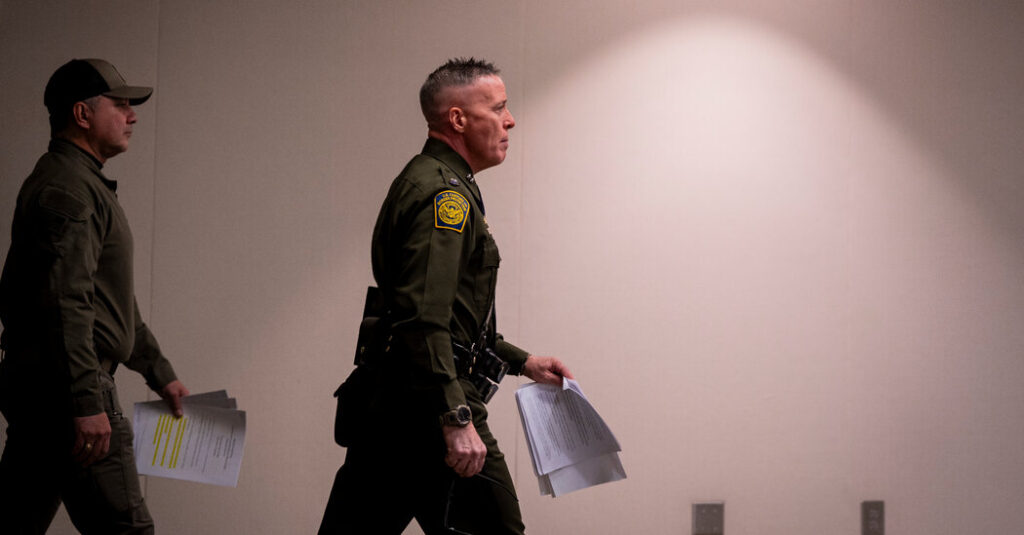
At least eight federal agents in tactical gear were involved in the Saturday operation to apprehend him that ended in the killing of Mr. Pretti, a U.S. citizen and nurse, according to a Times video analysis. Federal officials have said their operation in Minnesota is meant to deport “the worst of the worst,” but the display of force to target a man with a relatively low-level criminal record has alarmed observers who say their tactics are disproportionate.
“They are literally murdering our neighbors to catch people with misdemeanors,” said Mike Berger, Hennepin County’s chief public defender, whose office represented Mr. Huerta-Chuma in several cases.
Mr. Bovino said that Mr. Huerta-Chuma was not captured because “agitators” had harassed and disrupted federal agents.
Rodney Scott, the commissioner of U.S. Customs and Border Patrol, said such heated confrontations require more agents for single arrests. “We are basically putting up two teams — one team to make the original arrest and another team to protect those agents and officers,” he told Fox News on Sunday.
Federal officials’ description of Mr. Huerta-Chuma’s criminal record has also been disputed. Mr. Bovino on Sunday said it included “domestic assault to intentionally inflict bodily harm, disorderly conduct and driving without a valid license.”
But Mr. Huerta-Chuma was not convicted of domestic assault, according to Minnesota court records. In 2018, he was charged with misdemeanor domestic assault, but pleaded guilty to a lesser offense of disorderly conduct, according to records and Mr. Berger. The disorderly conduct conviction was later expunged.
Two women sought civil restraining orders against Mr. Huerta-Chuma, in 2010 and 2019, according to Hennepin County court records. The earlier case was dismissed after a judge determined the evidence did not prove domestic abuse had occurred; in the later one, the protection order was granted. A protection order does not indicate a criminal conviction.
Mr. Huerta-Chuma’s record also includes about a dozen traffic violations dating back to 2008.
Mr. Huerta-Chuma could not be reached for comment, and Mr. Berger, the public defender, said his office had not been in contact with him in years. When it did represent him, Mr. Huerta-Chuma had said he was a U.S. citizen, Mr. Berger said.
Administration officials have said their deportation campaign targets violent criminals. In Minnesota, the Department of Homeland Security launched a website listing scores of immigrants it said had been taken into custody during the crackdown.
But when agents have conducted operations in major cities, including Los Angeles, Chicago and Washington, D.C., most of the people arrested had no criminal record. In Minnesota, more than 100 refugees with no criminal record have been arrested, according to lawyers, family members and faith leaders.
Paul Schnell, the commissioner of the Minnesota Department of Corrections, said that several of the people DHS said it apprehended were actually handed over by state prison officials after completing their sentences. The state launched its own website: “Combating DHS Misinformation.”
Bernard Mokam and Hamed Aleaziz contributed reporting. Kitty Bennett and Georgia Gee contributed research.
Ernesto Londoño is a Times reporter based in Minnesota, covering news in the Midwest and drug use and counternarcotics policy.
The post The Man Agents Were Seeking When They Killed Pretti Remains at Large appeared first on New York Times.