In the waning heat of last summer, freshly back in my office at a major research university, I found myself considering the higher-education hellscape that had lately descended upon the nation. I’d spent months reporting on the Trump administration’s attacks on universities for The Atlantic, speaking with dozens of administrators, faculty, and students about the billions of dollars in cuts to public funding for research and the resulting collapse of “college life.”At the same time, I’d been chronicling the spread of AI-powered chatbots that have already changed undergraduates forever.
Initially, I surveyed the situation from the safe distance of a journalist who happens to also be a career professor and university administrator. I saw myself as an envoy between America’s college campuses and its citizens, telling the stories of the people whose lives had been shattered by these transformations. By the summer, though, that safe distance had collapsed back on me. The wave of campus crises was causing immediate effects in my own academic life. People I knew were losing their jobs. Yearslong projects were stranded. I heard from students cheating their way through every class with AI, and from faculty following suit. I watched professors lash out at other disciplines with misplaced blame. I listened to friends discuss whether they should send their kids to school abroad. I had personally devoted 25 years to higher education. Now it felt like the whole idea of the university might be ending.
Sitting in my office, I began searching for some cause for hope, some reason to believe that higher ed could stanch the damage for the next generation of students. It occurred to me that I’d been hearing less despair from colleagues at certain smaller schools that offer undergraduate study in the “liberal-arts tradition,” a broad and flexible approach to education that values developing the person over professional training. I wondered if these schools—especially the wealthy ones that cluster near the top of national rankings—might enjoy some natural insulation from the fires raging through the nation’s research universities.
I texted, emailed, telephoned, and Zoomed with friends in higher-education leadership. Current and former heads of both research universities and liberal-arts colleges confirmed my intuition: Well-resourced and prestigious small colleges are less exposed in almost every way to the crises that higher ed faces.
To dig deeper, I decided to embark on a fact-finding mission in the guise of a traditional college tour. In November, I went to visit four elite liberal-arts colleges—Amherst, Davidson, Smith, and Vassar—where I joined prospective students and their parents for their campus tours, sat in on classes, and spoke with undergraduates, professors, and administrators. Might schools such as these emerge as the accidental winners of the war on universities?
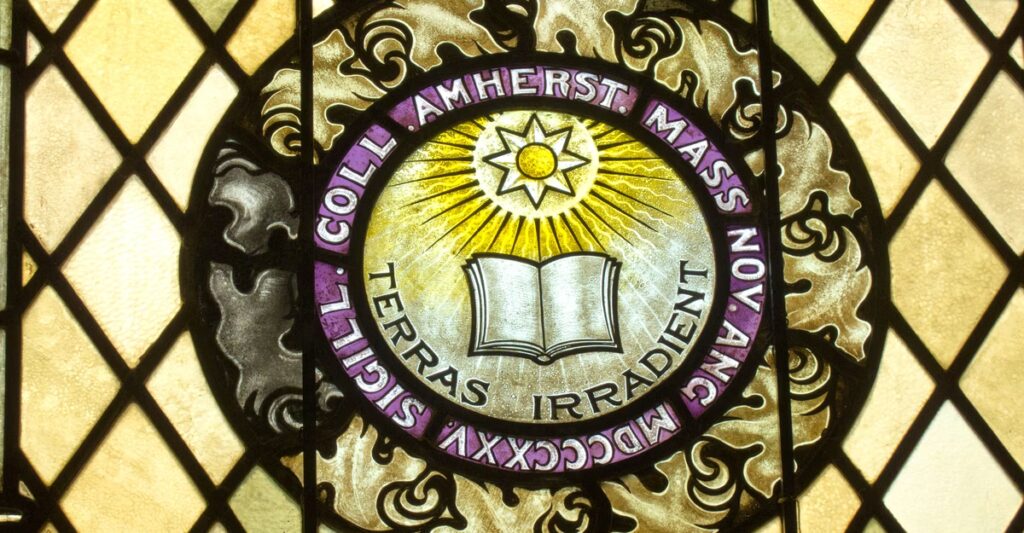
I came to Amherst College too late in the autumn to observe peak foliage, but amber and ochre remnants still spread across the Pioneer Valley in western Massachusetts. This is the scene Emily Dickinson, a local resident, would have taken in before composing the lines, “The maple wears a gayer scarf, / The field a scarlet gown.”
My tour began at the Colonial Revival residence that serves as the school’s admissions office, but we soon arrived in the new science building, a modern structure with oddball green furnishings. Nate Scharf, our sophomore guide, sat us down and gestured toward a small classroom where he had taken a psychology class. At a typical research university, an undergraduate course like this would meet inside a lecture hall, perhaps with separate breakout sections for discussion led by graduate students. But neither Scharf nor any of his classmates had ever been exposed to this scenario—because Amherst, like most liberal-arts colleges, has no graduate students.
No graduate students: The American public may not fully grasp the implications of this statement. At a university, grad students may end up leading class discussions, but that’s only part of the story. Their presence on a campus telegraphs a more important truth: that in terms of mission, teaching undergrads comes second to research.
[Read: Grad school is in trouble]
And at most universities, grad students play a crucial role within the research system: They perform the frontline work of science. Faculty members get federal grants, which are used to pay for doctoral students, who in turn serve as laboratory staff. Professors’ feeling of worth and productivity may be a function of how many doctoral students they advise—because that helps determine how many studies they can carry out, how many papers they can publish, and what sorts of new grants they can win to keep the process going. This endless competition is a major feature of the modern university—whether it’s an elite private school (such as Princeton or Duke), a public flagship (such as the University of Michigan or UC Berkeley), or a land-grant institution (such as Texas A&M or Virginia Tech).
A school like Amherst, though, which has no doctoral programs whatsoever, is free of the rat race of research productivity and expenditure. As these colleges like to point out, that’s good for undergrads, because faculty must focus on education. The lack of doctoral research programs also makes the schools more resilient to bullying from Washington. In 2025, the Trump administration made a point of suspending hundreds of millions of dollars in research grants to Columbia, Harvard, Northwestern, and other schools. It also threatened to impose a tighter limit on what are called “indirect costs”—the portion of each grant that covers all the broader costs of running a large enterprise for research. With so much funding endangered all at once, targeted universities had little choice but to negotiate—which is to say, to accede to some portion of the Trump administration’s demands.
At Amherst, this level of pressure simply couldn’t be applied. In 2024, the college took in around $3 million from all of its federal research grants put together. (For comparison: Washington University in St. Louis, where I teach, received $731 million that year from the National Institutes of Health alone.) Christopher Durr, an associate professor of chemistry, told me that his research is “designed to be done mostly in-house,” by which he means without external funding, and with the help of undergraduates. He studies biodegradable plastics in a lab that is mostly funded by the college itself, and he gets no research money at all from the federal government. Settling into an Eames-style chair in his office, I asked him what indirect-cost rate Amherst applies to its grants, and he said he didn’t know—an innocence that would be unheard of at a research university.
The research that can be done at a small liberal-arts college, with its more modest labs and equipment, is necessarily constrained. Even with Amherst’s generosity, Durr said “there’s a limit” to how far he can push his research. In truth, the most important scientific and medical discoveries aren’t likely to be made at a place like Amherst or Smith, the nearby women’s college, which tend to pay their own students to work on faculty research. But this need not be a limitation for undergraduates. The conditions that produce landmark discoveries are not necessarily the same ones that produce a serious education.
Perched along the shores of North Carolina’s Lake Norman, in the Charlotte suburbs at the northern edge of Mecklenburg County, Davidson College’s location is a crossroads for red and blue America. In the last election, two-thirds of Mecklenburg’s voters chose Kamala Harris; just a mile up the road, in Iredell County, two-thirds of voters went for Donald Trump.
Connor Hines, the current student-body president and a senior majoring in political science, is a self-described moderate conservative who grew up in the area. He told me that he chose to come to Davidson in part because its students are able to disagree with one another in thoughtful ways. His good friend Nina Worley, an educational-studies major who was raised in Harlem, said the same. “I knew that to be a good advocate for education policy, I needed to meet a Republican for the first time,” Worley told me. She and Hines do not see eye to eye on everything—the two do not agree, for example, on the policies of Alexandria Ocasio-Cortez. But they said they carry out that disagreement with respect.
[Read: The end of college life]
According to higher education’s many critics on the right, elite universities have tried to stifle disagreement; allegedly they’re pushing students into echo chambers instead of broadening their minds. The Trump administration made this accusation central to its war on research universities: With billions of dollars in withheld grants as leverage, it initially pressured nine institutions into signing an agreement, called the “Compact for Academic Excellence in Higher Education,”that would commit them to “fostering a vibrant marketplace of ideas on campus” and protecting conservative viewpoints.
In the meantime, under local pressure, reactionary speech suppression is taking hold at public universities: Many schools, including Auburn and the University of Michigan, have shut down their DEI offices; Texas A&M censored courses based on race and gender content; and Indiana University halted the print edition of the student newspaper, an act its journalists said amounted to censorship. Some private schools, including Columbia, Northwestern, and Cornell, have struck deals to restore funding that variously included provisions regarding civil-rights standards, disciplinary processes, DEI rubrics in admissions and hiring, and policies related to sex and gender identity.
Davidson, which, like Amherst, is far less exposed than research universities to the threat of withheld money, has not been explicitly asked to sign the compact. (Nor have any other liberal-arts schools, including the ones I visited.) Chris Marsicano, an associate professor of education studies who had introduced me to Hines and Worley, told me that the school was way ahead of the national conversation on campus dialogue in any case. In 2019, it created a Deliberative Citizenship Initiative, which runs programming to help students and faculty engage on issues about which disagreement is likely, such as immigration and border control. “We’re the hipsters of civil discourse,” Marsicano said. “We were doing it before it was cool.”
Certainly these sorts of efforts can be found at lots of universities: Ohio State has a Civil Discourse for Citizenship initiative, for instance, and WashU has just launched an Ordered Liberty Project, which includes associated coursework on the topic of “disagreement.” But they may be most likely to succeed when they’re applied to smaller student bodies, like Davidson’s. At lunch in the school’s campus commons, I watched President Douglas Hicks greet a dozen students by name. My tour guide explained that students and faculty tend to mingle there; in fact, they can’t avoid it, because everyone eats in the same place. Some might find this stifling or claustrophobic, but being forced to live together day by day may also stimulate openness and mutual respect. “You can’t hide,” Hicks told me.
[Read: Texas sends Plato back to his cave]
At a small liberal-arts college, where a cohort may number fewer than 500 people, admissions officers can also take a stronger hand in assembling a group of students who match the institution’s culture and its vibe while also having very different backgrounds. And the fact that almost everyone at a small liberal-arts college tends to live on campus, or very close to it, adds to the sense of intimacy. “It’s just much easier for me to get to know faculty here, much easier for me to get to know students, much easier for me to hear what’s on their minds,” Amherst’s president, Michael Elliott, told me.
One effect of this, he said, is that professors actually show up to faculty meetings to talk about the future of their institution. They participate in budgeting conversations, debate the creation of majors, and approve new courses. This is decidedly not the norm at many larger universities, where professors may not see these meetings as a core part of the job, and where administrators can ignore them altogether. (Last year, Northwestern reached a settlement with the Trump administration despite 98 percent of its voting faculty having recommended otherwise.) Elliott admits that all of this faculty participation can make the college move more slowly in decision making. But done right, faculty governance is a form of healthy campus discourse, too.
Perhaps no threat to higher ed is more acute than the recent, rapid spread of generative AI. “It’s just about crushed me,” one college teacher told me in the spring of 2023. “I fell in love with teaching, and I have loved my time in the classroom, but with ChatGPT, everything feels pointless.”
The remarkable test-taking, paper-writing power of AI is hardly under control at liberal-arts colleges such as Amherst or Davidson. But in my conversations with students and faculty, I witnessed a struggle to understand and respond to it with greater earnestness and complexity than I have encountered elsewhere in higher education. In my experience, students and faculty at research universities tend to have a Manichaean view of the technology: Either AI is an existential threat to be cast out, or a vital tool to be embraced as a professional virtue. Little room is left for nuance, which means that little progress can be made on shaping policy.
Davidson prides itself on having an unusually deliberate honor code. (Students I spoke with said this code is taken so seriously that they can leave their belongings anywhere on campus without fear that they will be stolen.) But the seductions of ChatGPT are hard to resist, and Marsicano noted that the college has seen an increase in code violations due to AI. That sounded like less of a problem here than elsewhere, though. If the students are availing themselves of the technology, then at least they appear to be doing so with some reservations.
Hines told me that he uses AI tools, though not for academic work. Worley said she’s avoided AI so far, because “I’m still struggling with what makes me comfortable about it and what doesn’t.” At Davidson, each professor can set their own approach to AI in the classroom, but that can be confusing. In the meantime, Worley and her roommates ponder what the rules should be. They ask, for instance: If it’s now okay to have AI write your emails for you, why is that okay? And they talk about AI data centers’ environmental costs. “Everyone’s wrestling with it,” she said.
Learning how to wrestle with an issue like AI, which is ambiguous and undecided, is the whole point of an education undertaken in the liberal tradition. It’s also made easier in a context where faculty-to-student ratios can be much smaller than they are at even elite research universities. (At a school like Davidson or Amherst, some classrooms will contain just a handful of students and a professor—a scenario in which siphoning work through Claude would not be easy.) Carina Cole, a Vassar media-studies student, told me that a supportive culture on campus also makes it possible to treat AI with greater care. Her fellow students are more likely to ask one another for help than turn to technology, she said. But Worley admitted that the situation feels fragile no matter what: “I’m holding on for dear life.”
At Amherst, I sat down with Matthew McGann, the dean of admission and financial aid. I asked how his school stacked up against the nation’s most prestigious universities. If a student also gains admission to Yale, do they go there instead? “They do,” he said. Amherst has a sterling reputation, but it still cannot compete against a famous Ivy.
The relative obscurity of even the best small liberal-arts colleges may be helping them to avoid the Trump administration’s war on higher ed. But that doesn’t mean that they’re immune from any risk of being targeted. Haverford College, in Pennsylvania, for example, has been made the subject of a civil-rights investigation for allegedly failing to address anti-Semitic harassment against Jewish students. (This is the same charge, and the same government action, that has been directed or threatened against Columbia, UCLA, Stanford, Cornell, Rutgers, and many other big universities.) Haverford may not rely on the federal government for giant research grants, but even just defending itself against investigation would be costly, as would, say, losing federal Pell Grants that subsidize low-income students.
Small colleges’ endowments could also be attacked, even if the schools are never targeted specifically. In 2025, Congress voted to increase the tax on endowment income, which private colleges and universities draw on for financial aid, from 1.4 percent to as much as 8 percent. (The wealthiest liberal-arts colleges spend a large portion of their endowment earnings to fund students who can’t afford to spend up to $100,000 a year to attend.) For the moment, institutions with fewer than 3,000 tuition-paying students—which means most liberal-arts colleges—are exempted from this increase, so their budgets remain untouched. But that could change.
Then there is the nagging question of practicality. Even if you believe that a liberal-arts college offers the best education, going to school to learn how to think might seem like a luxury today. In the end, you’ll still need to earn some kind of living. If the paths for getting there—which may include postgraduate study in a doctoral program or professional school—are diminishing, then college itself will follow suit.
Still, after spending several weeks on my tour of wealthy, liberal-arts colleges, I grew to think that the pitch they’re making to prospective students and their parents for the fall of 2026 was convincing. All things considered, when the time comes, I might rather see my own preteen daughter attend a school like Amherst or Davidson, Smith or Vassar, than a research university such as my own. The form of higher ed that they provide seems poised to be the most resilient in the years to come.
In a way, that resilience may pass on to the students who attend them. On my last night in western Massachusetts, I was set up to have dinner with a group of graduating Amherst seniors. By all measures, these were tremendously successful young adults. Hedley Lawrence-Apfelbaum is bound for a fellowship at the University of Oxford on his way to Harvard Law. Ayres Warren, who has already published a journal article on breast-cancer disparities, will pursue a career in environmental health-care management. Shane Dillon is plotting out a career in politics. All three of them told me they were worried about their futures—not because they had attended Amherst instead of Yale or Emory or Michigan State, but because the world seems so uncertain on the whole.
These seniors weren’t panicking, though—this was very clear. “We’ll see,” Dillon said when I asked what was next, what he feared, and what he hoped for. I’ve known a lot of brilliant undergraduates during the course of my career at research universities. Some have become wealthy in business; others have become famous; still more have made the world better through research and invention. But Dillon and the other students whom I met during my college tour struck me as being unusually attuned to the facts of their predicament. They were already living in the thickness of their own lives, aware of who they are and not just what they might become. They seemed to understand, by virtue of the education they’d received, that uncertainty is to be expected, and that the future lasts a long time.
The post The Last Safe Place to Go to College appeared first on The Atlantic.