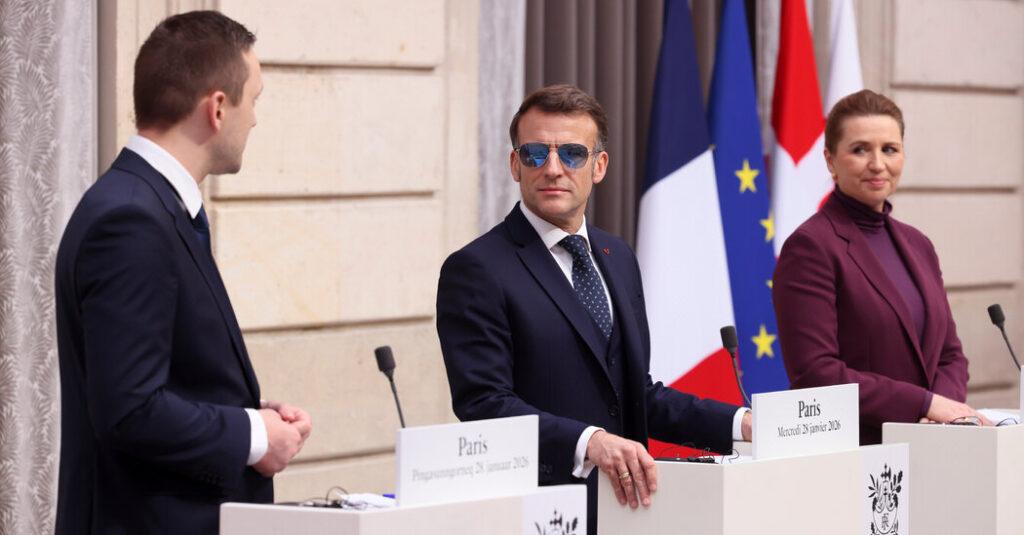
When President Emmanuel Macron of France welcomed the leaders of Denmark and Greenland for lunch in Paris on Wednesday, he was still sporting the blue-tinted aviator sunglasses that have become both a stylish personal accessory and a kind of metaphor for Top Gun-like swagger.
His punchy message hadn’t changed from when he first wore the shades last week, during a speech at the World Economic Forum in Davos, Switzerland: France, he vowed, would stand firm with its neighbors as they face an acquisitive President Trump. Greenland was a “strategic wake-up call for all of Europe,” he declared.
For Mr. Macron, Davos was a gift. The sunglasses — necessary, because of a medical condition in his eye — and his meme-ready repetition of the phrase “for sure” in his speech turned him into a social-media sensation. His defiant tone won him rare support across France’s fractured political landscape, after a year in which he had been punished by voters for pushing through an unpopular pension reform and written off by many as a lame duck.
More good news followed at home. Mr. Macron’s latest appointee as prime minister, Sébastien Lecornu, is on the brink of navigating a budget through France’s unruly National Assembly, a task that contributed to the fall of Mr. Macron’s previous two picks. For the first time since his misbegotten decision to call parliamentary elections in 2024, France seems likely to settle into a period of comparative political stability, at least until presidential elections next year.
At long last, after flirting with the lowest levels of popularity ever recorded for a French president, Mr. Macron’s fortunes appear to be brightening, if only modestly.
The question is what he can do with this late-term revival. With little more than a year left in office, can he lead Europe in devising a response to Mr. Trump’s might-makes-right view of geopolitics? Can he begin to realize his vision of “strategic autonomy” for Europe, the case for self-reliance he has made since his election in 2017, but which has often been dismissed?
“It all depends on him. He’s made his mark, and I think it’s now up to him to do something, to take the initiative,” said Raphaël Llorca, an analyst at the Jean-Jaurès Foundation, a research organization in Paris, who has written extensively about Mr. Macron. “This was almost a blessed alignment.”
With France’s domestic turmoil subsiding for now, analysts said Mr. Macron, 48, would not face pressure to resign or call an early election. That will free him to roam the world stage. Mr. Llorca said he hoped Mr. Macron would reach for the grand vision of a united, sovereign and self-reliant Europe that he first articulated in a landmark speech at the Sorbonne in 2017.
Beyond speeches and symbolic acts, though, Mr. Macron still faces tough constraints, starting with Europe’s disjointed leadership, which makes uniting the Continent behind ambitious goals challenging for anybody.
France’s domestic disarray has diminished its influence within the European Union at a time when the E.U. is exercising a more central role in coordinating defense policy, amid pressure from Mr. Trump and threats from Russia. France itself has balked at some changes, like allowing Britain to play a full role in a common procurement system for military hardware. Its squabbles with Germany have so far grounded plans for a next-generation European fighter jet.
France’s straitened finances, which were at the root of its monthslong budget impasse, will limit its capacity to rearm on the scale of its German neighbors. At current spending levels, analysts say, France is not on track to meet the pledge by NATO members to spend 5 percent of their gross domestic product on defense and defense-related programs by 2035.
Moreover, the maneuvering before next year’s elections will give France’s political parties little reason to grant Mr. Macron major victories, even on issues involving defense and security.
“The government has no majority in the Assembly,” said Mujtaba Rahman, an expert on France at the Eurasia Group, a risk consultancy. “The incentive of the other parties is to distance themselves from Macron’s legacy.”
Then, too, there is a fear that the far-right party, the National Rally, which leads opinion polls, will take control of France next year. That, in turn, would raise profound questions about France’s role in Europe, starting with its support for Ukraine’s membership in the European Union. The party remains ambivalent about Russia, with some of its members reluctant to confront President Vladimir V. Putin.
While Denmark’s prime minister, Mette Frederiksen, expressed thanks on Wednesday for France’s support in the clash with Mr. Trump, she took a shot at its domestic politics, saying it had gotten in the way of Europe’s alliance building.
France voted against a trade agreement between the E.U. and the Mercosur countries — Argentina, Bolivia, Brazil, Paraguay and Uruguay — citing the opposition of French farmers, who claim they will be harmed by a flood of South American goods, particularly beef. The E.U. signed the deal, but the European Parliament — including many French lawmakers — later voted to refer the agreement to the European Court of Justice.
“For me, as a Dane, it is a little bit difficult to understand why you are against Mercosur,” Ms. Frederiksen said to students at the elite university, Sciences Po, before her lunch with Mr. Macron. “In this world, where everything is changing rapidly, we need reliable partners and friends.”
French presidents have broad latitude on defense, security and foreign affairs, which Mr. Macron has exploited amid his political trials at home. He was instrumental, along with Prime Minister Keir Starmer of Britain, in organizing the coalition of the willing, a multinational force designed to secure Ukraine in the event of a cease-fire with Russia.
He has positioned himself on the vanguard of European leaders in defending Denmark and Greenland. He made a high-profile visit to Nuuk, Greenland’s capital, in December, during which he declared that “Greenland is not to be sold, not to be taken.” France plans to open a consulate in Nuuk in the coming weeks, Mr. Macron confirmed on social media on Wednesday.
Nearly nine years into his presidency, analysts say, Europe’s leaders are finally rallying behind Mr. Macron’s call for Europe to wean itself off reliance on the American security umbrella.
“He has street cred, if you will, of being one of the first to call for Europe to play more of a role in its defense,” said Georgina Wright, a senior fellow at the German Marshall Fund.
At Davos, Mr. Macron did not speak with the eloquence of Prime Minister Mark Carney of Canada, whose warning about a “rupture” of the post-World War II global order electrified the audience. But Mr. Macron’s more informal style — peppering his speech with the French-accented English phrase “for sure” — was a hit back home. French D.J.s sampled the line in mixes posted on social media.
His message — “We do prefer respect to bullies” — also resonated in a country that has long prized leaders who take an independent stance toward the United States. Mr. Macron’s approval rating has ticked up two points, to 20 percent, according to a new poll published by the French public opinion firm, Ifop.
That rating is still underwater. And the fact that Mr. Macron is term-limited means he may have limited scope to lift it further. “I like Macron,” Mr. Trump said recently, “but he’s not going to be there very much longer.” The conversation in France this year will inevitably turn to who comes after him.
As Mr. Rahman put it, “This may be as a good as it gets.”
Ségolène Le Stradic and Ana Castelain contributed reporting.
Mark Landler is the Paris bureau chief of The Times, covering France, as well as American foreign policy in Europe and the Middle East. He has been a journalist for more than three decades.
The post Sunglasses, and Stormy Times, Lift France’s Embattled Leader appeared first on New York Times.