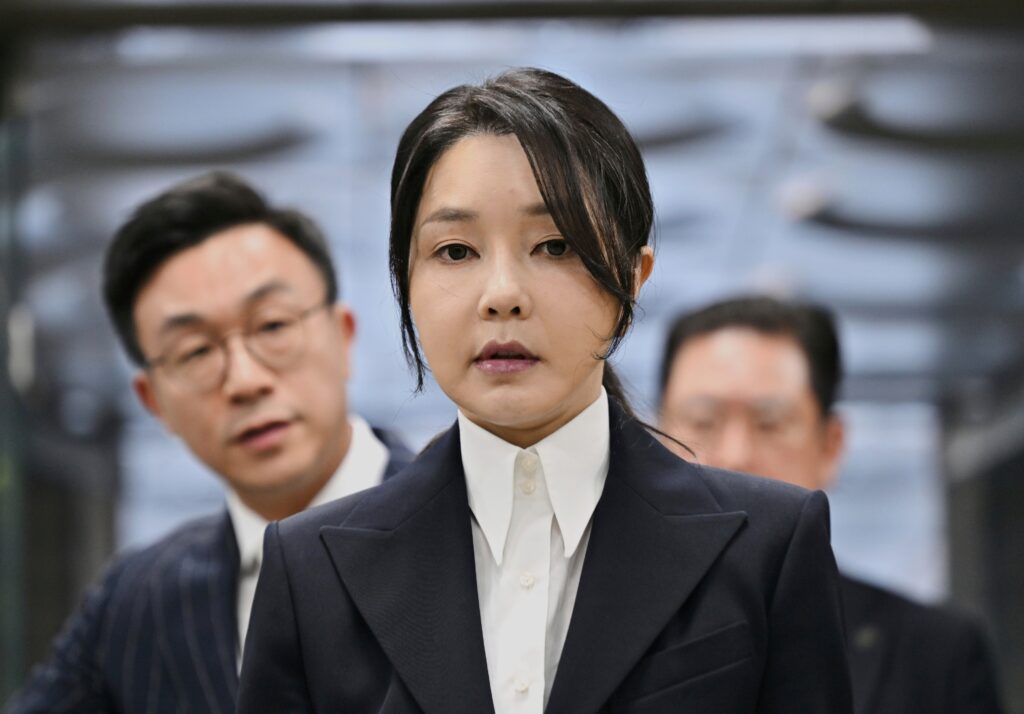
South Korea’s former first lady and her husband sit in separate cells. But their fall from the Blue House to the cell block is notable in part because it does not entirely stand out: Since South Korea’s transition to democracy less than 40 years ago, high level prosecutions have become something of a norm.
The former president’s wife, Kim Keon Hee, was sentenced Wednesday to one year and eight months in prison for accepting a Chanel handbag, tea and a diamond necklace from an influential church, in what the court found amounted to bribery. She apologized but did not admit to the full accusations. She’s been detained since August.
Her husband, Yoon Suk Yeol, is awaiting a verdict on rebellion charges for which prosecutors are seeking a death sentence, over his ill-fated attempt to impose martial law in December 2024. He went on to be impeached and removed from office. While the death penalty remains on the books in South Korea, the country has not carried out an execution since 1997.
In South Korea, high-ranking officials are not immune to legal punishment.
Chun Doo-hwan, who ruled as a military dictator in the 1980s, was tried and convicted in the 1990s, after the transition to democracy, for taking power in a coup, among other charges. He would later receive a pardon. His successor, Roh Tae-woo, was also convicted — for charges connected to the coup, violent suppression of dissent and corruption. He, too, would be pardoned. Lee Myung-bak, president from 2008 to 2013, was convicted and imprisoned on corruption charges in 2018, and pardoned by Yoon. Park Geun-hye, president from 2013 to 2017, was imprisoned the following year on charges including corruption, and pardoned in 2021. Roh Moo-hyun, president from 2003 to 2008, died by suicide in 2009 amid a bribery investigation in which charges had not been filed.
In South Korea, prosecutors wield enormous power. Several prosecutors have risen up to become president — including Yoon himself, who gained popularity as the country’s chief prosecutor by pursuing the case against Park.
“By going after top leaders, prosecutors got a lot of public support,” said Gi-Wook Shin, a professor of sociology studying contemporary Korea at Stanford University. “Even very powerful people, they have to be careful.”
Kim, Yoon’s wife, was found guilty of receiving luxury items as bribes from the Unification Church, an influential Christian religious movement. She was acquitted of other charges, including an alleged stock manipulation scheme and illegally obtaining public opinion polling data. Prosecutors had sought a 15-year prison term for the three charges, local media reported.
“The defendant misused her position as a means to seek profit,” the Seoul Central District Court found, according to South Korea’s Yonhap News Agency.
“I humbly accept the court’s stern words today and will not regard them lightly,” the former first lady said in a statement, Yonhap reported. “Once again, I am sorry to everyone for having caused concern.”
Meanwhile, Yoon is still awaiting a verdict over his failed martial law bid. On Jan. 16, he was sentenced to five years in prison on charges including obstruction of attempts to arrest him and fabrication of official documents.
The insurrection ruling is expected next month.
The post South Korea’s former first lady jailed for bribery ahead of husband’s verdict appeared first on Washington Post.