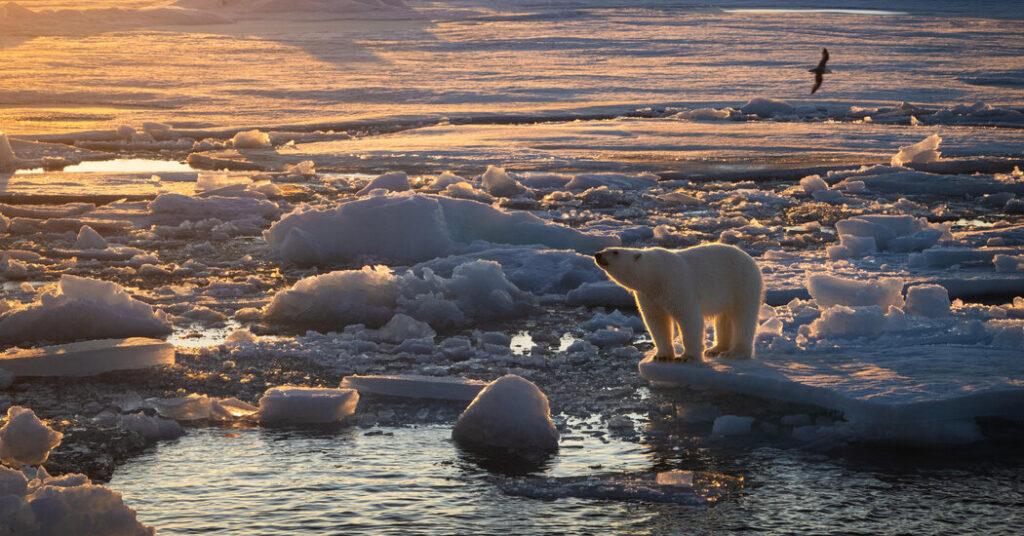
The population of polar bears in Norway’s Svalbard archipelago has improved over the past 27 years despite predictions that melting sea ice would make it harder for them to find food.
Researchers on Svalbard, between mainland Norway and the North Pole, compared the body condition index, a measurement of weight and fat content of the polar bears, with the rate of sea ice melting in the surrounding Barents Sea. Over a 27 year period, they found to their surprise that the polar bears were actually gaining weight as the ice receded.
“When I started, if you asked me what do you think will happen, I would assume they would be struggling and they would get leaner, skinnier and maybe you would see effects on reproduction and survival,” said Jon Aars, senior scientist at the Norwegian Polar Institute and author of the study, which was published on Thursday in the journal Scientific Reports. “That was wrong.”
The Svalbard polar bear population has remained stable at around 2,650 animals, while the number of ice-free days has increased by 100 since the study period began.
Dr. Aars said some of the polar bears are now eating reindeer and walrus, whose populations have increased since they have been protected from hunting. Others are taking advantage of denser congregations of ringed seals, which gather on remaining patches of sea ice, or eating new foods like bird eggs.
“They’ve always been able to do the best of the situation and find new ways to do things,” Dr. Aars said of the polar bears, which he has been studying since 2003.
Dr. Aars cautioned that the increase in body weight for the Svalbard bears might be temporary. The Arctic is warming several times faster than the rest of the planet, and the temperature in the Barents Sea area has risen 2 degrees Celsius, or 3.6 degrees Fahrenheit, since 2000. At the same time, local sea ice has declined twice as fast as any of the 19 other areas where polar bears live, the study said.
“There will be a line, and when it’s crossed, we will see polar bear starting to lose weight and getting more problems surviving and reproducing,” Dr. Aars said. “We do not know how profound this change will be and we don’t know if it will be happening in five, or 10 or 20 years.”
Dr. Aars said that a small group of about 250 Svalbard bears does not travel far for its food, while a larger group follows the sea ice to hunt seals. The more stationary bears are finding more food on land. As more sea ice melts, however, the larger “pelagic” group will have to swim farther to reach their food during the winter before returning to land to reproduce as the seasons change.
“Such long swimming trips are energetically demanding,” the authors wrote.
While the new study is surprising, it doesn’t mean that the global polar bear population of about 26,000 animals is thriving, according to biologists. Of the 20 distinct subpopulations of polar bears around the Arctic, two groups are increasing in size, four are stable and three are declining. Scientists don’t have enough information for the other 11 subgroups, according to the International Union for Conservation of Nature, a global conservation network.
“As you lose ice, eventually you lose bears,” said John Whiteman, the chief scientist for Polar Bears International, a conservation group, and an associate professor at Old Dominion University. “But the question is, in that short term, what are the regional circumstances, and will they allow bears to persist for a while in the face of ice loss?”
In addition to the loss of sea ice, polar bears also face threats from increased shipping in Arctic waters, toxic substances contaminating their food supplies, and hunting, according to researchers.
Both Dr. Aars and Dr. Whiteman said that each polar bear population was facing threats, but the warming climate is affecting each group differently. Moreover, getting the data about how the bears are faring is difficult and dangerous.
Each spring, Dr. Aars and his colleagues have flown over the region in a helicopter, shot the animals with tranquilizer darts and then measured them. Dr. Aars says he tries to avoid the bears if possible.
“We were attacked once in a field camp,” he said. “But we were able to scare that bear away.”
The post Some Polar Bears Are Getting Fatter Even as Sea Ice Shrinks (for Now) appeared first on New York Times.