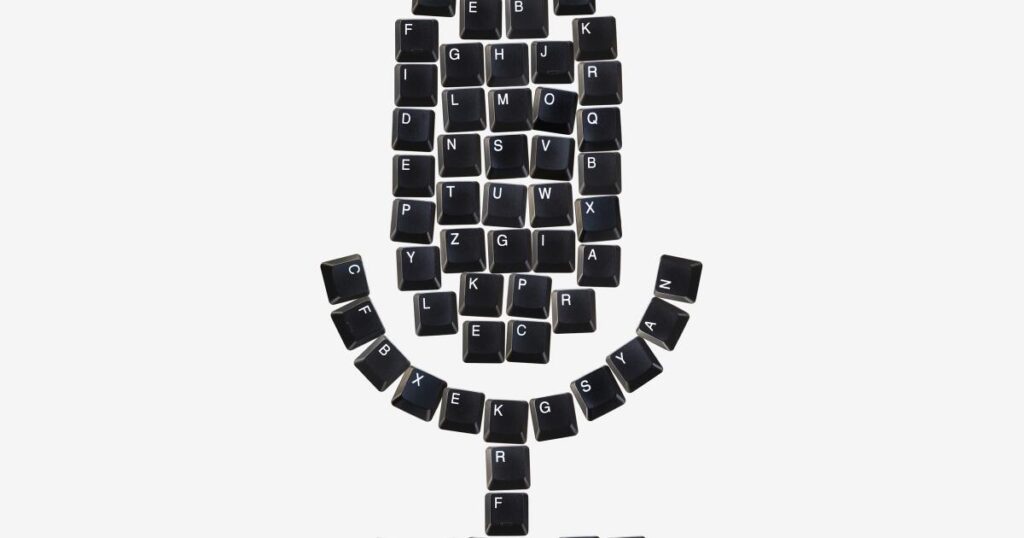
Gavin McNamara has abandoned his keyboard and spends all day talking rather than typing.
He speaks for hours with his computer and phone, sending emails, writing presentations, posting on LinkedIn and even coding through conversations using an AI dictation app from San Francisco startup, Wispr Flow.
The AI punctuates, formats and adapts his rambling into coherent copy. McNamara averages 125 words per minute, which is twice the average typing speed.
“At this point, anything that could be done by typing, I do by speaking,” said the 32-year-old, founder of software agency Why Not Us. “I just talk.”
Across 77 apps, he has dictated nearly 300,000 words in the past five months — that’s equivalent to writing three novels.
California’s tech titans and startups are at the forefront of a movement to use AI and the large language models they are based on to push people to interact with technology using their voices rather than their fingers.
“AI and LLMs have changed the dynamic,” said CJ Pais, the San Diego-based creator of free voice-to-text dictation app Handy. “Using your voice is much faster than typing.”
A mix of independent developers and startups, including Handy, San Fransico’s Wispr Flow and Willow and others, have sprung up to offer accurate voice interaction with artificial intelligence.
The biggest names in tech are also creating new ways for people to partner with AI. Meta’s latest smart glasses rely on voice. OpenAI and Meta have designed distinct personalities for their bots’ voice chats. Even Amazon’s Alexa and Apple’s Siri are undergoing AI upgrades, which the companies anticipate will have everyone talking to their tech much more.
These free and paid methods for using spoken words with computers have attracted millions of users, including coders, executive assistants, lawyers, content creators, and medical practitioners. Some optimists think the keyboard could become obsolete.
“I’m excited to announce that we’ve removed keyboards from the most prestigious television awards in the world,” Allan Guo, the founder of Willow, said in a post on LinkedIn, noting that the Emmy Awards team used Willow’s voice dictation for sending Slack messages and clearing inboxes faster in preparation for the 2026 awards.
Over the years, big tech companies have adapted many of their products with voice-first features – for convenience. Today’s pivot away from voice as an accessibility feature to a productivity tool.
In late 2022, the maker of ChatGPT started giving away unfettered acccess to its automatic speech recognition model called Whisper, trained on 680,000 hours of multilingual data. OpenAI shared the tech for accurate audio transcription, once a closely guarded big tech secret. Anyone could now download and run high-quality AI transcription for free on their laptop.
The new wave of AI dictation apps uses Whisper as the foundation and builds on top to offer live dictation. While there are free alternatives, paid subscription costs between $8 and $12 a month.
AI-powered dictation is now gaining a toehold among programmers and regular users – and getting people to talk to their laptops. Be it writing emails, sending SMS, designing a website, or giving AIs tasks, early adopters say dictation allow them to work faster, think more clearly, and be more productive.
“The people who’ve adopted voice heavily aren’t going back. Once you’re talking 20 hours a week to your laptop, typing feels like friction,” said Naveen Naidu, the general manager of New York-based voice dictation app Monologue. “Where I think it’s heading: voice becomes the delegation layer. You speak your intent, and things happen.”
These new AI dictation apps leverage Apple’s advanced chips on iPhones and Macs to run private on-device dictation.
Geoffrey Huntley, an independent software developer, switched almost completely to voice for work in June.
He often starts projects by opening a voice prompt and asking the AI to interview him about his concerns and project requirements before any code is generated.
“I speak to it, like I’m riffing in a jazz band, backwards, forwards, backwards, forwards,” Huntley said. This vocal dance helps refine the specifications, then the AI takes the wheel, and builds software.
Beyond coding, Huntley uses voice to “let it rip” when capturing blog post ideas or messaging, using apps like Superwhisperor Whisper Flow to get a “first dump” of thoughts before moving to a keyboard for final editing.
A growing number of software developers in Silicon Valley are dictating coding instructions for hours at a time instead of typing. The combination of rapidly advancing AI agents that can code for hours, with voice inputs capturing thoughts faster than typing, has boosted their productivity.
Self-described “vibe coder” McNamara built over 25 web apps in a few months, a speed of development that would be impossible without voice instructions.
“I don’t think that [typing], by any means, would be even efficient or effective to get there as fast as I did with talking,” McNamara said.
He used a meandering conversation and a few hours to get AI to build Sprout Gifts, a gifting registry for kids, and an app to appraise any items via photos.
To be sure, AI can make mistakes, and its work needs to be checked.
Meanwhile, wide adoption has brought new inconveniences, as even power users feel awkward talking to their laptops. Crowded open offices are not designed for many people to be conversing with their computers at the same time.
“Love voice, but not in an office setting,” said one user on X. “I dislike talking around other people. I would do it in a closed-door office, or go work in my car.”
McNamara uses headphones so people assume he is on a call.
“It’s like the social hack that I have,” he said.
While it is too early to call whether and when the Qwerty keyboard might follow the ticker-tape and fax machines into obsolescence, the velocity toward voice is accelerating, said Dylan Fox, founder of San Francisco-based Assembly AI, which offers audio models to companies.
“We’re definitely in the beginning of what we think of as like this 10 to 100x increase in demand for voice, AI applications and interfaces,” he said.
For the coder, McNamara, talking more to chatbots has made him a better buddy.
He used to be bad at responding to texts. Now he gets back to friends right away.
“I am so quick to respond, they are like ‘Who’s this guy?’” he said.
The post Silicon Valley is driving users to ditch keyboards and spend hours talking to their tech appeared first on Los Angeles Times.