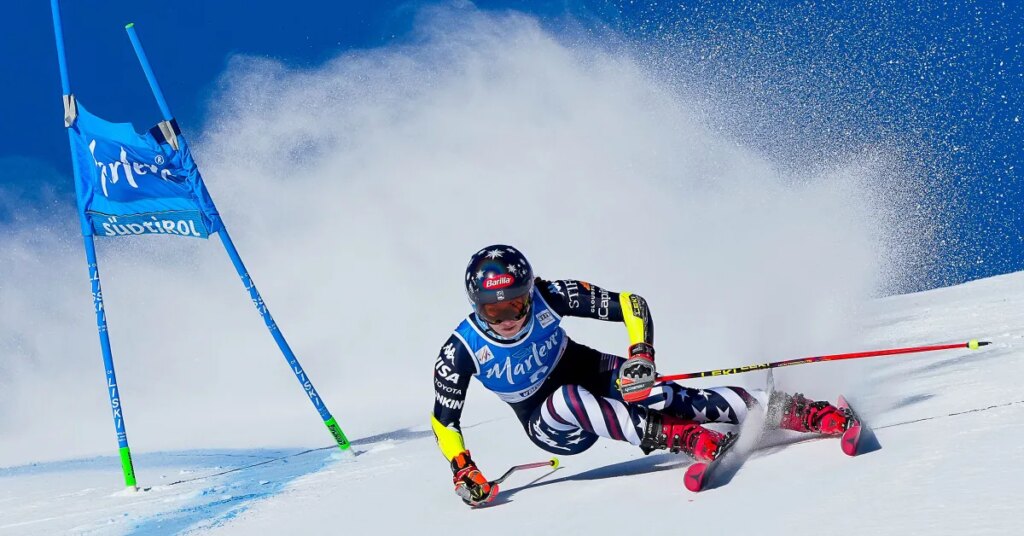
In November 2024, Mikaela Shiffrin, the American alpine skiing superstar, was seconds away from a milestone 100th World Cup victory. The setting—Vermont, her home state—was storybook. Family, friends, and rabid supporters cheered.
Then in her second run in the giant slalom—the faster of the two technical ski events (slalom being the other)—Shiffrin, who has won more World Cup races than any other alpine skier in history, slipped. She struck a gate and somersaulted onto her back before crashing into protective netting. She suffered a stab wound through her abdominal muscles, caused by either her pole, the gate, or perhaps the sheer force of the accident.
[time-brightcove not-tgx=”true”]
The 2025 World Championships were about two months away, and Shiffrin would need surgery as well as time to rehab. She finally made it back on snow in Europe, where she’d compete in a slalom race in Courchevel, France, in late January, but her mind started putting up roadblocks during one of her first training sessions. “I was watching my teammates ski, thinking, ‘I did know how to do that, but I can’t,’” Shiffrin recalled during a video interview from St. Moritz, Switzerland, where she competed in mid-December. “‘I’m not even close.’”
Read More: Chloe Kim on Going for Her Third Olympic Gold, Her Pet Snake, and Her NFL Boyfriend
At the start gate, and during her actual runs, more unproductive ideas settled in. “These crazy thoughts were piercing my brain,” says Shiffrin, who finished 10th in her first slalom race back. “Half of my brain was imagining the crash, but in the new place. And the pain. I could feel the pain. That was probably the scariest thing.”
The sensation was akin to what Shiffrin felt when her father died suddenly in 2020, after an accident in his Colorado home. “I wouldn’t ever have anticipated a trauma from injury to be quite that similar to a grief fog,” says Shiffrin. “The way it zaps your energy. The way you just can’t necessarily think straight on any given day.”
She calls her comeback regiment “exposure therapy”—repeated runs on the mountain began to ease her fears. She won the combined event, along with fellow American Breezy Johnson, at Worlds and notched her 100th World Cup victory, with a win in slalom, in late February in Sestriere, Italy.
“I still get those thoughts about crashing,” says Shiffrin. “You just get a little numb to them. I’m aware of the risks. But I’m not beholden to them.”
Entering her fourth Olympic Games, Shiffrin remains the most dominant female skier on earth. She sits atop the overall World Cup standings, having started the 2025-26 season with five straight slalom victories—and six overall, dating back to last season—before Camille Rast of Switzerland broke her streak on Jan. 4 (Shiffrin finished second). But while she’s won five overall World Cup titles, the most in history for women, and cemented her status as skiing’s GOAT–her record World Cup win total now sits at 108, 22 clear of the prior all-time leader, Swedish great Ingemar Stenmark—her Olympic legacy is more mixed.
She broke through in Sochi, winning gold in slalom, at just 18, during those 2014 Games. “I went to Sochi totally naive and loving that,” says Shiffrin. “My ignorance is bliss.” She traveled to PyeongChang four years later with a plan to compete for five medals. But weather delays scrambled the schedule and she could race in only three: Shiffrin won a gold in giant slalom and a silver in the combined. But she finished a surprising fourth in the slalom, her best event.
Two career Olympic golds can’t be dismissed. But Beijing was, to put it kindly, a setback. Shiffrin contracted COVID in the weeks leading up to those Games, couldn’t get in enough training, and wound up stretched too thin. She competed in six events (giant slalom, slalom, super-G, downhill, alpine combined, and the mixed team parallel event), did not finish in the giant slalom or slalom, and failed to come home with a medal.
In Milano Cortina, she’ll almost certainly pare down her schedule, sticking to her core technical disciplines, slalom and giant slalom, and participating in the new team combined event. The prospect of Shiffrin pairing with Lindsey Vonn, who’s excelled in the downhills this season, to fight for USA gold surely has NBC execs salivating. (Vonn would ski downhill on the morning of Feb. 10, and Shiffrin the slalom in the afternoon; the team with the fastest combined time wins.)
Read More: Inside Lindsey Vonn’s Unprecedented Olympic Comeback
Shiffrin will lean on her experience in Italy. “I feel very aware of all the things that could happen that I can’t expect,” she says. “I know very well that we could do everything right on paper and it might not end up with a medal. But I feel really connected with my coaches, with the staff, with everyone around me, and that’s building in a way that, whatever comes up, we’ll be able to handle it together. That’s the best I can do.”
Every Olympic prep period presents unique challenges. This time around, aside from warding off mental demons that arose from her crash, Shiffrin, at 30, must also fight the indignities of age. “Recovery takes longer,” she says. “My body hurts more. You sleep wrong and you’ve got a tweak in your neck. That didn’t happen before. So energy management will be a really big focus as we get closer. I can’t really do much more than what I’m currently doing, which is trying to get my skiing to the best comfort level it can be. Then dance with the one you brought.”
One addition to this pre-Olympic routine: a podcast she started in late October, called What’s the Point With Mikaela Shiffrin. To date, her guests have included her fiancé, Norwegian two-time Olympic medalist skier Aleksander Aamodt Kilde; fellow American skier Johnson; and New Zealand’s Alice Robinson, who sits third in the overall World Cup standings. “I appreciate having the space to speak honestly with teammates and competitors,” says Shiffrin. “Podcasts are this world where you can create that space. And simultaneously, over the past five years, since my dad passed away, I have struggled with the ‘what’s the point’ question. Sometimes it’s existential. ‘What am I doing here?’ And sometimes it’s just day to day, the minutia of what life is. But talking with other people and connecting with other people— why are they racing? Why are they competing? Why do you do this?—all these conversations are so interesting and help me gain perspective.”
Her dream guest is Stephen Colbert. “I would love to talk to him about his perspective on existence and grief,” says Shiffrin. In 1974, when Colbert was 10, he lost his father and two older brothers in a plane crash. “How he explains his own experience with grief and loss, it just feels so insightful, like one of those life-changing conversations,” says Shiffrin. While the cancellation of Colbert’s showcan in no way be compared to the loss of loved ones, Shiffrin would be curious to ask him about whether coping with tragedy in his past has any bearing on his present.
“Grief, I’ve also realized in the last five years, is proportional somehow to what you’re experiencing,” says Shiffrin. “When a child loses a pet, when you lose a job that you really cared about, when you get injured as an athlete, or when a professional violinist either retires or injures their hand and can’t play anymore, these meaningful things in our lives that you can lose suddenly and tragically or over a period of time, it is still not any easier. The loss of his show and the general sense of grief, I think that absolutely could be a connection. It’s just different. Because there’s the hope of a different path. There’s a hope to get it back. He’s not entirely silenced. It’s just going to look a lot different. That’s where the biggest difference is, in the finality of death.”
It’s a heavy conversation, probably best saved for a post-Olympics booking when Shiffrin has a bit more bandwidth. “I think it’s going to be stressful,” Shiffrin says of the Games. “Because I am a little bit of a ball of stress most days, even when I’m not competing. So in that sense, l’m well-versed on handling the stress of it and maybe even the pressure of it.” The actual skiing, she says, can keep her calm. “It’s beautiful, it’s serene, it’s passionate, it’s powerful,” says Shiffrin. “And when any athlete skis their very, very best, you’re 1,000% at peace with your body on the mountain, it’s something that you can’t experience anywhere else, really, in the world.”
The post Mikaela Shiffrin Wants to Win–and Talk About Loss appeared first on TIME.