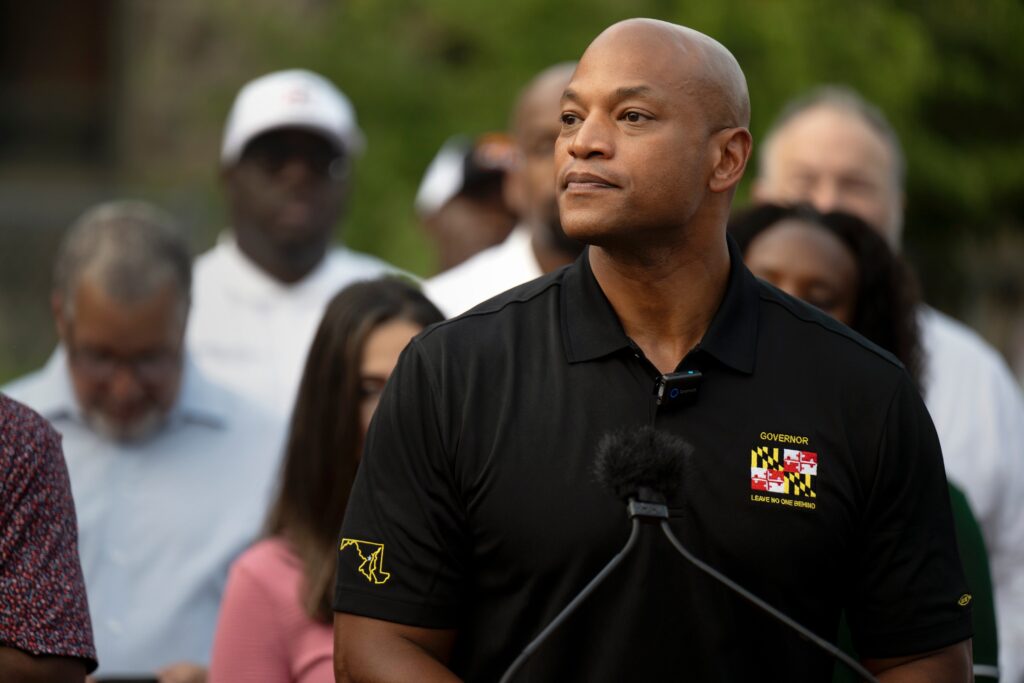
The fast-tracked redistricting plan pushed by Maryland Gov. Wes Moore (D) faces its first big political test on Thursday as the House of Delegates takes up a vote to advance it.
Designed to give Democrats an edge in the 2026 midterm elections, the proposal asks voters to approve new congressional boundaries in November — at the same time they select the candidates to represent those eight districts.
The new boundaries could oust the state’s lone Republican in Congress — House Freedom Caucus Chair Andy Harris (R-Maryland) — and the map represents one of Democrats’ last redistricting pushes nationwide before the primary season gets underway.
Democrats across the country have sought counterpunches to Republican redistricting in four states — Texas, Missouri, North Carolina and Ohio — done at President Donald Trump’s behest. The national political arms race has Democrats gaining advantages in California. But the party’s referendum effort to pick up seats in Virginia hit a legal snag earlier this week, as a judge ruled the effort invalid.
Maryland’s effort faces a steep political climb, needing a three-fifths majority in both chambers of the General Assembly plus voter approval in November. The largest hurdle in Annapolis remains the Maryland Senate, where Senate President Bill Ferguson (D-Baltimore City) remains steadfast in saying the mid-cycle redistricting is likely to backfire in the courts.
Other Democrats, led by Moore and cheered on by House Minority Leader Hakeem Jeffries (D-New York), remain undaunted.
“From day one, I’ve been very clear — if there is a national conversation happening right now about fair maps across the country, then Maryland would be part of that conversation,” Moore said Tuesday at the start of an hours-long public hearing on the plan.
He described the map as restoring balance in Washington, after Republicans in other states recast their congressional maps.
Maryland’s proposed boundaries would dilute Democrats in the seven districts where they already hold the seats, making most districts more competitive than the landslide wins often posted in recent elections. The proposal distributes more Democrats into Harris’s Eastern Shore district, which has been a Republican stronghold for generations.
Moore, a national political figure widely viewed as a potential 2028 presidential contender, cast the plan as good for democracy.
“That’s how democracy is supposed to work. To create more competition and accountability — and not less,” he said, accusing the Trump administration and its allies of what he called “political redlining.”
“It is imperative that Maryland do its part to ensure that Congress is able to function as a meaningful check on executive overreach,” Moore said. “Debate the map. Improve it, if necessary. And then take the vote.”
Republicans cried foul, casting it as preposterous that a “fair” map would eliminate all of Maryland’s GOP representation in Congress. Republicans make up roughly a quarter of Maryland’s electorate.
“Authoritarian regimes and systems eliminate their political competition instead of persuading voters,” said Del. Kathy Szeliga (R-Baltimore County.)
“How can you ask us to trust democracy when you’re taking it so lightly?” she said.
Szeliga was the plaintiff in a 2022 lawsuit that overturned Democrats’ last effort to oust Harris, which a judge threw out for “extreme” partisan gerrymandering.
The existing congressional map is the result of a settling that lawsuit: Maryland Democrats pushed through a map in just days after the other one was thrown out. Voters in 2022 approved the map in November at the same time they elected representatives to the seats.
Ferguson has cited the legal ruling in that case as core to his refusal to drawing new boundaries, arguing that changing the current map could ultimately result in courts redrawing boundaries and handing more seats to Republicans.
He also says it’s too late in the election calendar to implement the changes, and has pointed out Republicans have promised to challenge any new proposal in courts.
“There are so many legal challenges and issues here,” Ferguson told reporters on Tuesday.
“At the end of the day, the people elect us to make decisions and do the hard work of understanding the law and context.”
Ferguson pointed out that of the more than 500 people signed up to testify on the bill in the House on Tuesday, about three-quarters opposed it. Resident Elizabeth Hopkinson was among them.
“Two wrongs do not make a right,” she said at Tuesday’s hearing. “We should be worried more about Maryland than retaliating against this president.”
Democrats hold supermajorities in both chambers of the General Assembly, but the map requires more than the typical simple majority because it is a referendum that also changes the Maryland Constitution.
In addition to drawing new boundaries, the proposal would tweak language central to the lawsuit that overturned the last map in 2022. Then, Anne Arundel County Senior Judge Lynne A. Battaglia ruled for the first time in state history that rules about legislative districts in the Maryland Constitution applied not just to General Assembly districts, but to congressional ones as well.
The proposal under debate Thursday also would ask voters to clarify in the Maryland Constitution that those rules should apply only to state legislative districts.
Del. C.T. Wilson (D-Charles) is leading debate on the House floor Thursday, and has argued the proposal will make congressional districts more competitive and force elected officials to appeal to a broader range of voters.
House Minority Leader Jason Buckel (R-Allegany) said his caucus will try to amend the proposal on the floor, but he ultimately expects the chamber to grant it final passage by Friday.
It is unclear whether Moore and his allies can persuade Maryland senators to take up the bill over Ferguson’s objections.
More than 20 Black faith leaders — influential in this majority-minority state — this week publicly urgedFerguson to relent and allow a vote.
“Our nation is facing an existential threat, and we cannot sit idly by, passively decrying what is happening in our country,” the clergy wrote in their letter. “This is a moral imperative and we must act now. Failure to do so will harm Maryland’s economy, threaten our democratic freedoms, and cede the power of the people to the power of a person.”
Katie Mettler contributed to this report.
The post Maryland’s last-ditch redistricting plan faces first political test appeared first on Washington Post.