“They now call it the ‘Donroe Doctrine,’” President Trump told reporters after American commandos captured President Nicolas Maduro of Venezuela this month.
He seemed pleased that his foreign policy strategy could be distilled into a quippy two-word phrase riffing on the 19th century Western Hemisphere-focused Monroe Doctrine.
And whom to thank for that line? The New York Post, an influential part of the Rupert Murdoch media empire, which coined the portmanteau in a front-page headline.
Fox might be the moneymaker, but The Post has long been understood as Mr. Murdoch’s id. The tabloid, started by Alexander Hamilton more than 220 years ago, obsessively covers issues like crime and immigration alongside celebrity gossip. More recently, it’s added cancel culture to the list.
In other words, the paper’s preoccupations also look a whole lot like Trump’s, with a Republicanism that is suspicious of urban centers and sees “woke” overreach on the political left.
The Post, once strictly a regional paper, has found an audience around the country. It has 100 million unique monthly visitors to its website and is the third-most-read newspaper in America by print circulation, having overtaken the embattled Washington Post in 2023, according to figures from the Alliance for Audited Media.
Now, there’s a surprising new effort from the Murdochs to export the New York Post’s brand of screaming headlines to the West Coast, with a newspaper run by an Australian.
In November, the biggest names from News Corp, the parent company of The Post, descended on the Fox studio lot in Los Angeles for a private coming-out party for The California Post, which started publishing on Monday.
News Corp’s chief executive, Robert Thomson, summoned key advertising clients, including Amazon and Disney, to mingle with Keith Poole, The Post’s editor in chief, and the new California Post editor, Nick Papps. The Fox Corp chief executive, Lachlan Murdoch; News UK chief, Rebekah Brooks; the Wall Street Journal editor Emma Tucker; and top tabloid editors from Australia joined the party.
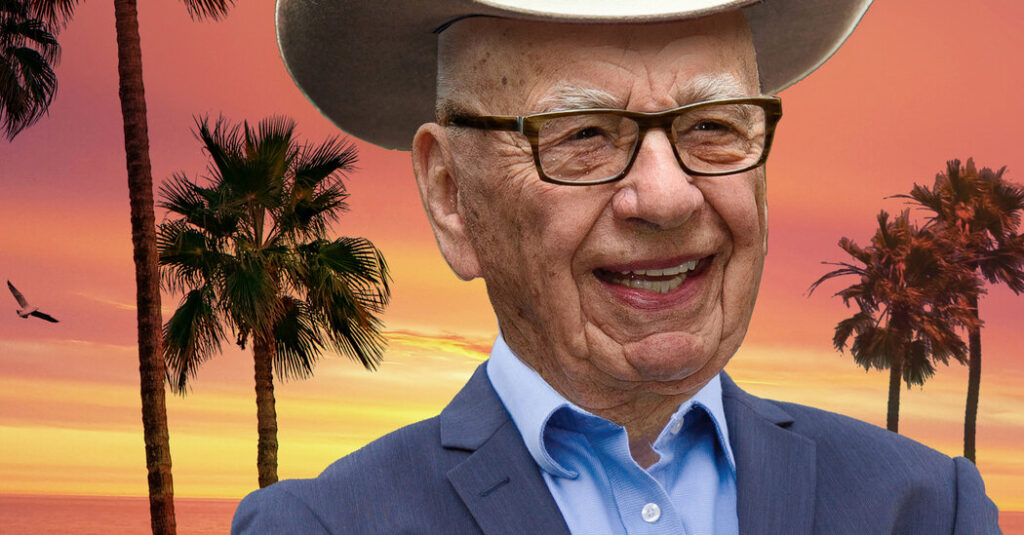
And there was 94-year-old Rupert Murdoch.
The message was clear: This is not a toe-dip to test the frothy waters of Hollywood, but a well-funded push to cement The Post as a national brand.
While its newspaper peers have been shrinking or closing, The Post’s obsession with local news has helped turn it into a wider phenomenon: No story is too small to turn into a national culture war. And on that front, California offers rich new material.
Mr. Poole, who calls “common sense” the publication’s guiding light, says the paper’s worldview has so far been welcomed in the Golden State.
“They are hankering for a brand like The Post to be able to say publicly what perhaps they’re frightened of saying themselves,” he said.
Others say that the tabloid’s crusades are corrosive. Donna Lieberman, executive director of the New York Civil Liberties Union, said The Post acted as a “propaganda machine” for the Trump administration to “promulgate bias and fear about immigrants contrary to all the data that we know.”
Already, The Post has picked its West Coast villains (Gavin Newsom and Los Angeles mayor Karen Bass, whom it has labeled “Commiefornia’ Democrats”) and the issues it will slam them for (homelessness, the government’s response to the 2025 wildfires). A social media ad for The California Post alluded to Mr. Newsom’s signature coif with “Here to trim egos.”
Some favorite themes have migrated west with the paper. Just as The New York Post is always warning that Manhattan’s billionaires will leave for Florida with the advent of new taxes, The California Post has sounded the alarm that Silicon Valley billionaires are also headed for Miami.
Meanwhile, the tabloid has written about a wealthy California town advertising for diversity, equity and inclusion interns. And Los Angeles, the opinion pages recently warned, might be a “Third World basket case.”
Suffice to say, The Post is making itself at home.
‘The Post Is Fun to Read’
In December, the digital market intelligence company Similarweb ranked The Post No. 9 among the top U.S. news websites, up from No. 12 five years ago. And the paper has kept its website free, while many of its competitors have erected online paywalls, giving it outsized impact on social media.
The tabloid’s sway over the national conversation is harder to measure. But crime, immigration and cancel culture are all issues that helped Mr. Trump return to the White House in 2024. This time, the president was buoyed not just by red state support but by an increase of votes in blue cities like New York and Los Angeles. He also picked up a raft of tech and finance donors, based in part on concern over “woke culture” and antisemitism — subjects that The Post covers extensively.
Mr. Poole said that the majority of its New York readers are registered Democrats.
The political strategist Stu Loeser, who was Mayor Michael Bloomberg’s press secretary, described an ambient quality to The Post’s impact, saying its articles often permeate social media, TV and podcasts.
“I frequently hear people say, ‘I don’t know where I heard this, but…’” about Post articles, Mr. Loeser said.
“There’s plenty of people who would never agree with The Post’s worldview who still read it for entertainment value,” said former New York City Mayor Bill de Blasio, who was a regular target of the newspaper during his mayoralty.
There were Mr. de Blasio’s midmorning Brooklyn gym trips (the tabloid pointed out that he had a full 30 minutes blocked out for changing his clothes); the sad fate of a groundhog he’d dropped (“Staten Island Zoo officials went to great lengths to hide the death from the public — and keep secret the fact that ‘Chuck’ was actually ‘Charlotte,’ a female impostor”); and the revelation that the mayor’s regular coffee order was a double espresso with four sugars (“I cringe every time I have to get,” an aide wrote). More seriously, the paper relentlessly covered the federal investigations into Mr. DeBlasio’s fund-raising.
Despite all that, “The Post is fun to read,” said the former mayor, who more recently has been in the tabloid’s pages regularly for his chaotic love life. “They’re witty as all hell.”
Historically, The Post operated at a loss, sometimes of more than $40 million a year. But in 2021, the News Corp chief executive Robert Thomson declared that The Post was finally profitable after deep cost-cutting.
Trump Administration: Live Updates
Updated
- Trump says he shut his eyes at the last cabinet meeting because it was ‘boring.’
- Democrats block spending package as D.H.S. talks continue.
- Another top Kennedy Center official resigns.
Sean Giancola, The Post’s chief executive officer and publisher, said The Post remained profitable and now makes the bulk of its revenue from digital advertising, a difficult financial model for most news sites, though he declined to provide any financial figures.
When Mr. Giancola started the job in 2019, his mandate was to make The Post less reliant on print revenues. And the only way to make a digital brand, he decided, “was a national brand.” A lot of its readers, executives discovered, were already in places like Florida, Texas and California, though advertisers still viewed The Post as a regional outlet.
“Every C.E.O. reads The Post,” Mr. Giancola said. “Do we get credit for that? Not nearly enough.” (He pointed to comments from Jamie Dimon, chief executive of JPMorgan Chase, who said The Post was his first read of the day in a 2024 interview with The Wall Street Journal.)
California is the second-largest media market in the country and has an economy larger than that of most countries. It felt like a natural target.
“If we actually expand to another territory on the other side of the country, perhaps people will start to take notice and really actually realize we are a national brand, so it will open up a different budget, different partnerships,” Mr. Poole said.
According to Mr. Giancola, print editions of The California Post will replace the physical New York Post in California. The Post already prints in the state, so it wasn’t a big lift to switch, he said, and “the physical front page matters,” a counterintuitive strategy in an age of sharply declining newspaper circulation.
Its first California cover, headlined “Oscar Wild,” dredged up drama between the brothers Josh Safdie, the director of the Oscar contender “Mary Supreme,” and Benny Safdie, who directed last year’s “The Smashing Machine.”
A Key Node in the Conservative Ecosystem
“The tabloid style, for good or for bad, is more consumable and easier to follow,” said Lis Smith, a Democratic political strategist. (Ms. Smith became a household name in the tristate area after The Post revealed she was dating former New York Governor Eliot Spitzer. “ELIOT AND DeBABE,” blared the 2013 cover.) “They look for story lines that tap into not just political narratives, but cultural narratives.”
This often involves turning newsmakers into larger-than-life characters. The paper’s favorite targets are typically Democrats or those embroiled in a sex scandal. Ideally, they are both, like Mr. Spitzer, or perhaps The Post’s most perfect subject, the infamous sexter and former Democratic congressman Anthony Weiner (who inspired the memorable headline “STROKING GUN”).
Mr. Trump has made no secret that The Post — which has been covering him since the 1980s — is his first read of the day, and has a framed 2023 New York Post front page that features his glaring police mug shot hanging just outside the Oval Office. The president has dined with Mr. Poole, The Post’s editor in chief, alongside Rupert Murdoch and other News Corp executives in recent months, and singled out Mr. Poole by name in a post on his social media network, Truth Social. Mr. Trump said the “very successful editor-in-chief” should take over the “highly inaccurate, ‘China Centric’” Wall Street Journal.
Of his relationship with Mr. Trump, Mr. Poole was coy, allowing only that they talk “now and then.”
The Post has considerable influence in New York politics, though its critical coverage of Zohran Mamdani didn’t stop him from being elected New York City mayor. The opinion pages echoed Mr. Trump’s rhetoric describing him as a “communist lunatic” during the mayoral race, and the editorial board accused Mr. Mamdani of antisemitism — criticisms that Mr. Mamdani denied but that became national talking points for Republicans, and for the campaign of his competitor, Democratic former New York governor Andrew Cuomo.
The front page after Mr. Mamdani’s electoral victory — with the headline “THE RED APPLE” and a mocked-up photo of Mr. Mamdani holding a hammer and sickle — instantly became a collector’s item for his supporters and sold out across newsstands. The Post, sensing a business opportunity, now sells the metal plate version of the front page on its online store for $75 and a “Red Apple” mug for $16.
Andrew Epstein, a close aide to Mr. Mamdani, said the new mayor found the “Red Apple” front page “hilarious.”
“I think there’s an appreciation for the camp of it,” Mr. Epstein said.
But Mr. Epstein also accused The Post of tapping into Islamophobia in much of its coverage of Mr. Mamdani, who is Muslim.
“Stoking division and suspicion in our city,” Mr. Epstein said, “has always been one of their tactics, and I think it became particularly ugly in the closing months of the general election.”
Post reporting is a key node in the conservative media ecosystem, and is frequently picked up by Fox News.
The tabloid was extremely critical of New York City’s handling of an influx of migrants and asylum seekers in the past few years.
A September article in The Post credited police sources with estimating that up to 75 percent of those arrested in Midtown were migrants (though the officers did not ask their immigration status). The report was soon amplified by Fox News. Likewise, Fox boosted reports in The Post that Tren de Aragua, a Venezuelan gang, was using New York’s migrant crisis to grow in the city. The network aired a Fox Nation special on the topic called “Blood in America: The Tren de Aragua Invasion.”
“The notion of chaotic Democratic cities is the argument that The Post is making, the lead purveyors in it,” Mr. Loeser said.
Using California to Go National
Both the print and online versions of The California Post will feature locally reported news as well as content from The New York Post, which publishes some 300 stories a day.
Mr. Papps, a veteran News Corp editor, has relocated from Melbourne, Australia, to Los Angeles to run The California Post, reporting to Mr. Poole in New York. The paper has already hired more than 80 newsroom staff members, according to a Post spokeswoman.
Mr. Papps said that the publication, though based in Los Angeles, would also have reporters in places like Sacramento, San Diego and San Francisco. He said he saw “an enormous opportunity to play a role in the big debates and to advocate for change where we see the need for change.”
The New York Post’s Page Six editor, Ian Mohr, has moved across the country to start Page Six Hollywood, and the outlet has poached journalists from Variety, The Hollywood Reporter, The San Francisco Standard and The Minnesota Star Tribune. Mr. Mohr said Page Six Hollywood would operate as a five-day-a-week newsletter that covered the entertainment business and media world, as well as “some of the sociology of the business and L.A.”
“A little more David Zaslav and less Lindsay Lohan,” he said.
As for who will become a Page Six Hollywood character? “We’ve identified some people,” Mr. Mohr said, “that have a lot of money and now have a tremendous amount of influence but have been pretty under the radar.”
Joel Pollak, who spent nearly 15 years at Breitbart, the right-wing news site, is the opinion editor. Mr. Pollak, whose X bio labels him as a “conservative, pro-Israel writer,” said in an interview that his motivation for taking the role was “revenge.”
As the wildfires whipped through Los Angeles last year, Mr. Pollak watched the destruction of most of his neighbors’ houses in his Pacific Palisades neighborhood. (His home survived.) “I feel like there is a cascade of government failures in so many ways,” he said.
Ken Doctor, a media analyst and the chief executive of Lookout Local, which has news websites in Santa Cruz, Calif., and Eugene, Ore., said that most local newspapers in the state were shadows of their previous selves and that The Los Angeles Times had receded as a force.
“If you have the deep pockets of News Corp and you have the ego of News Corp, you say, ‘OK, we can have a presence there,’” Mr. Doctor said.
But, he cautioned, California, with a population of about 40 million people, has vastly different cultures in different regions, making statewide publications tricky.
Mariel Garza, a former Los Angeles Times editorials editor who recently co-founded the Golden State Report on Substack, said The California Post was entering at a key moment in state politics. “If you wanted to be a relevant, powerful, influential conservative voice in California, this would be the time,” she said.
California is also at “the epicenter of a bunch of the story lines that matter both locally and nationally, including A.I. and politics, and arguably they haven’t been covered to the extent that they should be,” said Kevin Delaney, the editor in chief of The San Francisco Standard, a local news organization co-founded in 2021 by the venture capitalist Michael Moritz.
But Mr. Delaney said that what he thought was needed to combat a weakened media across California was “strong native West Coast news organizations that are independent and can speak as part of the national conversation about the issues.”
“The New York Post is an East Coast publication that aspires to have a West Coast presence,” he said.
Additional production by Juliana Castro Varón Rebecca Lieberman and Brent Murray. Robert Gebeloff contributed reporting.
Katie Robertson covers the media industry for The Times. Email: [email protected]
The post MAGA Tab in LA-LA Land! The California Post Launches appeared first on New York Times.