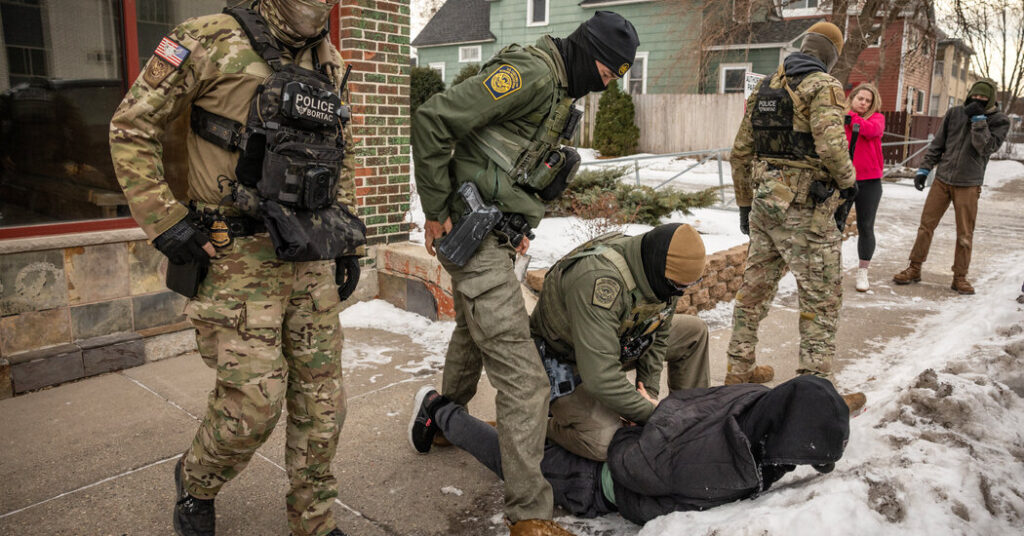
A federal judge on Wednesday evening ordered federal agents to stop detaining and deporting refugees in Minnesota who were lawfully admitted to the United States, and to immediately release those currently held for re-examination of their cases.
The judge granted a temporary restraining order, halting for now the Trump administration’s operation, which has swept up at least 100 people so far. The administration is likely to appeal the ruling.
“Refugees have a legal right to be in the United States, a right to work, a right to live peacefully — and importantly, a right not to be subjected to the terror of being arrested and detained without warrants or cause in their homes or on their way to religious services or to buy groceries,” said Judge John R. Tunheim of the U.S. District Court for the District of Minnesota.
“At its best, America serves as a haven of individual liberties in a world too often full of tyranny and cruelty,” the judge wrote in a 32-page opinion. “We abandon that ideal when we subject our neighbors to fear and chaos.”
Earlier this month, the Trump administration said it was reopening thousands of refugee cases in Minnesota, with a focus on those who had arrived in the United States under President Joseph R. Biden Jr. and had yet to obtain legal permanent residency, or green cards. The Homeland Security Department said that it would be ensuring that no criminals were among them, as the administration has heightened scrutiny of immigrants involved in fraud schemes in Minnesota.
Judge Tunheim’s order came in response to a class-action lawsuit filed by refugees represented by the International Refugee Assistance Project, the Berger Montague law firm and the Center for Human Rights and Constitutional Law.
Sergio Perez, the law and human rights center’s executive director, said the order “vindicates the rights of people who fled war, famine and persecution to build a better life in the United States.”
Federal agents began arresting refugees in the Twin Cities on Jan. 13, in their homes, on the streets and in stores. After processing them, they put the refugees on planes to Texas for interviews with immigration officers.
It is not known if any refugees had already been deported, lawyers said, because they have not been contacted by family or friends of everyone detained.
The refugees who were detained had fled countries in Africa, Asia and Latin America.
The lawsuit argued that the government has been illegally targeting refugees with the aim of pressuring them to accept deportation or strip them of their lawfully obtained right to remain in the United States.
Some of the refugees told the Times that they had been subjected to hourslong questioning. Others have remained imprisoned for more than a week and then transferred between Immigration and Customs Enforcement detention centers in shackles, according to their family members.
Many of those released after questioning have been left on the streets of Texas without money and identification, which were confiscated by authorities. Family and friends have tried to help them make their way back home.
One of the refugees interviewed by The New York Times, Walid Ali, 19, reported that he was beaten by agents at a processing facility in St. Paul because he protested when they took away his belongings, including his wallet with his driver’s license, Social Security number and bank card.
Mr. Ali, who arrived in the country as an unaccompanied minor and has an active green-card application, was arrested by agents outside his apartment building in St. Paul on Jan. 13. He was released in Houston five days later.
Another refugee, Selamawit Mehari, 38, a single mother of three from Eritrea, said that she was chained at the wrists, waist and ankles when she boarded a plane to Texas with immigrants from several other countries. She was released on Jan. 17, and received her green card that same day.
While Wednesday’s court decision specifically addresses the situation unfolding in Minnesota, it has national implications as the Trump administration is expected to expand the refugee policy to other states.
On Jan. 9, the administration announced that it was starting a “sweeping initiative” to conduct new background checks and intensive verification of refugees to check for fraud and other crimes.
“The initial focus is on Minnesota’s 5,600 refugees who have not yet been given lawful permanent resident status,” said the announcement from U.S. Citizenship and Immigration Services, which had not said that people would be detained as part of the process.
Before the U.S. government extends an invitation for displaced people to receive safe haven, the applicants undergo rigorous vetting abroad by the Department of Homeland Security and other government agencies. They must prove that they have a well-founded fear of persecution based on their race, religion, political opinion, nationality or membership in a particular group.
Once admitted to the United States, refugees must apply for green cards within a year but generally do not face arrests or threats of deportation if they delay.
Miriam Jordan reports from a grass roots perspective on immigrants and their impact on the demographics, society and economy of the United States.
The post Judge Orders Release of Minnesota Refugees Targeted in ICE Crackdown appeared first on New York Times.