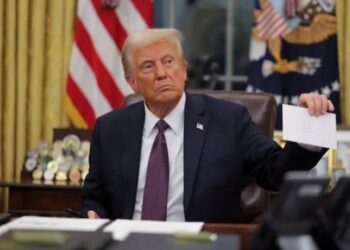
This week, Honduras inaugurated a new president, Nasry Asfura, a construction magnate backed by seemingly strange bedfellows: members of the notorious MS-13 gang and President Trump. Mr. Trump had urged Hondurans to vote for Mr. Asfura days before MS-13 gang members posing as election observers threatened to kill anyone who didn’t vote for that candidate. Amid weeks of election uncertainty and protests, Mr. Trump warned Hondurans of “hell to pay” if they chose a different outcome. Mr. Asfura’s victory marks the success of Mr. Trump’s campaign to resuscitate a political party tainted by its widely known ties to cartels.
The story of how Mr. Trump came to intervene in Honduran politics and align himself with a foreign terrorist organization is essential for understanding the world he is trying to build. He has been meddling in multiple elections in Latin America, and recently captured Venezuela’s president, Nicolás Maduro, in a military operation to have him face federal drug trafficking charges here. He’s now threatening to arrest the president of Colombia on suspicion of drug trafficking and to bomb cartels in Mexico. His actions may seem contradictory. But there is a coherent logic to them: They expand territorial power for a class of transnational elites who believe they’re above the law.
Last month, Mr. Trump pardoned one of the country’s best-known convicted drug traffickers: Juan Orlando Hernández. Mr. Hernández was the president of Honduras from 2014 to 2022; in that time, there was a steep surge in migration from that country to the United States as families fled his narco-state. In 2024, he was sentenced to 45 years in prison for his role in what the U.S. Department of Justice called “one of the largest and most violent drug trafficking conspiracies in the world.” He was convicted of conspiring to distribute hundreds of tons of cocaine, reportedly boasting of plans to “stuff the drugs up the gringos’ noses.” In explaining his pardon, Mr. Trump relied on a conspiracy theory circulating in conservative circles: that Mr. Hernández was a political prisoner of former President Joe Biden’s. It was, in Mr. Trump’s words, a “witch hunt.”
But Mr. Trump’s real motivations are hidden in plain sight. Not long after his second inauguration, the Claremont Institute, an influential conservative think tank in California, published a call for him to pardon Mr. Hernández. So did Mr. Trump’s longtime friend and fellow felon Roger Stone in a blog post, written with Shane Trejo. Both argued that the pardon would hurt President Xiomara Castro, a democratically elected progressive and the first woman to be president of Honduras. They wrote that it would re-empower the right-wing party, presumably by rehabilitating it.
The goal, Mr. Stone wrote, was to save Próspera, a semiautonomous city on the Honduran island of Roatán. Próspera was backed by Mr. Hernández and Trump-aligned tech moguls such as Peter Thiel and Marc Andreessen; corporations there pay incredibly low taxes to Honduras. It was built in a “special economic zone,” a rapidly multiplying form of territory with its own business-friendly laws, like looser environmental regulations and labor standards. (It’s what the Trump administration brokered for Gaza in its cease-fire with Israel.)
Special economic zones were pioneered in Puerto Rico, where in the mid-1900s the entire archipelago was transformed into such a zone and much of the native-born population — including most of my maternal relatives — subsequently left amid widespread unemployment. Proponents of the zones claim that they create prosperity for domestic populations. Patrick Neveling, a political economist, calls this an excuse “used to funnel a lot of state money into private hands.” In the case of Puerto Rico, its taxpayers paid for the infrastructure for transnational corporations to conduct tax- and customs-free manufacturing there, and for government-backed loans for foreign investors.
Globally, more than 5,400 special economic zones have become home to dozens of start-up cities like Próspera, corporate-led jurisdictions with their own laws. In “The Network State,” a 2022 book that was influential in Silicon Valley, the tech entrepreneur Balaji Srinivasan, a leading proponent of start-up cities, fantasizes that these territories will not only compete with nation-states but someday replace them.
Many Hondurans, including Ms. Castro, opposed Próspera as an affront to national sovereignty. Not long after Ms. Castro’s inauguration, the Honduran Congress repealed the law, passed by the country’s right wing, that had opened Honduras to start-up cities. This was unacceptable to the pillaging class. As Mr. Stone wrote on his blog, “May the Próspera experiment prevail, the common good be saved, and global leftism be damned by the benevolent hand of President Trump!”
The people behind start-up cities like Próspera have long been whispering in Mr. Trump’s ear about bringing their neocolonial experiments to the United States, branded as “freedom cities.” Mr. Trump has publicly advocated them. For all his rhetoric about putting America first and making America great, Mr. Trump isn’t a nationalist. He’s in league with transnational elites who lack allegiance to this or any country. While distracting voters with anti-immigrant rhetoric, he is laying the groundwork for the disenfranchisement of working people across the Americas.
MAGA Republicans often complain that the United States is turning into the “third world” because of immigration. But it’s Mr. Trump who has remade the United States in the image of the Latin America that our government and chief executives helped create with foreign interference: a place where masked men routinely leap out of unmarked vans to snatch citizens, where people are disappeared and human rights activists publicly killed, where soldiers patrol cities to crush dissent, and where organized crime and the state blend into a single machinery of power that protects the interests of the oligarchs.
At first glance, it may seem like karma: The terror that the United States wrought for generations in Latin America has come home. But the victims are not the transnational elites who have long colluded with corrupt officials to take vulnerable people’s territories and feast on their oil, fruit and precious metals. The victims are the displaced migrants forced to leave their homelands and the American workers who have to compete with their criminalized labor. This isn’t an accident. It seems to be the goal: to entrench a permanent underclass across the Americas. Mr. Trump claims that his goal is to remove immigrants from this country, but in fact he is expanding the pool of vulnerable labor for transnational elites. By stripping millions of people of legal status in the United States, Mr. Trump likely created more undocumented people than he removed last year.
In many liberal circles, it is treated as an article of faith that immigration is nothing but positive for the economy. The silence about how criminalized labor depresses wages is born out of both ignorance and fear of fueling anti-immigrant hatreds. But that silence allows people like Mr. Trump’s homeland security adviser Stephen Miller to caricature liberals as elites who want a cheap labor force. The American left needs to break its silence on this issue and articulate a politics that connects labor and immigrant rights.
Elites in both parties have long benefited from a manufactured underclass. The right-wing party in Honduras came to power in a 2009 military coup, after which the Obama administration briefly cut off aid to the country, then resumed it, including tens of millions of dollars for the military and police. In 2015, after tens of thousands of Hondurans marched against the narco-state, the U.S. ambassador, James Nealon, claimed that relations between the two countries were “perhaps the best in history.”
In the mid-2010s, protesters of the corporation- and cartel-friendly regime were kidnapped, raped and killed. This oppression and instability were partially responsible for the surge in migration from Central America which President Barack Obama confronted. But in the administration’s discussions about the “root causes” of the exodus, there was no reckoning with the role of the U.S. government or American investors.
During the Biden administration, Próspera’s backers sued Honduras for nearly $11 billion under an international tribunal governed by investor-state dispute settlement rules, in response to the country’s efforts to reclaim its sovereignty. In 2024, dozens of Democratic lawmakers asked Mr. Biden to remove liability from the corporate-friendly rules from trade agreements for Central America and the Caribbean, to protect vulnerable economies from litigious elites. But Mr. Biden failed to act. The ongoing lawsuit and similar ones threaten to bankrupt Honduras, one of the poorest countries in the hemisphere.
Human rights activists in Roatán have been fighting for years to protect their ancestral lands and resources from Próspera. But many are now afraid for their lives; at least one prominent activist recently fled the community in fear, two members of the Honduran Black Fraternal Organization told me. Everyone there knows what tends to happen to people who resist the pillaging classes in Central America: They’re killed, even the activists with international reputations such as the Honduran land defender Berta Cáceres, whose assassination in 2016 was ordered by the U.S.-military-trained president of an internationally financed hydroelectric company she was protesting.
The start-up city Próspera’s billionaire architects insist that the project creates jobs for Hondurans and boosts economic development. Some clearly believe that. They’re so sure of the backwardness of the population, they can’t help but see themselves as saviors. It’s the same attitude that Democratic elites have toward rural Americans. The truth is that the fates of working-class Americans and Hondurans are entwined.
With the return of the right-wing party to Honduras, calls for oversight are likely to be ignored. The right-wing party, an ally of Próspera, governed its citizens the way Mr. Trump and his allies envision governing Americans: through violent dispossession and exploitation. In the United States, a mirror world has already begun to form with the unleashing of multiple federal police forces that have already killed at least three citizens and a number of immigrants. These police forces do not protect the body politic; they protect the bottom line of transnational corporations that surveil and jail us for profit.
We don’t stand a chance against them until we bridge the engineered divide between America’s native-born working classes and the rural poor of Latin America, including those who are now undocumented workers in the United States.
Politicians who care to restrain the expansion of transnational corporate power need, first of all, to abandon their cowardice on amnesty. A pathway to citizenship for longtime undocumented people with no criminal records would open the door for millions of disenfranchised people in this country, many of them Mexican, to start organizing with working-class Americans. Only by expanding who counts as an American can we rebuild the solidarity necessary to confront the elites who profit from our precarity.
That doesn’t mean embracing an open-border policy that favors mass migration. What is missing from the immigration debate is a complete moral framework. This framework has to recognize not only the right to migrate but also what Miriam Miranda, a Honduran activist for the Afro-Indigenous Garífuna, calls “the right to stay.” A politics that celebrates movement while ignoring displacement serves capital, not people. Its logical endpoint is a world where we all become migrants — where communities everywhere are hollowed out again and again so that extraction can continue uninterrupted.
What Mr. Trump is doing in Latin America is not an aberration. The pardon, the blessing of a former — and likely future — narco-state in service of private power, the military strikes: This is the governing model that he and his allies are trying to globalize. A world where national sovereignty is dead, the rule of law is nonexistent for corporations, and convicted felons like Mr. Trump and Mr. Hernández run the world for the pillaging classes. MAGA was never a revolt against elites. It was the elites’ most effective instrument.
Mr. Trump’s meddling reveals what his movement is for — not borders, nations or workers but a cross-continental free-for-all where people are uprooted so profits can move freely.
Jean Guerrero is a contributing Opinion writer for The New York Times. She is the author of “Hatemonger: Stephen Miller, Donald Trump and the White Nationalist Agenda” and “Crux: A Daughter’s Quest for Her Border-Crossing Father,” which won a PEN Literary Award. She is a senior journalism fellow at the U.C.L.A. Latina Futures 2050 Lab.
The Times is committed to publishing a diversity of letters to the editor. We’d like to hear what you think about this or any of our articles. Here are some tips. And here’s our email: [email protected].
Follow the New York Times Opinion section on Facebook, Instagram, TikTok, Bluesky, WhatsApp and Threads.
The post In Honduras, the American Right Is Piloting Our Future appeared first on New York Times.