Prime Minister Keir Starmer of Britain is hunting for business opportunities he hopes will help revitalize a stagnant economy. President Xi Jinping of China is looking for a strategic opening to court a key American ally.
Meeting in Beijing on Thursday, the two leaders agreed to pull their relationship out of a yearslong “ice age,” a reset driven by different but coinciding needs to navigate an increasingly volatile Washington.
For Mr. Starmer, the first British leader to visit China since Theresa May in 2018, the trip is a pragmatic gamble that warmer ties will bring more growth for his country. For Mr. Xi, Britain’s overture helps Beijing demonstrate that it is an essential partner for the West, regardless of Washington’s efforts to isolate it as part of a deepening rivalry.
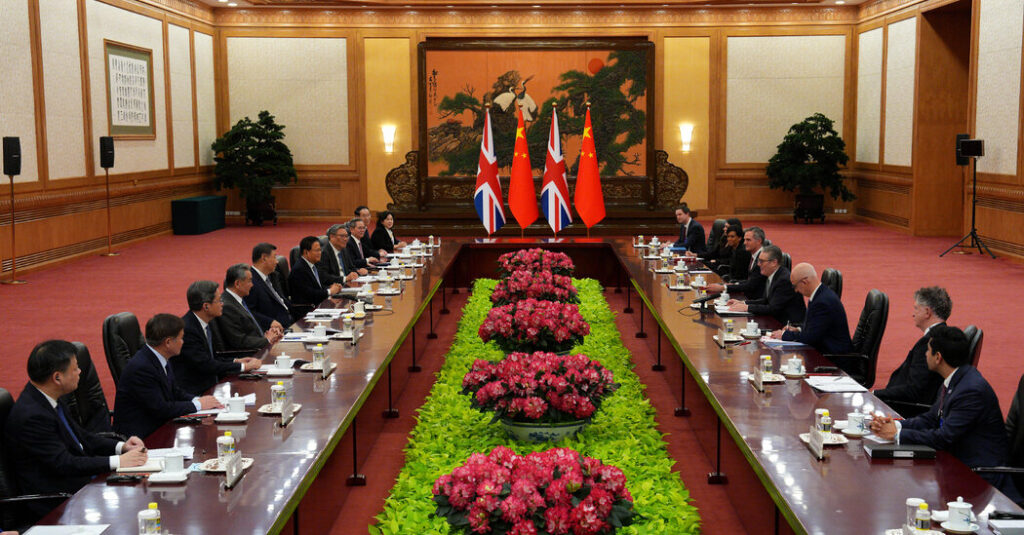
Meeting in the Great Hall of the People in Beijing, Mr. Xi and Mr. Starmer hailed the benefits of cooperation. Mr. Xi said China was willing to “transcend differences” with Britain, and sought to depict China as a reliable global power. “No matter how much China develops and grows stronger, it will not pose a threat to other countries,” he said, according to an official summary.
In the past, the countries have sparred over human rights and Chinese interference in British politics. Concerns about Chinese espionage were at the heart of years of delays in the approval of a new Chinese mega-embassy in London, which critics said would make it easier for Beijing to conduct spying operations.
Mr. Starmer, who made the trip with a large delegation that included executives from banking, pharmaceutical and automobile companies, described China as vital to Britain’s interests.
He told Mr. Xi that British businesses were eager to take advantage of any available opportunities in the world’s second-largest economy. He called for a “more sophisticated relationship” that would allow Britain and China to cooperate economically while managing their disagreements.
By emphasizing business over security and human rights, Mr. Starmer, a Labour Party politician, is breaking from years of successive Conservative Party prime ministers. “For years, our approach to China has been dogged by inconsistency — blowing hot and cold, from Golden Age to Ice Age,” Mr. Starmer said in an official announcement about the visit. “But like it or not, China matters for the U.K.”
Mr. Starmer is trying to woo Beijing without provoking President Trump. Just days ago, Mr. Trump threatened to slap a 100 percent tariff on Canada if Prime Minister Mark Carney made a trade deal with Beijing. There is no indication that such a pact is in the works, though Mr. Carney agreed to lower import duties on some Chinese electric vehicles during a visit to Beijing earlier this month.
Tensions between the United States and Europe have also grown over Mr. Trump’s threats to seize Greenland, which belongs to Denmark, a member of the U.S.-led North Atlantic Treaty Organization. Earlier this month, Mr. Trump warned that he would impose tariffs on Britain and other European countries unless Greenland was sold to the United States. He has since walked back those threats.
Mr. Starmer’s trip is the latest in a flurry of visits by Western leaders to China that has been designed to project China as the stable alternative to an unpredictable United States under President Trump. On Monday, he hosted Prime Minister Petteri Orpo of Finland. In December, he welcomed President Emmanuel Macron of France and, in about a month, Chancellor Friedrich Merz of Germany is expected to travel to China.
But the business-as-usual demeanor masks a period of extraordinary political shifts in China. Behind the scenes, China has been rocked by one of its biggest scandals in years following the purge of its top general, Zhang Youxia, over the weekend. While Mr. Xi appeared unruffled in state media footage of Thursday’s meeting, the move was a reminder of the opacity of elite Chinese politics even as the Communist Party seeks to project a more open face to the world.
A Hedge Against an Unpredictable United States
Western middle powers like Britain, feeling increasingly alienated by the United States, are now looking to hedge their economic interests by rebalancing toward China, analysts said.
“For the past few years, companies were diversifying and de-risking from China. Now, they are doing so from the United States,” said Steve Okun, head of APAC Advisors, a geopolitical consulting firm.
Mr. Xi offered a thinly veiled critique of the current U.S. trade posture in his meeting with Mr. Starmer. He warned that “unilateralism, protectionism and power politics have been rampant.” He argued that major powers had an obligation to lead the world away from returning to the “law of the jungle,” a pointed swipe at the Trump administration’s unilateral use of tariffs.
China wants to ensure Britain remains a reliable export market, especially for its higher value goods like electric vehicles, solar panels and batteries, analysts say. A stubborn real estate crisis has made the Chinese economy more reliant on exports for economic growth, which has been fanning trade tensions with China across the world.
Beijing also hopes that London, Europe’s financial capital, can play a larger role in internationalizing the yuan, China’s currency. British financial firms welcome more yuan exchange, seeing it as an opportunity to do more business with China.
Mr. Xi called on the two countries to increase cooperation in finance, health care, artificial intelligence, bioscience and renewable energy. And he urged Britain to relax restrictions and open wider to Chinese firms.
Even as Mr. Starmer seeks to emphasize the benefit of cooperating with China on trade, he is under political pressure at home to address reports of Chinese espionage in Britain. Human rights groups have also urged him to demand the release of the Hong Kong pro-democracy dissident Jimmy Lai, a former media tycoon and a British citizen who was convicted in December of national security crimes.
“It’s imperative that Starmer doesn’t abandon principle in pursuit of profit during his visit to Beijing,” Yasmine Ahmed, the U.K. director of Human Rights Watch, said in a statement. “At the very least, he needs to publicly press Xi for the release of Jimmy Lai and speak up for the dramatic erasure of freedoms in Hong Kong.”
Speaking to reporters after the meeting, Mr. Starmer said that he had raised Mr. Lai’s case as well as the treatment of Uyghurs, a persecuted ethnic minority in China’s far western region of Xinjiang, with Mr. Xi.
Asked if Mr. Xi acknowledged those concerns, Mr. Starmer said, “Yes, we did have a respectful discussion about that.”
China’s official summary of the meeting, unsurprisingly, made no mention of Mr. Lai. It noted, however, that Mr. Starmer said Hong Kong was a “unique and important bridge” between China and Britain.
Michael D. Shear in London and Berry Wang in Hong Kong contributed reporting.
David Pierson covers Chinese foreign policy and China’s economic and cultural engagement with the world. He has been a journalist for more than two decades.
The post In Beijing, Starmer and Xi Seek a Way Around a Volatile U.S. appeared first on New York Times.