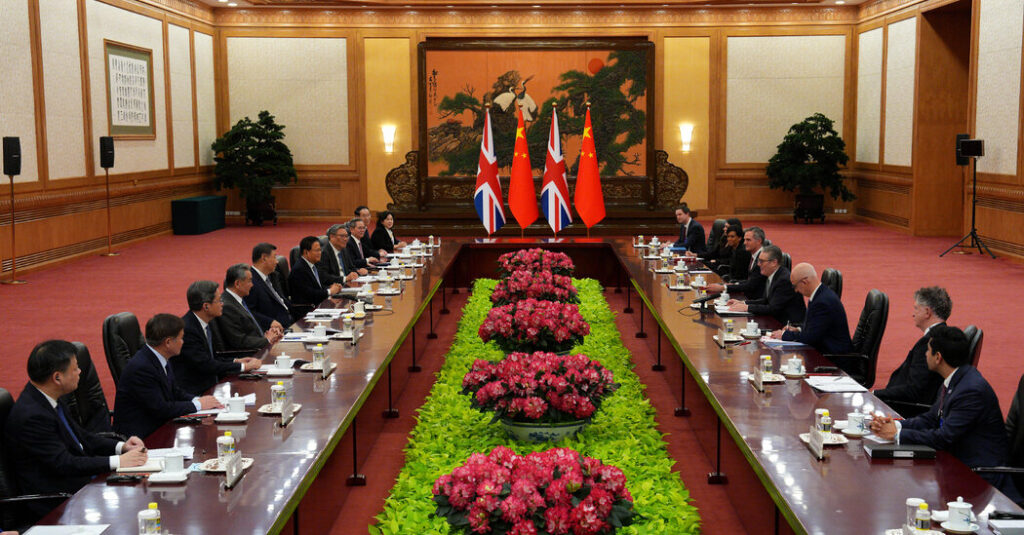
President Xi Jinping of China and Prime Minister Keir Starmer of Britain met in Beijing on Thursday, setting the stage for the two countries to reset ties at a time when relations between the United States and its European allies have been shaken by disputes over security and trade.
Mr. Starmer, the first British leader to visit China since Theresa May in 2018, has sought to re-engage with Beijing in the hopes of reviving Britain’s lagging economy. He traveled with a large business delegation that included executives from banking, pharmaceutical and automobile companies.
By emphasizing business over security and human rights, Mr. Starmer, a Labour Party politician, is breaking from years of successive Conservative Party prime ministers. “For years, our approach to China has been dogged by inconsistency — blowing hot and cold, from Golden Age to Ice Age,” Mr. Starmer said in an official announcement about the visit. “But like it or not, China matters for the U.K.”
“It is in our national interest to engage with China,” Mr. Starmer told reporters on Wednesday after arriving in Beijing. “There are huge opportunities to be had.”
Mr. Starmer is trying to woo Beijing without provoking the ire of President Trump. His trip comes just days after Mr. Trump threatened to slap a 100 percent tariff on Canada if Prime Minister Mark Carney made a trade deal with Beijing. There is no indication that such an agreement is in the works, though Mr. Carney agreed to lower import duties on some Chinese electric vehicles during a visit to Beijing earlier this month.
Tensions between the United States and Europe have also grown over Mr. Trump’s threats to seize Greenland, which belongs to Denmark, a member of the U.S.-led North Atlantic Treaty Organization. Earlier this month, Mr. Trump threatened to impose tariffs on Britain and other European countries unless Greenland was sold to the United States. He has since walked back those threats.
For Mr. Xi, Mr. Starmer’s trip is the latest in a flurry of visits by Western leaders that China has held up as evidence that, unlike the United States, China is a stable global power that can be trusted. Behind the scenes, however, China has been rocked by one of its biggest political scandals in years following the purge of its top general, Zhang Youxia, over the weekend.
Mr. Xi projected a business-as-usual demeanor on Monday as he hosted Prime Minister Petteri Orpo of Finland. In December, he welcomed President Emmanuel Macron of France and, in about a month, Chancellor Friedrich Merz of Germany is expected to travel to China.
“An increasing number of perceptive figures in the West have come to realize that blindly following a single hegemon and severing global connections ultimately undermines their own countries’ development and prosperity,” an editorial in the Global Times, a Communist Party newspaper, said on Wednesday.
Even as Mr. Starmer seeks to emphasize the benefit of cooperating with China on trade, he is under political pressure at home to address reports of Chinese espionage in Britain. Human rights groups have also urged him to demand the release of the Hong Kong pro-democracy dissident Jimmy Lai, a former media tycoon and a British citizen who was convicted in December of national security crimes.
“It’s imperative that Starmer doesn’t abandon principle in pursuit of profit during his visit to Beijing,” Yasmine Ahmed, the U.K. director of Human Rights Watch, said in a statement. “At the very least, he needs to publicly press Xi for the release of Jimmy Lai and speak up for the dramatic erasure of freedoms in Hong Kong,”
Berry Wang contributed reporting.
David Pierson covers Chinese foreign policy and China’s economic and cultural engagement with the world. He has been a journalist for more than two decades.
The post In Beijing, British Prime Minister Sees ‘Huge Opportunities’ appeared first on New York Times.