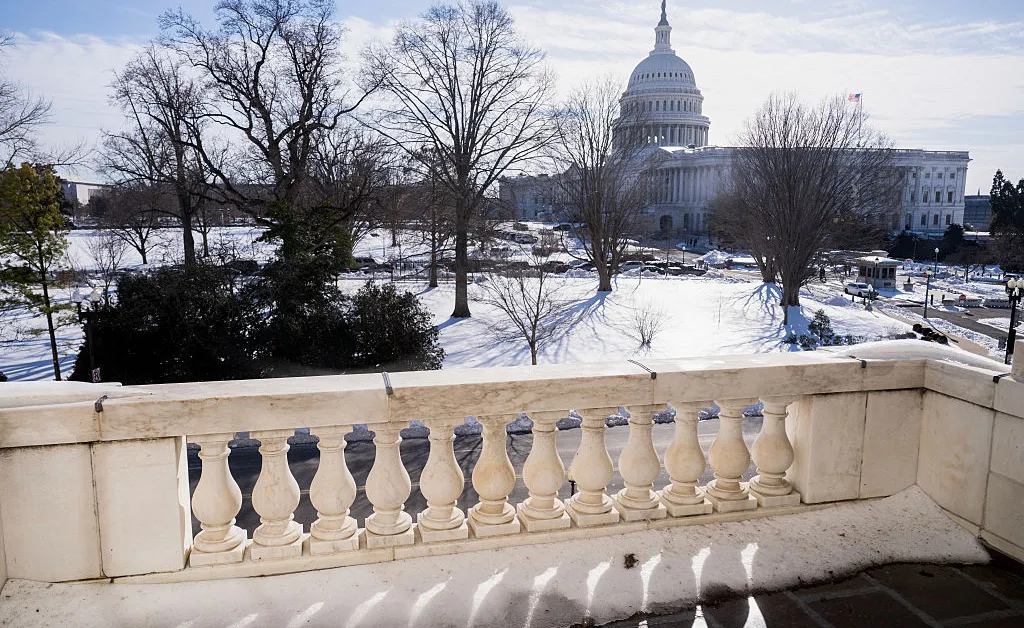
Congress is creeping toward a partial government shutdown that could start at the end of this week, just a few months after the country emerged from the longest shutdown in its history.
Funding for a number of federal agencies will expire after midnight on Friday, but Senate Republicans and Democrats have yet to reach an agreement over a six-bill appropriations package. The deadlock comes after federal officers shot and killed a second U.S. citizen in Minneapolis this month, fueling outcry over the Trump Administration’s immigration crackdown. Senate Democrats are objecting to a bill that includes funding for the Department of Homeland Security (DHS) unless significant changes are made—and are signaling that they are prepared to block the bill’s passage, even if that leads to the government shutting down again.
[time-brightcove not-tgx=”true”]
The last shutdown, which started on Oct. 1 and lasted for 43 days, saw hundreds of thousands of federal workers being furloughed and thousands more working for weeks without pay, flights being disrupted across the country as airports grappled with staffing shortages, and federal food aid that millions of Americans rely on becoming the center of a tense legal battle.
The Senate may pass some of the six bills in the package at issue in the current standoff, or none of them—regardless, if all of the bills don’t pass, the country will face a partial government shutdown.
Although the shutdown wouldn’t be as widespread as the last one, since lawmakers have already passed measures funding several agencies, it would still impact a number of the federal government’s functions and services. A lot of those effects could also be mitigated, though, if the shutdown ultimately ends as soon as Monday.
Here’s how the possible shutdown could affect you.
How would a partial shutdown affect federal workers?
If Congress fails to pass the appropriations package, many federal workers at the agencies that haven’t been funded would likely be furloughed. Staffers who are considered to be essential workers, though, would be expected to continue working without pay. After the government reopens, federal employees are guaranteed, by law, to receive back pay. Independent contractors, however, don’t have that same guarantee.
How would a partial shutdown affect air travel?
The last government shutdown led to widespread flight disruptions across the country. While Transportation Security Administration (TSA) agents and air traffic controllers are deemed essential workers, they have to work without pay. Many staffers called in sick, leading to long lines at airport security checkpoints and delayed flights.
The departments that house both the TSA and the Federal Aviation Administration, which employs air traffic controllers, are among those that would be impacted by a partial shutdown.
How would a partial shutdown affect Social Security, Medicare, and Medicaid?
Social Security, Medicare, and Medicaid are all considered to be “mandatory spending,” and so aren’t funded through annual appropriations. That means Social Security payments are typically still distributed during a government shutdown, and Medicare and Medicaid continue to operate.
But some services for the programs could be halted during a shutdown, as they have been in the past, such as benefit verifications or the issuance of new Social Security cards and replacement Medicare cards.
How would a partial shutdown affect immigration enforcement?
While DHS is one of the agencies that would be affected by the possible shutdown, immigration enforcement likely wouldn’t be impacted—at least, in the short term.
The “Big Beautiful Bill” that President Donald Trump signed into law last year granted Immigration and Customs Enforcement (ICE) a $75 billion supplement, in addition to its approximately $10 billion base budget. That financial cushion means that the agency likely wouldn’t experience disruptions in its operations even if Congress doesn’t approve new DHS appropriations before the deadline.
How would a partial shutdown affect the IRS?
The Internal Revenue Service (IRS) is one of the agencies that would be impacted by a partial shutdown. During the most recent shutdown, the IRS continued operating, but eventually had to cut back on some of its services. During the 2018-2019 government shutdown, at least 26,000 IRS staffers were called back to the office to work without pay ahead of tax season, but more than half of them didn’t show up.
The prospect of a partial shutdown comes as the deadline for filing taxes is less than three months away.
The agency’s workforce has already been reduced by Trump’s sweeping federal staffing cuts over the past year, which raised concerns about possible disruptions to taxpayer services even before the likelihood of another shutdown spiked.
Would SNAP be affected by a partial shutdown? What about national parks and museums?
No. An appropriations bill that included funding for the Department of Agriculture, which houses the Supplemental Nutrition Assistance Program (SNAP), was already passed by Congress, so even if the government shuts down this week, SNAP benefits will continue.
Similarly, national parks, the Smithsonian Institute’s museums, and the National Zoo have already received funding through an appropriations bill that was passed by Congress, and so will remain open even if there is a partial shutdown this week.
Would mail delivery be affected by a partial shutdown?
No. The U.S. Postal Service isn’t funded through annual appropriations; instead, the agency funds itself. That means that, even if the government shuts down this week, services such as mail delivery and post office operations will be unaffected.
The post If The Government Shuts Down Again, How Could You Be Impacted? appeared first on TIME.