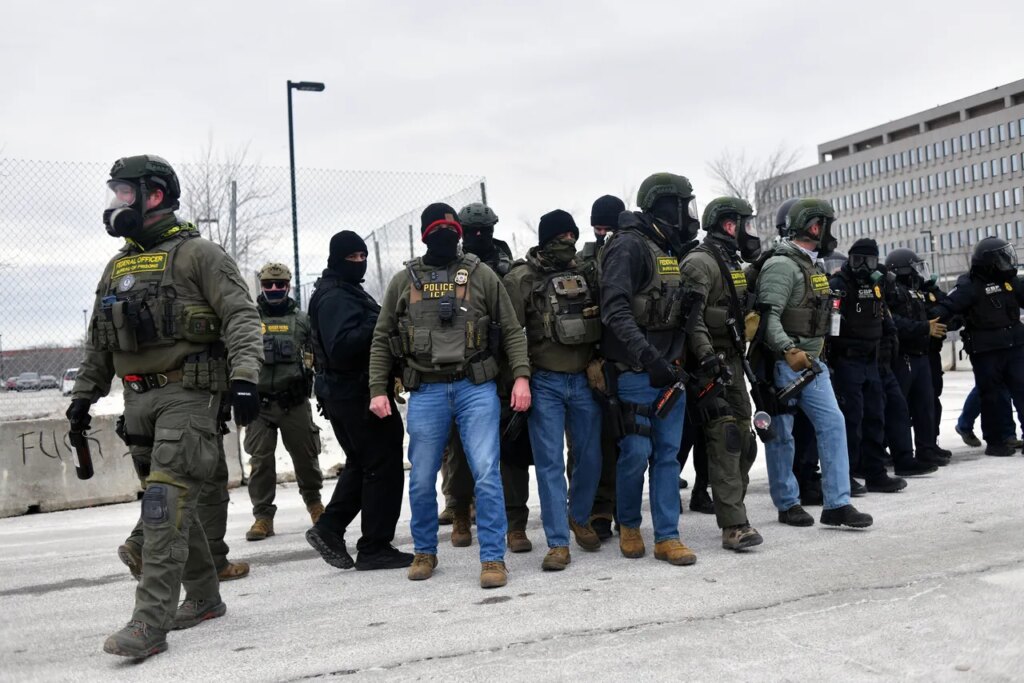
As a veteran of the war on terror, I have spent the past year watching Immigration and Customs Enforcement officers expand their operations across the country on a heretofore unprecedented scale and with a new faux-military bearing. From equipment to weapons to tactics, ICE and other immigration enforcement bodies want to be seen as combat forces carrying out their missions. Witness on Thursday, when White House border czar Tom Homan talked about Minneapolis as a “theater” for his agents. Overlooking that ICE is not, in fact, part of the armed services of the US—it’s a civilian law enforcement agency—it is useful to break down their operations through a military lens to find the strategic implications. Because if an agency wants to cosplay as a military force, it deserves to be evaluated as one.
Let’s start with the tools of the trade: equipment, uniforms, and armament. From the military perspective, soldiers choose the appropriate equipment and armament for the mission. An infantry squad would not go into a jungle campaign equipped for an urban fight. Squads in Iraq and Afghanistan often “dressed down” for counterinsurgency missions, where building mutual trust with locals was more important than showing up as if ready for World War III. Sometimes, units went into the opposite posture when a show of force was needed. Equipment, armament, and tactical employment vary from mission to mission.
ICE agents—civil representatives of the law, remember—often show up to raids kitted out as if they’re preparing to enter Fallujah circa 2004 against a well-entrenched enemy equipped with machine guns, mortars, and explosive vests. They also arrive in a mishmash of uniforms, hoodie sweatshirts, military gear, and masks, leaving everyone confused as to whether these are law enforcement officers or just some random dudes.
Where soldiers tailor their armament for the mission, ICE agents carry weapons and equipment inappropriate for simple search-and-seizure missions: ballistic helmets, bullet resistant plate carriers, magazine drop pouches on their legs, weapons loaded with a cornucopia of optics, silencers, and other attachments you wouldn’t catch your average infantryman dead with (the more weight on the weapon makes it less effective in a firefight).
Tactically, the way ICE performs its missions has little to do with “enemy” posture or the mission. One, there is no “enemy:” There are persons who may or may not have violated civil law. These people have not declared an intent to resist violently and with deadly force. Yet ICE shows up with maximum force and intimidation—often roping in people on the sidelines and increasing the media impact of their actions.
Generally, ICE agents move with zero military sense. They bunch up and cluster around their target or in doorways; in a combat zone, soldiers clustering up like this could be annihilated by a single grenade or burst from an automatic weapon. It also demonstrates that ICE agents often have very little clue what their mission is. Soldiers are taught to disperse and always move with a head on a swivel for situational awareness. As a soldier, you are taught to point your weapon only at something you intend to shoot. ICE agents have brandished their weapons. Soldiers train to reserve deadly force for identified enemies and to preserve life where possible. ICE and federal agents have publicly killed two unarmed American citizens.
Multiple images show ICE agents “stacking” on a door, a formation used in close quarters combat. Rather than resembling any type of recognizable urban warfare formation, ICE agents’ tactics often seem to be modeled off what they’ve seen in movies or imbibed via TV shows or video games. Given that training for ICE officers has dropped down to about six a half weeks, TV and movies might be their biggest source of knowledge. It demonstrates that ICE agents aren’t moving with a tactical focus; they’re doing what they think will look cool and intimidating in photographs.
When you get down to the basics of what ICE does—seizing and restraining people—they approach it in a chaotic fashion. Videos show officers bunching up, milling around, often turning on bystanders. They smash windows haphazardly, abandon cars with their engines still running alongside the road, and operate in a manner one Maine sheriff referred to as “bush-league policing.” Military tactics for seizure and search are far more precise. Every person in the squad has defined duties and responsibilities: While some form an outer cordon to ensure unit security, one searches the individual taken into custody, one maintains security over the prisoner, one logs everything found, etc.—all with the goal of reducing confusion and preserving the integrity of the unit.
In Iraq and Afghanistan, 20 years of counterinsurgency operations demonstrated that escalating combat for no reason often just creates more violence. Units found that de-escalation often created fewer civilian casualties, which in turn meant that those civilian’s families were less prone to take up arms against coalition forces, which reduced coalition casualties. Escalation, by the same token, often undermined US policy. As a result, units trained to de-escalate where possible, while preserving the option to return violence with proportional but catastrophic lethality for anyone who initiated violence.
ICE tactics rarely seek to de-escalate but instead ramp up violence via threats, intimidation, and assault. These tactics vaguely resemble the worst of US military operations in the war on terror, which left embedded bitterness and hatred in the local populations. Repression, humiliation, and degradation—especially the accidental or deliberate killings of family members—drove more recruits into the ranks of al Qaeda, the Taliban, and their allies than anything else.
Here we transition to link the tactical with the strategic. Military strategy is most broadly defined as combining the ways (tactics) and means (resources) to achieve a specific end. If ICE tactics are the means to a strategic end, then the implications are either confusing or chilling. Confusing, because if the administration hoped to increase deportations while keeping public support, ICE tactics are counterproductive. Chilling, because ICE tactics do line up with one theory recognized by military strategists: the theory of control.
This theory, which is commonly seen in authoritarian states like the People’s Republic of China or Russia, encompasses many realms of irregular conflict: media warfare, psychological warfare, and legal warfare (sometimes called “lawfare”), to name a few. While strategies of control can be used against external enemies, they can also be used internally. A strategy of control uses terror tactics to create a violent resistance to justify its brutal subjugation and as an excuse to change laws enlarging the definition of terrorism and treason. Regimes then use the surrounding chaos and noise to continue its other initiatives. It is, roughly speaking, conducting policy by crisis.
War, it is said, is a continuation of policy by other means. State-backed violence, too, can be a continuation of policy. Stephen Miller, White House deputy chief of staff for policy, has repeatedly urged ICE agents to escalate their tactics and increase arrests, and he broadcast to agents that they had “federal immunity.” Since that last remark in October 2025, ICE tactics have become far more violent. But historically speaking, host nations—and in this case we speak of California, Illinois, Oregon, Minnesota, and Maine, I guess—simply do not take well to long-term abusive behavior.
If political ends of these tactics are not to sow profound mistrust, confusion, doubt, anger, and division, then they appear misdirected and misapplied. Tactics disconnected from strategy ultimately result in strategic failure. In this case, ICE tactics would endanger a Republican majority in Congress and control of the White House.
In the end, no matter how hard ICE tries to project its militant image, it remains an arm of the civilian authority and not that of the military. It is not fighting enemies of the United States. It is vital that we remember this and resist normalizing military-style tactics in our streets.
ICE agents and US military members do share one very real commonality: We all swore an oath to uphold and defend the Constitution of the United States. While the military upholds this, ICE agents flaunt their extraconstitutional actions on our TV and phone screens every day.
Personally, ICE’s operations seem like a fever dream of the worst parts of the war on terror coming back home to roost. From ineffective facial recognition scans (BATS and HIIDES, anyone?) to “geardos” who spent more time at Ranger Joe’s (a military outfitter) than the range to late-night raids to catch a local terrorist leader who, half the time, was just a random guy trying to get through the day. We brought the mechanisms of a surveillance state to war with us, and they snuck into our duffel bags and followed us home. We emphasized accomplishing the mission no matter what and bred a generation of yes-men. We drove in heavily armed convoys down neighborhood streets, and now those trucks roll through our streets.
My generation spent its youth at war. We volunteered to do this, I acknowledge, but with the somehow implied belief that we could do some good. And that what we did mattered and that we stood for something. Something significant and unique. But as we watch the least effective and most morally objectionable of our tactics come home and be used amongst and against us, we are left with a profound feeling of betrayal. This, too, is a result of misaligned tactics.
The writer is using a pseudonym out of concern for retribution from the Trump administration.
Let us know what you think about this article. Submit a letter to the editor at [email protected].
The post ICE Pretends It’s a Military Force. Its Tactics Would Get Real Soldiers Killed appeared first on Wired.