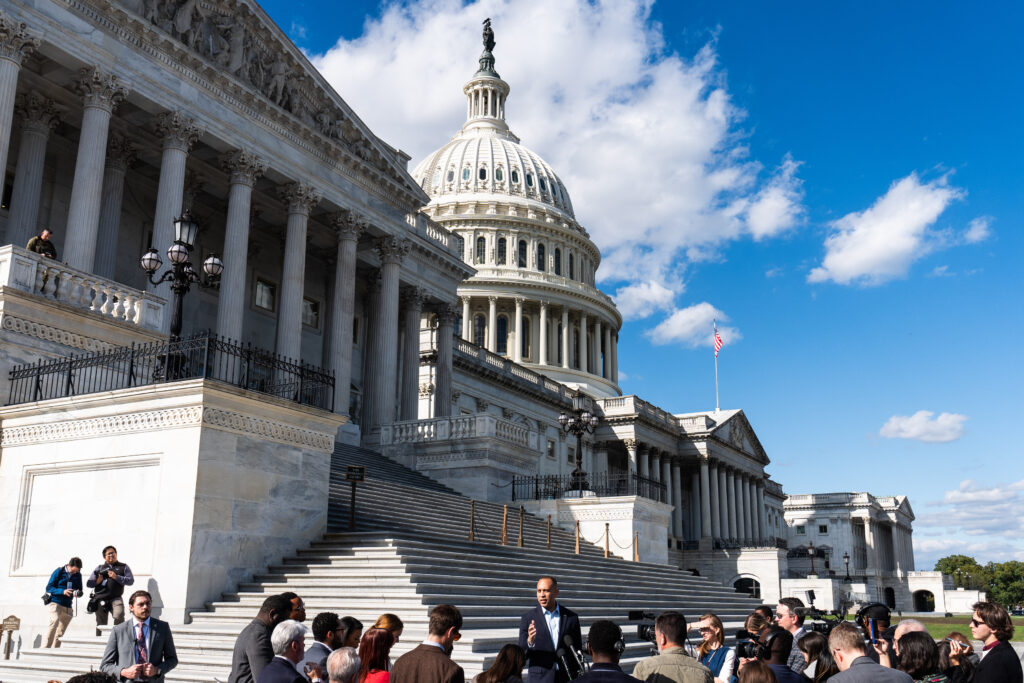
The federal government is on track to shut down at the end of Friday, as congressional Democrats push for changes to Immigration and Customs Enforcement policies as part of a sweeping funding package.
After a series of shootings by federal personnel, Democrats say they will not vote to fund the Department of Homeland Security without new accountability measures. But the funding is lumped into one piece of legislation with money for several other Cabinet departments — so blocking DHS’s budget would close those agencies, too.
The whole government closed in October for the longest period in U.S. history, as Congress deadlocked over demands from Democrats to extend enhanced health care subsidies that expired at the end of last year.
This shutdown would be more limited, as six of 12 annual appropriations bills that fund the government have already been signed into law. However, the departments still unfunded make up the bulk of discretionary funding and include some of the largest federal agencies, including the Defense and Health and Human Services departments.
Here’s what you need to know about the potential shutdown beginning this weekend.
Why is the government poised for a shutdown?
When lawmakers struck a deal to end the last shutdown in November, they set Jan. 30 as the deadline to fully fund the rest of the government.
They were on track to do that at the end of last week. The House passed a $1.2 trillion funding package on Thursday, despite concerns from Democrats about ICE’s aggressive actions against U.S. citizens and undocumented people without criminal records during immigration enforcement operations around the country, including Minnesota.
Then federal agents shot and killed 37-year-old intensive care nurse Alex Pretti in Minneapolis on Saturday. Pretti’s killing outraged Democrats, who pledged to block funding for Homeland Security, which includes ICE, until Republicans agree to new accountability measures.
The Homeland Security funding is part of a six-bill package that includes other agencies. Democrats have urged Republicans to separate out the Homeland Security bill to allow the other five bills, which have greater bipartisan support, to pass and avoid a broader shutdown. Republican leaders say they will not do so.
When would a shutdown begin?
The government is fully funded through Jan. 30, meaning a partial shutdown would begin at 12:01 a.m. on Saturday, Jan. 31. It would continue until Congress passes bills funding all or parts of the shuttered agencies, either by extending funding levels or passing new spending laws.
Last year’s shutdown, which stretched from Oct. 1 to Nov. 13, when workers returned, was the longest in the country’s history.
What services would still be operating during a shutdown?
Unlike last year’s shutdown, this closure would not cover the entire federal government — only the portions that have not been funded by the six appropriations laws already enacted.
Federal agencies have yet to publish plans of which services they expect to remain operating and what will be closed.
The Interior Department was covered by funding that has been approved, so national parks and museums such as the Smithsonian in D.C. should remain open. The Commerce Department, which collects some of the country’s economic data, and the Agriculture Department, which provides services such as SNAP, have also been funded.
Immigration and Customs Enforcement (ICE), the agency at the center of the shutdown controversy, would be prevented from receiving $10 billion proposed in the funding package. But it could continue to operate uninterrupted because the GOP’s tax and spending law from last summer, the One Big Beautiful Bill Act, allocated $75 billion to the agency.
The U.S. Postal Service will continue operating; its services are funded through the sale of postage products, mail and packages, and through a line of credit from the Treasury.
Social Security payments generally continue during government shutdowns. The Social Security trust fund receives revenue directly through payroll taxes, not appropriations. The same goes for Medicare, the health insurance program for seniors.
What would be closed during a partial shutdown?
Several government agencies are still waiting for funding to be approved, including the Labor Department, which collects significant economic and workforce data; the Department of Homeland Security, which includes TSA; the State Department; the Department of Housing and Urban Development and the Transportation Department.
Staff could be furloughed from these agencies or required to work without pay, and services could be slowed or shuttered.
The IRS is also waiting for funding, meaning services could be affected at the beginning of tax filing season. In its planning documentsfor the October shutdown, the IRS said tax refunds would generally not be paid during the pause, and in-person taxpayer assistance centers would be closed.
The post Here’s what would stay open during a partial government shutdown appeared first on Washington Post.