Not long ago, Aviaja Sinkbaek, an office manager in Greenland, thought it was time to ease further away from 300 years of Danish rule and maybe think about independence. She was even open to drawing closer to the United States.
Now as she watches the images of violence coming out of Minneapolis from her pale green rowhouse on a hillside above Nuuk, Greenland’s capital, her ears still ringing with President Trump’s threats about getting her homeland somehow, she’s changed her mind.
“It’s crazy,” Ms. Sinkbaek said about what’s happening in Minnesota.
“He’s crazy,” she added, about Mr. Trump.
Ms. Sinkbaek, 51, had worked in the Boston area as an au pair years ago, but said America was no longer a “safe option.”
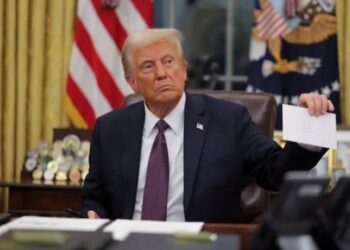
Though Mr. Trump recently declared that he won’t seize Greenland by force, the crisis he has single-handedly created has alarmed American allies in Europe, threatened the NATO alliance and pushed U.S. relations with Denmark to a breaking point. It has also revealed the shifting view of America from abroad, at least from the perspective of this Arctic island that is a semiautonomous territory of Denmark.
The United States defended Greenland during World War II and the Cold War, and Greenlanders used to see Americans as protectors. But now the idea of joining up with the United States — a deeply divided nation with no universal health care, widening inequality and chaos on full display in the streets of Minneapolis — is not so appealing.
“What are we supposed to think of the U.S. now?” asked Julie Rademacher, who heads a Greenlandic association in Denmark. She said she too had been disturbed by the news from Minnesota.
“I feel a lot of sympathy with many American citizens,” she said. “It must be hard to live like that.”
Most of Greenland’s 57,000 people — a tiny population on a gigantic island — are Indigenous Inuits and many are well-informed on how the United States has treated its own Indigenous people and its territories overseas.
Greenland’s per capita income of around $60,000 is considerably higher than those in the American territories of Puerto Rico, Guam and American Samoa, Ms. Rademacher pointed out. The growing consensus among Greenlanders, according to many interviews conducted in the past few weeks, is that they are far better off under their current system, which is subsidized by Denmark but allows Greenlanders a fair bit of latitude to run their own affairs, than they would be as Americans.
The pressure by Mr. Trump has backfired in an important way. Instead of hastening Greenland to split off from Denmark — a sentiment that had been growing in recent years — it has pushed Greenland closer to its former colonizer.
That shift became explicit when Greenland’s prime minister, Jens-Frederik Nielsen, stood beside Mette Frederiksen, Denmark’s prime minister, in Copenhagen this month and said that if Greenland were forced to choose between Denmark and the United States, it would choose Denmark.
It was a strong message. If anything, Greenland had been moving away from Denmark and a poll last year showed that the majority of Greenlanders favored independence.
Colonized in 1721, the island has gained more autonomy in recent decades. Denmark still pays for more than half of its budget, but the local economy, based primarily on fishing, has been growing, giving Greenlanders hope that one day in the not-so-distant future they will be able to rely on themselves.
There’s also been a greater interest in re-examining the colonial past and all the abuses that came with it. Resentment toward Denmark had been growing, along with a greater itch to cut the cord.
Mr. Trump changed all that.
Many Greenlanders now see Denmark as their best protector in a topsy-turvy world and say independence would leave them vulnerable.
“We are not discussing independence right now,” said Aqqaluk Lynge, a former member of Greenland’s Parliament. “What we are talking about is survival.”
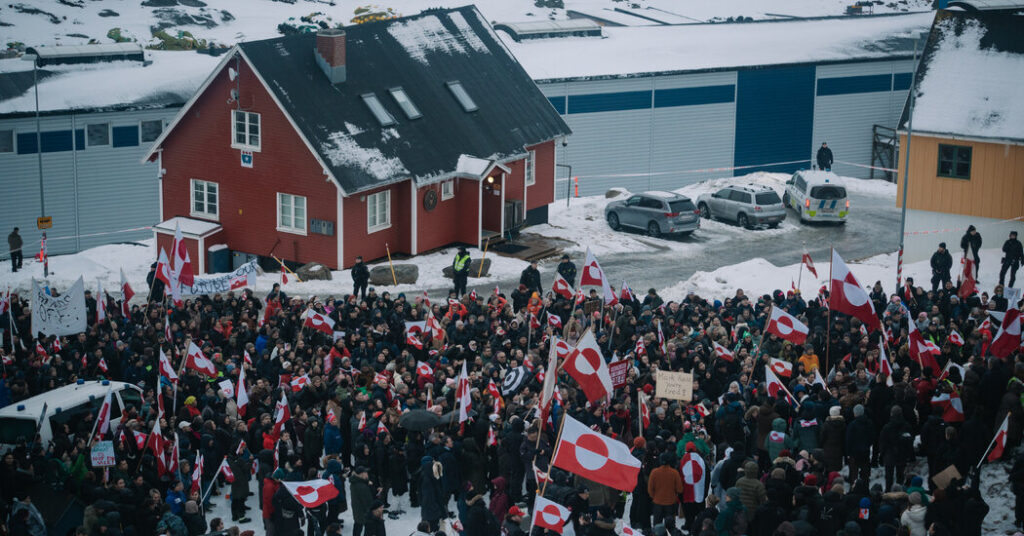
In the past few weeks, as Mr. Trump sharpened his threats, people interviewed in Nuuk said they were sleeping poorly, felt anxious and distracted, and were glued to their phones. His fixation with Greenland has created almost a second weather system that Greenlanders can’t escape.
The fears spiked during a sudden blackout in Nuuk last week. Many people said in interviews that they thought it was the beginning of an American invasion. It turned out to be a malfunctioning power line because of high winds.
Many Greenlanders said they felt grateful to Denmark’s prime minister for standing up to Mr. Trump, including her recent decision to import a small contingent of European military forces to carry out exercises in Greenland and back her up — at least symbolically.
“I just say, ‘Wow,’” Ms. Rademacher said. “It takes a lot of courage to stand up to the world’s most powerful man.”
Qupanuk Olsen, a former member of the Greenlandic Parliament with a large following on social media, said she still supports independence but that the appetite among the wider public is less now.
“People are scared,” she said. “They think Denmark has saved us.”
She, personally, disagrees with that, saying, “We have been manipulated into believing that we cannot stand on our own.”
For centuries, Danish authorities undermined Greenlandic identity, suppressing Indigenous religion, breaking up families and displacing communities. Greenlandic women and girls had been subjected to forced birth control as part of a state-led effort to keep down population growth — a policy that left lasting trauma and that Ms. Frederiksen apologized for a few months ago.
But as fears of a U.S. takeover have spread, the feelings about independence have grown more complicated.
“If you want independence now, it’s like taking something out of the oven too early,” said Ivik Paulsen, a lawyer living in Nuuk. “Something has stepped in front of it that we have to deal with first.”
Many Greenlanders come from ancestors who learned how to survive in one of the most remote and desolate places on the planet. Today they are used to a high Scandinavian standard of living, and some credit Denmark for that.
Corinne Halling, a front desk manager at a hotel in downtown Nuuk, said she sees Denmark as “a parent above us that helps.”
“That’s a huge advantage and a huge privilege,” she said.
Breaking away from Denmark is not a good idea right now, she said, so “why not strengthen the cooperation instead?”
Jeffrey Gettleman is an international correspondent based in London covering global events. He has worked for The Times for more than 20 years.
The post Greenlanders Watching Turmoil in the United States Say No Thanks appeared first on New York Times.