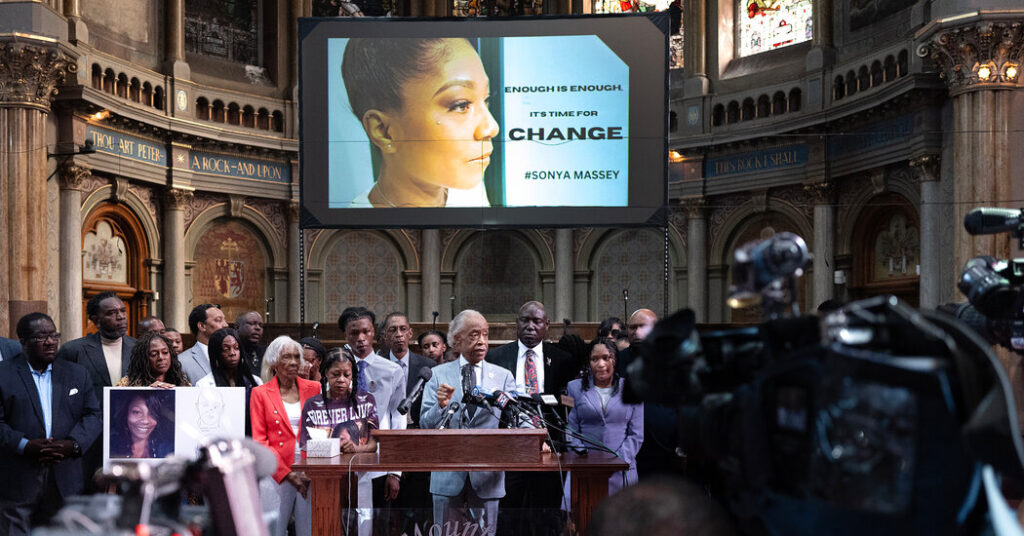
The Illinois sheriff’s deputy who shot and killed Sonya Massey, a Black woman who was confronted by officers at her home in 2024 after she had called 911, has been sentenced to 20 years in prison.
The deputy, Sean Grayson, who is white, was found guilty of second-degree murder in October, a rare instance of an American law enforcement officer convicted for an on-duty shooting.
During his trial in state court, prosecutors accused Mr. Grayson of needlessly escalating the encounter with Ms. Massey, 36, who had called 911 for help one night in July 2024 because she was concerned that someone was lurking outside her house in Springfield, Ill.
After Mr. Grayson and another deputy arrived, they looked through the yard and found no one hiding. Then they knocked on the front door, spoke with Ms. Massey and stepped inside her house.
Their discussion was cordial until Ms. Massey moved to remove a pot of hot water from her stove. After picking up the pot, Ms. Massey said, “I rebuke you in the name of Jesus.”
After that, the encounter escalated quickly. Mr. Grayson told Ms. Massey to drop the pot and threatened to shoot her in the face, using an expletive. Within seconds, the deputies had pulled their guns, and Mr. Grayson fatally shot Ms. Massey in the head.
The day before the shooting, Ms. Massey’s mother, Donna Massey, had called 911 and told a dispatcher that her daughter had been having mental health issues. She asked that they not send “combative” police officers.
Mr. Grayson, who took the witness stand in his own defense during his trial, said that he feared for his safety when Ms. Massey lifted the pot of hot water.
The shooting prompted outrage in central Illinois as well as in Chicago, where protesters marched carrying signs with Ms. Massey’s name.
Mr. Grayson was fired by the Sangamon County Sheriff’s office shortly after the shooting. The sheriff at the time, Jack Campbell, resigned after Gov. JB Pritzker of Illinois and members of the public called for him to step down.
A few months later, the Justice Department opened an investigation, writing in a letter to officials in Sangamon County that the shooting raised “serious concerns” about the way the sheriff’s office interacted with Black people and people with behavioral health disabilities.
The Justice Department said this month that it had found no discriminatory practices behind the fatal shooting.
Jacey Fortin covers a wide range of subjects for The Times, including extreme weather, court cases and state politics across the country.
The post Former Deputy Sentenced to 20 Years in Fatal Shooting of Sonya Massey appeared first on New York Times.