Mayor Zohran Mamdani’s victory in New York City came despite his unsparing critiques of Israel’s treatment of Palestinians, which raised concern among many of the city’s Jewish leaders.
Amid that fraught relationship, made more tense by his response to a protest outside a synagogue in November, some of the mayor’s Democratic colleagues are seeking to push legislation to curry favor with pro-Israel Jewish voters and create some distance from Mr. Mamdani’s views.
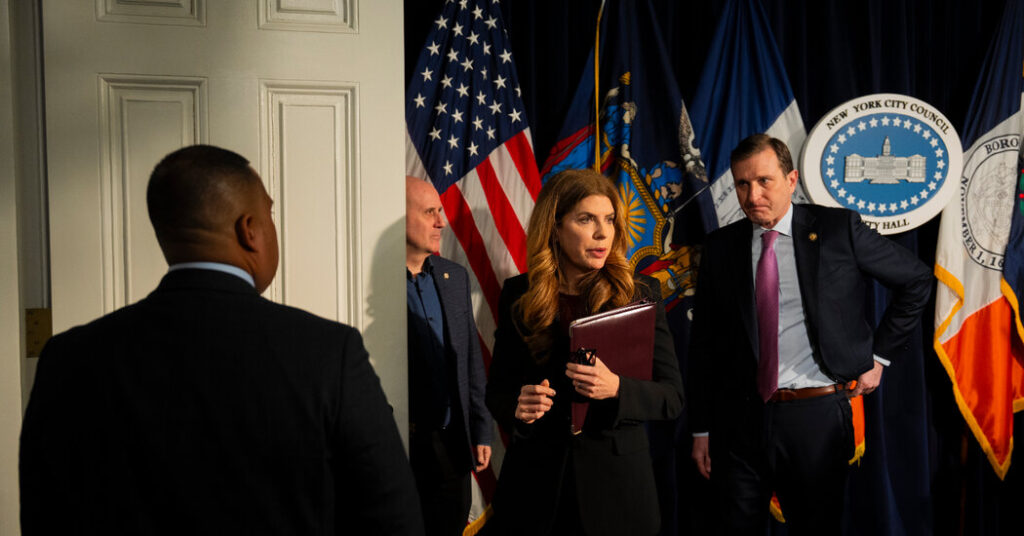
On Thursday, the new speaker of the City Council, Julie Menin, was expected to formally introduce a bill that would allow the Police Department to ban protests within a barrier of up to 100 feet from a house of worship to protect congregants’ right to peacefully pray and avoid “injury, intimidation and interference” from demonstrations.
Her bill comes weeks after Gov. Kathy Hochul, a fellow Democrat, proposed a similar ban on demonstrations, but with a 25-foot buffer outside houses of worship, along with laws punishing protesters who “alarm and annoy” people seeking to enter a temple, mosque or church.
Both proposals are in direct response to recent high-visibility protests near synagogues, including one outside Park East Synagogue in Manhattan where demonstrators chanted “death to the I.D.F.” and to “globalize the intifada.” Both are being pushed by leaders whom the mayor needs as partners to help push his affordability agenda.
And both may pose weighty constitutional questions.
A slew of recent court decisions, including a unanimous decision from the Supreme Court in 2014, have ruled that similar limits on demonstrations were unconstitutional.
State and federal courts have wrestled in recent decades with the question of how much government can limit protests in the name of safety. The cases have often centered on demonstrations around abortion clinics — and sometimes churches where funerals are taking place. (Ms. Hochul’s proposal would apply to reproductive health centers as well.)
Ms. Menin’s bill directs the Police Department to devise and publicize safety plans for rallies outside religious institutions, and to submit those plans to the Council and mayor. The police commissioner would have to address what conditions would lead to setting up or removing the barriers.
Ms. Menin cited city rules blocking electioneering within 100 feet of a polling site and a 2008 city law that created a buffer around reproductive health clinics. She suggested her bill would pass legal muster because it targets hate speech, even though the Supreme Court has ruled that protesters can hold offensive — even homophobic — signs outside funerals and houses of prayer.
“The First Amendment right to peacefully protest is sacrosanct,” Ms. Menin said in an interview. “What’s not sacrosanct is inciting violence, intimidation and harassment.”
Eugene Volokh, a senior fellow at the Hoover Institution at Stanford and a First Amendment expert, said that both Ms. Hochul’s and Ms. Menin’s proposals “are very likely to be unconstitutional. The 100-foot one almost certainly is.”
“People can still worship,” he added. “It is just that they might have to see offensive or upsetting speech while they are going to temple or church.”
Mr. Mamdani, a critic of Israel who has called the country’s conduct in Gaza a genocide, said he would not issue an opinion on the plans until he receives a Law Department review of their legality.
“The mayor is committed to fighting antisemitism and ensuring that New Yorkers continue to be able to worship freely as well as exercise their First Amendment rights,” said Dora Pekec, a spokeswoman for the mayor. She later added, “He continues to await the outcome of that review.”
The Supreme Court has been focused on preventing sweeping limitations on demonstrations. But the justices have shown some willingness through the years to limit protests, so long as the ordinances in question are focused on ensuring that people can enter and exit buildings safely and not on limiting certain opinions from being expressed.
Most recently, the court unanimously struck down a Massachusetts law in 2014 that created a 35-foot buffer zone around abortion clinics.
Mark Goldfeder, chief executive officer of the National Jewish Advocacy Center, wrote in a letter to Mr. Mamdani that Ms. Menin’s proposal is “not a speech restriction, but an access and safety protection that preserves robust expressive activity while limiting the narrow set of behaviors that predictably produce obstruction and intimidation at entrances.”
Proponents of these measures, like Mr. Goldfeder, pointed to a range of restrictions around protesting outside funerals, which the courts — though not the Supreme Court — have allowed. Mr. Goldfeder noted that when protests become “targeted confrontation, the harm is not merely offense at a message, but the loss of safe access, dignity and religious liberty without intimidation.”
,The funeral prohibitions referenced in Mr. Goldfeder’s letter are far narrower than Ms. Hochul and Ms. Menin’s proposals. They ban demonstrating within 300 feet for just the hour before and the hour after a funeral.
“If the government interest here is to protect physical access and to protect people from intimidation, then pushing protesters 100 feet or 300 feet away is more than you need to protect those governmental interests,” said Lucinda M. Finley, a law professor at the State University of New York at Buffalo. Anthony Hogrebe, Ms. Hochul’s communications director, said the governor was trying to strike a balance between ensuring people’s right to protest and making people feel safe when they go to a house of worship.
He added that Ms. Hochul’s “proposal was designed to provide meaningful protections to New Yorkers attending religious services and stand up to legal challenges.”
Liz Krueger, a longtime state senator whose Manhattan District includes Park East Synagogue, said that after the contentious protest in November, she resolved to act. After that protest in November, Police Commissioner Jessica Tisch apologized and said the police should have set up a “frozen zone” at the synagogue’s entrance because the space became “chaotic.”
After studying the Massachusetts law that the Supreme Court struck down, Ms. Krueger and others agreed that a 25-foot barrier protecting worshipers had the best chance of passing legal muster.
“I am trying to hold strong to my beliefs in our Constitution and what we should be doing,” Ms. Krueger said. “At the same time I am hearing the fear, particularly from older Jews and Jews who wear clothing making them obviously Jewish in public. Their concerns are legitimate.”
Janos Marton, a lawyer who previously worked for the American Civil Liberties Union, said that these bills are not only constitutionally questionable, but also unnecessary, given the existing state law prohibiting criminal interference with health care and religious services. He and several other opponents of the proposals pointed to other laws that already penalize people who obstruct or interfere with worshipers entering houses of prayers. These laws also criminalize behavior that puts worshipers in some danger.
“No matter how ugly this one particular incident at Park East Synagogue was, that’s not a sufficient record to change state policy in such a dramatic way,” Mr. Martin said.
Assemblyman Micah Lasher, who helped write Ms. Hochul’s proposed measure, said recent events at synagogues indicated the opposite.
“Park East and other incidents have demonstrated that the current law is not an effective deterrent to conduct that crosses the line into harassment,” he said.
Benjamin Oreskes is a reporter covering New York State politics and government for The Times.
The post For Protesters at Houses of Worship, How Far Away Is Too Far? appeared first on New York Times.