The Federal Reserve held rates steady on Wednesday at the central bank’s first meeting of the year, saying that the U.S. economy has been expanding at a solid pace and that the job market has shown some signs of stabilization.
The move, which leaves rates in a range of 3.5 percent to 3.75 percent, followed three reductions in the final months of 2025. Most of the members of the Fed’s 12-member committee voted to keep rates unchanged. But Stephen I. Miran, whom President Trump appointed to the Fed late last year, again issued a dissent and voted in favor of a quarter-point cut.
Christopher J. Waller, a Fed governor who was appointed during Mr. Trump’s first term and is among the contenders to be the next Fed chair, also voted for a quarter-point cut.
Any pause in rate cuts could inflame tensions between the Fed and Mr. Trump, who has pushed for lower interest rates to boost the economy. The president has made escalating attacks on the central bank and is trying to oust Lisa D. Cook, a Fed governor, in a case that is before the Supreme Court.
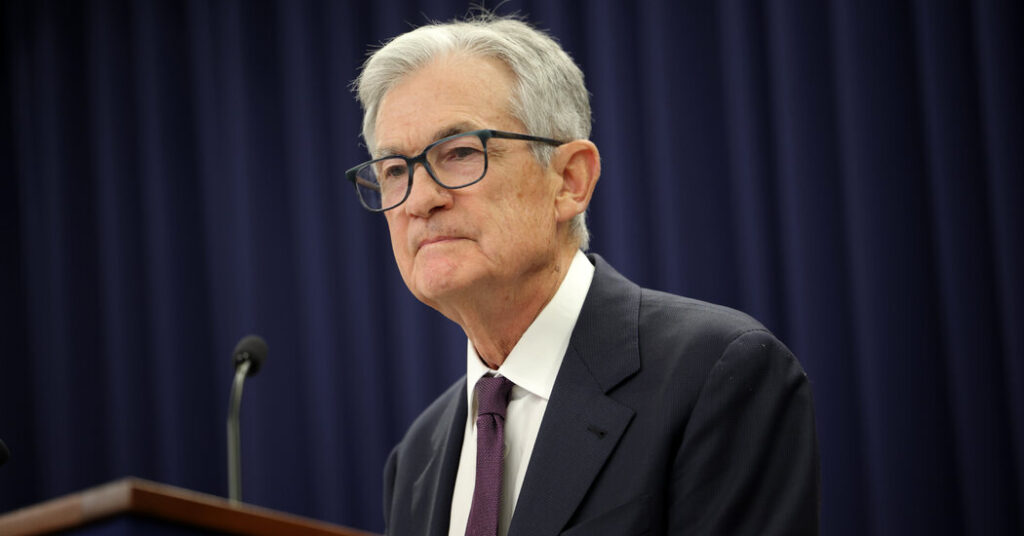
At a news conference after the decision, Jerome H. Powell, the Fed chair, repeatedly declined to comment on questions about the political attacks.
He gave a more upbeat picture of the economy than in previous months. He said that data suggested the job market was “stabilizing” after a period of weakness last year, and that consumer spending and business fixed investment remained strong, even though consumer confidence has been poor.
“The economy has once again surprised us with its strength, not for the first time,” Mr. Powell said.
Mr. Powell declined to commit the Fed to any timeline for future rate cuts, saying the Fed is “well positioned” to address economic challenges and had not made any decisions about upcoming meetings. He also downplayed any possibility of a rate increase in the near future.
“We don’t take things off the table, but it isn’t anybody’s base case right now,” he said.
Fed officials had grown more divided about what to do about rates beginning in September, after the unemployment rate and inflation edged up from earlier in the year. The Fed is charged with both maintaining a strong job market, which can require cutting interest rates, and keeping inflation in check, which can require raising them.
But in recent weeks, the picture for inflation and the job market has improved somewhat. Inflation ended last year more subdued than feared, and though the labor market remained somewhat sluggish, the unemployment rate fell back to 4.4 percent.
Concerns remain that a government shutdown late last year has affected the quality of economic data, particularly for inflation. But Fed officials appeared reassured Wednesday that they can afford to take their time with future cuts.
Kay Haigh, an analyst at Goldman Sachs Asset Management, wrote in a note that the Fed was “likely on an extended pause.” He said she expected the Fed to ease interest rates further later in the year, as moderating inflation allowed for two further cuts.
Michael Pearce, the chief U.S. economist at Oxford Economics, said he expected the Fed to remain on hold at least through June, because of stabilizing labor market conditions. “Arguably the biggest events shaping the outlook for the Fed are occurring outside the institution,” Mr. Pearce said. He pointed to the legal battle over Ms. Cook’s potential firing, and a criminal investigation of the Fed by the Trump administration that, Mr. Pearce said, could compromise the Fed’s independence and lead to inflation in the longer run.
Earlier this month, the Trump administration opened a criminal investigation into Mr. Powell’s handling of renovations at the Fed’s headquarters in Washington. Mr. Powell responded in a video message, saying the legal threats were “pretexts” by the administration to coerce the Fed into lowering its borrowing rates.
Mr. Powell declined to comment on the video messages on Wednesday, as well as grand jury subpoenas that had been issued as part of the investigation. He defended his decision to attend the Supreme Court hearing on Ms. Cook’s case the previous week, saying it was “perhaps the most important legal case in the Fed’s 113-year history.”
Scott Bessent, the Treasury secretary, had called Mr. Powell’s decision to attend the hearing “a mistake” and said he was politicizing the case.
Mr. Powell defended central bank independence in the news conference, calling it an “institutional arrangement that has served the people well.”
If politics got in the way, it would create the perception that the bank would act in the interest of one group or another, rather than the broader public, Mr. Powell said. Analysts fear that political influence over the Fed could lead to lower interest rates in the short term, but undermine the credibility of the institution and ultimately raise expectations for inflation.
Mr. Powell’s term as chair expires in May, and Mr. Trump is expected to appoint a successor who would favor lower interest rates. But while powerful, any future Fed chair is just one vote on a policy-setting committee that contains seven governors, the president of the New York Fed and four regional bank presidents.
Asked to give advice to whoever comes next in the post, Mr. Powell cautioned against venturing into any political issues. “Don’t get pulled into elected politics. Don’t do it.”
Colby Smith, Ben Casselman and Lydia DePillis contributed reporting from New York.
Ana Swanson covers trade and international economics for The Times and is based in Washington. She has been a journalist for more than a decade.
The post Fed Holds Rates Steady as It Points to an Improving Economy appeared first on New York Times.