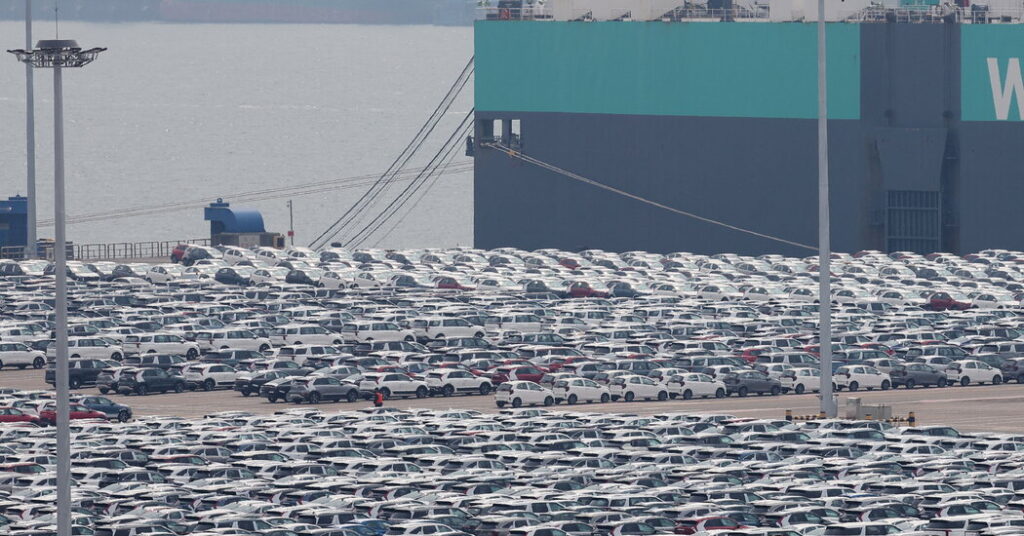
Canada, facing U.S. tariffs that threaten its auto industry, announced on Thursday an agreement with South Korea to explore bringing Korean automotive manufacturing to the country.
Though scant on details, the accord was another move by Prime Minister Mark Carney to diversify Canada’s trade away from the United States in response to Mr. Trump’s volley of tariffs.
The agreement also fits with Mr. Carney’s widely hailed call at the World Economic Forum last week for middle power nations to band together after what he characterized as an irreversible “rupture” to the world order by Mr. Trump’s aggressive economic and diplomatic policies.
Mr. Trump has repeatedly said that the United States does not need autos from Canada and imposed a 25 percent tariff on Canadian vehicles, ending a period of duty-free entry dating back to 1965. The vast majority of Canadian auto production is sent to the United States, though Canada also imports a sizable number of U.S. vehicles.
“This agreement will grow our auto sector, create good jobs and reinforce Canada’s position as a global leader in future-ready vehicle manufacturing,” Mélanie Joly, the industry minister, said in a statement on Thursday.
Since President Trump took office a year ago, U.S. automakers have been steadily retreating from Canada in response to tariffs and the Trump administration’s targeting of electric vehicles.
Stellantis abandoned the retooling of a factory in the Toronto suburb of Brampton, Ontario, and moved production of its new Jeep model to Illinois. General Motors has closed an electric delivery van plant in Ontario and on Friday will cut a shift at its pickup truck plant in the province.
A Ford assembly line in Oakville, Ontario, has been idle since May 2024. It is supposed to retooled to make large pickup trucks after the company abandoned plans for electric vehicle production there, but no specific start date has been set.
Mr. Carney, in another significant effort to build trade relations with other nations, announced during a visit to Beijing this month that a small number of electric vehicles from China would be allowed into Canada at a low tariff rate.
Canada and China suggested that the decision would open to the door to investments in Canada by Chinese carmakers. During the Biden administration, Canada followed the lead of the United States and essentially shut out Chinese E. V.s by applying a 100 percent tariff.
Mr. Trump last week threatened a 100 percent tariff on all Canadian exports to the United States if Canada “makes a deal with China.”
It was unclear what deal Mr. Trump was referring to and Mr. Carney has said that Canada has no intention of seeking a broad free trade agreement with China.
Mr. Trump has also hit South Korea economically. This week, he threatened to increase tariffs on South Korean products because he believed the country had not ratified a trade deal with the United States quickly enough.
Last year, the United States rattled South Korean businesses by arresting 475 people during an immigration raid at an electric vehicle factory in Georgia being built by the South Korea industrial giants Hyundai and LG. Most of those who were detained were South Korean nationals employed by subcontractors to finish building the factory.
But South Korea’s willingness to make auto related investments in Canada may also be related to its desire to sell a fleet of submarines to the Royal Canadian Navy. After choosing to buy diesel electric submarines, which are not made in the United States, Canada is now weighing bids from Hanwha Ocean, a South Korean firm, and Thyssenkrupp Marine Systems of Germany.
The auto agreement between the two countries was signed on Tuesday when a South Korean government delegation was in Ottawa to promote Hanwha’s bid.
Hyundai, through its brand, as well as under the Kia and Genesis names, controls about 12 percent of the Canadian auto market, according to the Canadian government. But, unlike the United States, it currently does not manufacture any vehicles in Canada.
The only major South Korean presence in Canada’s automotive industry is an electric battery plant in Windsor, Ontario, jointly owned by LG and Stellantis. Low demand for Stellantis electric vehicles has meant that it is making batteries for storing power rather than propelling cars.
Ian Austen reports on Canada for The Times. A Windsor, Ontario, native now based in Ottawa, he has reported on the country for two decades. He can be reached at [email protected].
The post Canada Signs Auto Deal With South Korea, Moving Further From the U.S. appeared first on New York Times.