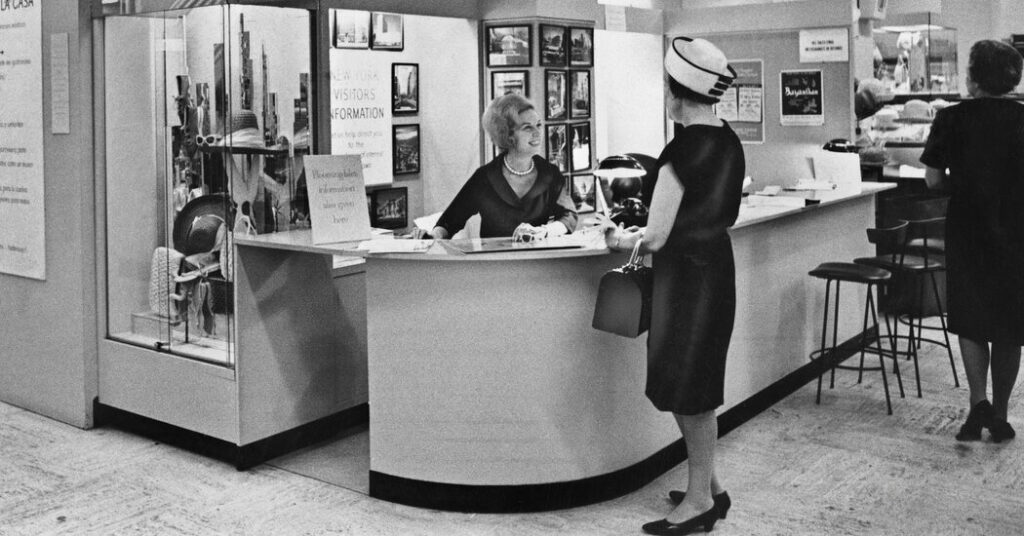
In 1976, the CBS correspondent Morley Safer went to Bloomingdale’s to film a segment for “60 Minutes” on the hypnotic effect the store had cast over Manhattan’s consumer psyche. More than a century old, Bloomingdale’s had become a culture, a routine — drawing 300,000 people a week, many of whom lined up on Saturday mornings before the store opened at 9:45, to spend the day there.
“You’ve got stockings, brassieres, tickets, brie cheese, I mean you’ve got everything you want in Bloomingdale’s,” a young Village Voice reporter named Blair Sabol exuberantly explained to Safer, who seemed mystified by all the things people were buying: a small sneaker to be worn as a pendant around the neck, a big bed in the shape of a sneaker, ceremonial masks from New Guinea, 146 kinds of bread.
Bloomingdale’s was hip both to the emerging culinary revolution and the change in the country’s erotic habits that preceded it. The store was second only to the Metropolitan Museum of Art as the city’s “sexual meeting ground,” Safer reported in a manner that seemed at once dubiously speculative, preposterously insular and probably right. It is impossible to argue with a vibe.
The recent news that Saks Global — the operator of Saks Fifth Avenue, Neiman Marcus and Bergdorf Goodman — entered Chapter 11 bankruptcy has revived questions about the fate and experience of department stores, the slow depletion of energy, the loss of heat — something for which “everyone is responsible and no one is responsible,” as Isaac Mizrahi framed the upending.
Even some of the most devoted have fallen away. Tracked down in Scottsdale, Ariz., where she has been for years, Ms. Sabol, the onetime Village Voice reporter who used to live near Bloomingdale’s solely for the proximity, has not been to a department store in 10 years, she told me.
The internet was not at fault — “Amazon? Please. No. Cruising reels? No,” she said, as if offended by the suggestion. It was what she considered the sterilized atmosphere of the department store itself that kept her away, the lack of possibility and chance, the alienation produced by ever higher pricing. As a “psychological boost,” department stores were, as she put it, “no longer hitting it.”
Like so many students of recreational acquisition, Ms. Sabol remarked on how indistinguishable luxury department stores had become from one another as they consolidated around the world’s biggest and most expensive labels. During her long period of infatuation, “every store had an identity,” she said, “and you aligned yourself with that identity in the way that a man would align himself with a football team.”
Stores can and do emerge from bankruptcy, but periods of financial turmoil only solidify the reliance on the most commercially exalted brands because independent designers, there to provide the lure of character, back away from relationships with companies that cannot or will not pay them.
A lawyer specializing in distressed debt, Joseph Sarachek, is representing 30 small vendors who are each owed between $100,000 and $10 million from the Saks corporation, he told me. “My office was in Rock Center for 20 years, and I would often go across the street into Saks to look for a unique gift for my wife,” he said. “I’d run into a bunch of other guys just like myself. We were not there to buy Chanel.”
When you walk through the doors at the Saks flagship in Midtown these days, you are no longer greeted by the humble $30 lip oil but rather by a European village worth of handbags, each costing thousands of dollars — Chanel, Valentino and so on. This onslaught of leather is a relatively recent development. In 2019 Saks tripled the space it allotted to handbags as part of a $250 million renovation and what the company announced was a “new business model” that “reimagined the department store concept with the revolutionary migration of beauty to the second floor.” This transition marked a significant switch in messaging. For decades, cosmetics had occupied the ground floor at Saks and most department stores, welcoming the shopper whose budget might not have surpassed expenditures in the two digits.
Eight months after the shift, Nordstrom opened its first major store in New York City. With 320,000 square feet of space seven blocks north of Saks, the store sticks to the idea of keeping makeup and perfume at the point of entry.
On a recent tour of Manhattan department stores — after an admittedly long absence — I found Nordstrom, which posted more than $15 billion in revenue during the last fiscal year and returned to family ownership, to be the busiest, liveliest, the most inviting. Rather than stop for lunch at L’Avenue at Saks, which serves a Dover sole for $85, I ate at Wolf, one of Nordstrom’s four restaurants, where a kale salad costs about what it would at Sweetgreen and no one is taking a picture of it.
The first visible sign that Saks was in the sort of trouble occasioning mission drift came four and a half years ago, when the department store devised, with WeWork, SaksWorks, which turned over the 10th floor of the company’s flagship store to rentable co-working space. The walls were covered in moss; the scent of pepperwood was pumped into the air; the venture lasted under two years.
If you are in your 20s, department stores have been dying ostensibly for the whole of the time you have been conscious. “Lackluster upon lackluster,” an analyst at Piper Jaffray described the sector in a New Yorker article in 2003 — seven years before Instagram ignited our scrolling addictions, 16 years before the closure of Henri Bendel, 17 before the end of Lord & Taylor and Barneys.
The decline might be traced further back, sometime around 1989, when B. Altman shut down on Fifth Avenue. By then, Bloomingdale’s had been abandoned as an urbane meeting ground in romantic comedy (see “Manhattan”), replaced by The Sharper Image (see “When Harry Met Sally”).
Retail buying had already begun to lose its allure as a profession for ambitious young women with great taste, bringing its own reverberations, as Marvin S. Traub, who led Bloomingdale’s in the 1970s and ’80s, argued toward the end of his life. Between 1972 and 1990, the percentage of women completing MBA programs multiplied by a factor of eight. A talented Wellesley graduate who might have once gone to Bloomingdale’s to work as a buyer for women’s wear — as J.D. Salinger’s sister, Doris, had been in the 1960s — now had the option to go work as a retail analyst at JP Morgan.
If the outsize success of Bloomingdale’s during the Traub era was attributed to the store’s embrace of the modern, he and his merchants had also gone deep into the past. The notion of selling everything to everyone — the notion that Amazon adopted — was rooted in the emergence of the department store in the late 19th century. In the 1880s, a store of this kind might have had 15 small departments; by 1925 it would have had 125. In addition to clothes and furniture, Siegel-Cooper on Sixth Avenue, for example, sold cameras and pet monkeys. Wanamaker’s in Philadelphia was thought to have the best bookstore in the country.
The founder, John Wanamaker, made his store a center of the city’s social life, the ultimate “third place,” 130 years or so before the term was coined. In 1909, he bought the organ that had been built for the Louisiana Purchase Exposition of the 1904 St. Louis World’s Fair. When the organ made its debut at Wanamaker’s in 1911, President William Howard Taft was among the 40,000 who showed up. Concerts and other spectacles became a regular feature of department stores around the country.
Printemps New York, which opened in the Financial District last year, seems to be toeing closest to this line, with a wine shop and five places to eat and drink, one of which brings in a singer every Monday night to sing French songs. The store occupies the old Irving Trust building, where the intricate red mosaics designed by the artist Hildreth Meière in the 1930s for what was then the bank’s lobby, remain and seem to draw people on their own.
Entering Printemps from Broadway, you see a coffee bar as you would in many bookstores. There was a time when book stores were thought to be dead. But over the last five years, the number of independent booksellers around the country has increased, however unpredictably, by 70 percent. Last month Barnes & Noble confirmed that it would open 60 new stores this year. Analysts examining this trend have credited the sense of community the stores have built and their sensitivity to local tastes — those tastes often belonging to an affluent knowledge class, happy to spend $30 on the latest Ian McEwan novel, unable to spend $2,500 on a tiny Chloe satchel.
In his television segment 50 years ago, Safer pointed out that Bloomingdale’s had become so popular because it functioned as a neighborhood store on the Upper East Side, “probably the largest congregation of upper middle-class affluence gathered anywhere in the world.”
The spending power of that group has shrunk, and it is precisely this group — the merely well-off — that luxury department stores have ignored, a retail consultant suggested to Reuters recently. To survive, the demographic targets would have to change, he believed. Saks and its competitors will “need to compete better for the affluent, not just the wealthy.”
Ginia Bellafante writes features, profiles and social criticism for The Times.
The post Can Department Stores Ever Be Fun Again? appeared first on New York Times.