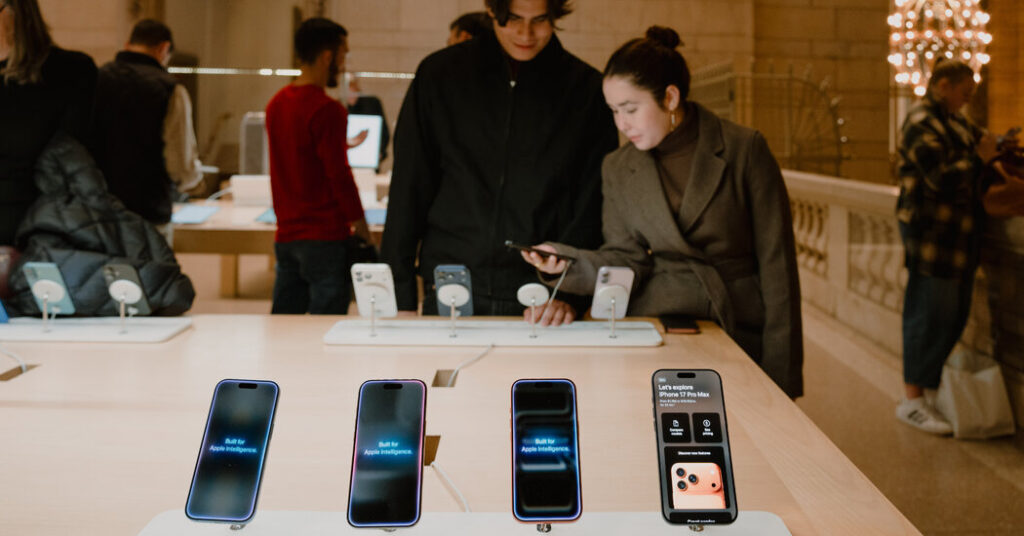
Apple on Thursday reported record quarterly sales of the iPhone thanks to new, higher-priced models, which enticed holiday shoppers and helped drive a rebound for the brand in China, the largest smartphone market in the world.
Revenue for the three months ending in December rose nearly 16 percent from a year earlier to $143.8 billion, the largest quarterly growth since 2021. Profit rose 16 percent to $42.1 billion.
In September, Apple introduced redesigned iPhones: a thin model called the iPhone Air and an overhauled iPhone Pro, which features a raised bump across its back. Those changes, coupled with robust holiday spending, continued to lift iPhone sales in the quarter. Revenue from iPhones was $85.3 billion, up 23 percent from the same period a year ago.
The newest versions of the iPhone also appealed to customers in China after years of weak sales there. Apple’s iPhones made up 22 percent of smartphone shipments in China in the quarter — more than any other company, including local rivals — after lagging a year earlier, according to Counterpoint Research, which tracks the smartphone market.
Apple reported its sales in China rose 38 percent to $25.5 billion in the quarter.
“IPhone had its best-ever quarter driven by unprecedented demand, with all-time records across every geographic segment,” said Tim Cook, Apple’s chief executive, in a news release on Thursday.
Apple’s results topped expectations. Wall Street analysts had predicted quarterly revenue of $138.38 billion and profit of $39.49 billion.
Apple has lagged other tech juggernauts in the artificial intelligence race. Rivals are spending tens of billions of dollars on developing the technology and building data centers, the computing sites that power the technology. They have trumpeted the technology’s benefits for their businesses.
Apple has taken a different tack, slowly rolling out A.I. features and working with other companies. This month, it said it would use technology developed by Google to power A.I. products including its personal assistant, Siri, which is expected to be upgraded this year.
Apple’s results suggested the company has avoided the effects of a global shortage in memory chips, which have become scarcer and more expensive because of increased demand from A.I. chipmakers like Nvidia and AMD.
Contracts between consumer electronics makers and their suppliers typically last six months, which means companies like Apple could face higher costs for memory later this year, said Mehdi Hosseini, an analyst at Susquehanna International Group, a quantitative trading firm.
“They have the scale and they have the size to procure memory,” he said. “The question is: How can they absorb much higher prices?”
For the quarter, Apple’s revenue from services, which include the App Store and Apple Music, rose nearly 14 percent from a year ago to $30 billion.
Last week, the company said it would raise the fee for some transfers from Apple Cash, its competitor to the digital payments app Venmo.
Apple reported mixed results in other parts of its business. Sales of iPads rose 6 percent to nearly $8.6 billion. But sales slowed for wearables, which include the Apple Watch and AirPods, and Macs.
Kalley Huang is a Times reporter in San Francisco, covering Apple and the technology industry.
The post Apple Reports Record iPhone Sales Amid Holiday Bump appeared first on New York Times.