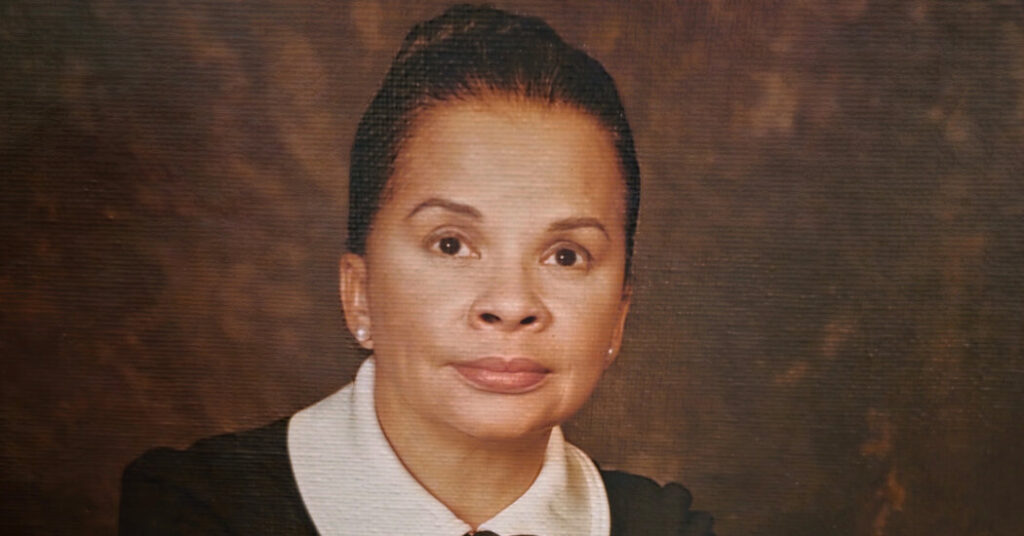
Dr. Angella D. Ferguson, a pediatrician whose groundbreaking research aided in the early diagnosis and treatment of sickle cell anemia, a painful and deadly disease that disproportionately afflicts people of African descent, died on Jan. 6 at her home in Chevy Chase, Md. She was 100.
Her death was confirmed by her nephew Roger W. Ferguson Jr., an economist and former vice chairman of the Federal Reserve.
Dr. Ferguson was one of a small group of pediatricians — including Yvette Fay Francis-McBarnette and Doris Wethers — who as Black women physicians were rarities for their time, and who as researchers focused on sickle cell, a field that many white clinicians had overlooked.
About 100,000 Americans and more than 7.7 million people worldwide are affected by sickle cell disease, in which the body produces red blood cells that are stiff and sickle-shaped rather than smooth and round. (Sickle cell anemia is the most common form of the disease.) The misshapen cells can clog blood vessels and impede the flow of oxygen, damaging organs.
About 80 percent of sickle cell cases are believed to occur in sub-Saharan Africa. The condition was first described in the medical literature early in the 20th century, but it was still not well known when Dr. Ferguson and her colleagues began their work several decades later.
“Dr. Ferguson’s research changed the landscape for sickle cell diagnosis in children,” the Sickle Cell Disease Association of America wrote in 2021, “and made a huge impact on how we identify and treat S.C.D. to this day.”
In the late 1950s, when Dr. Ferguson had a private pediatrics practice in Washington, D.C., and was a research instructor at Howard University, she observed that her Black patients were more likely than those of European heritage to produce the sickle-shaped cells.
She developed a blood test that could diagnose sickle cell in infants and children under the age of 12. It remains the standard in most states.
She also recommended guidelines for treatment, including giving affected children under 5 at least one glass of water each day to increase blood volume and facilitate the flow of the sickle-shaped cells. In addition, she advocated for delivering larger amounts of oxygen to sickle cell patients during medical procedures to avoid infection and other side effects.
In the 1960s, Dr. Ferguson and Dr. Roland B. Scott, then both pediatricians at Freedmen’s Hospital in Washington, helped found the Association for Sickle Cell Anemia Research, an early support and education organization.
As she studied the development of Black infants, Dr. Ferguson also arrived at a tangential finding: They tended to sit and stand earlier than the offspring of parents of European descent. She suggested that the difference might be because Black babies were more often from poorer families and were therefore less likely to use a highchair or playpen, leading to faster development of sitting and standing ability.
Angella Dorothea Ferguson was born on Feb. 15, 1925, in Washington. She was the fifth of six children of George A. Ferguson Sr., who taught mechanical drawing in the city’s public schools and owned an architectural firm that designed churches, and Mary (Burden) Ferguson, who managed the household.
Despite her father’s multiple jobs, the family was so poor during the Depression that Angella worked in her elementary school’s cafeteria in exchange for free meals she could bring home.
In high school, she developed a passion for chemistry and math. She received a bachelor’s degree in chemistry from Howard University in 1945 and a graduated from Howard’s College of Medicine in 1949. (At the time, Black women made up about one in a thousand physicians in the United States, according to a University of California, Los Angeles study.)
She completed her internship and residency at Freedmen’s Hospital (now Howard University Hospital). She then studied radioisotopes at Bethesda Naval Hospital in Maryland (now the Walter Reed National Military Medical Center) and conducted postgraduate study in hematology at New York Hospital-Cornell Medical Center in New York (now NewYork-Presbyterian Hospital/Weill Cornell Medical Center).
Dr. Ferguson joined the Howard faculty in 1953 and became a full professor a decade later. Taking on an administrative position in the 1970s, she oversaw the development and evaluation of academic and research programs as well as the design and construction of a new hospital that replaced Freedmen’s. In 1979, she was named Howard’s associate vice president of health affairs. She retired in 1991.
Her marriages to Charles M. Cabaniss, a doctor, and Leonard Altemus, a dentist, ended in divorce.
Dr. Ferguson is survived by two daughters from her first marriage, Carla V. Cabaniss and Caryn Cabaniss Mudd; a sister, Carole F. Howard; three grandchildren; and two great-grandchildren.
Sam Roberts is an obituaries reporter for The Times, writing mini-biographies about the lives of remarkable people.
The post Angella Ferguson, a Leader in Sickle Cell Anemia Research, Dies at 100 appeared first on New York Times.