Doctors in Chicago saved the life of a young Missouri man with a rare infection that had liquefied his lungs, hooking him up to what they have called a total artificial lung. The patient, whose name was not released, survived on the lung for 48 hours, and then received a lung transplant.
Two and a half years later, the patient, now in his mid-30s, is alive and back working in his family business, according to Ankit Bharat, his lead surgeon and executive director of the Northwestern Medicine Canning Thoracic Institute where the surgeries were performed.
Few patients ever develop such severe lung disease, but experts said the transplant in Chicago will give hope to those in such desperate circumstances and show doctors that they can be saved.
Bharat is the first author of a paper describing the artificial lung procedure published Thursday in the journal Cell Press.
In May 2023, the Missouri man was airlifted to Northwestern suffering from lung failure triggered by influenza that rapidly deteriorated into a rare, severe complication called necrotizing pneumonia. The condition is characterized by intense inflammation, destruction of lung tissue.
“His kidneys were failing. His heart was in big trouble,” Bharat said in a video interview. The death of cells was so severe in the lung that the tissue transformed into a liquid mass filling both chest cavities with pus.
“In face, he was so sick that when he came within a day and a half his heart stopped completely,” Bharat said.
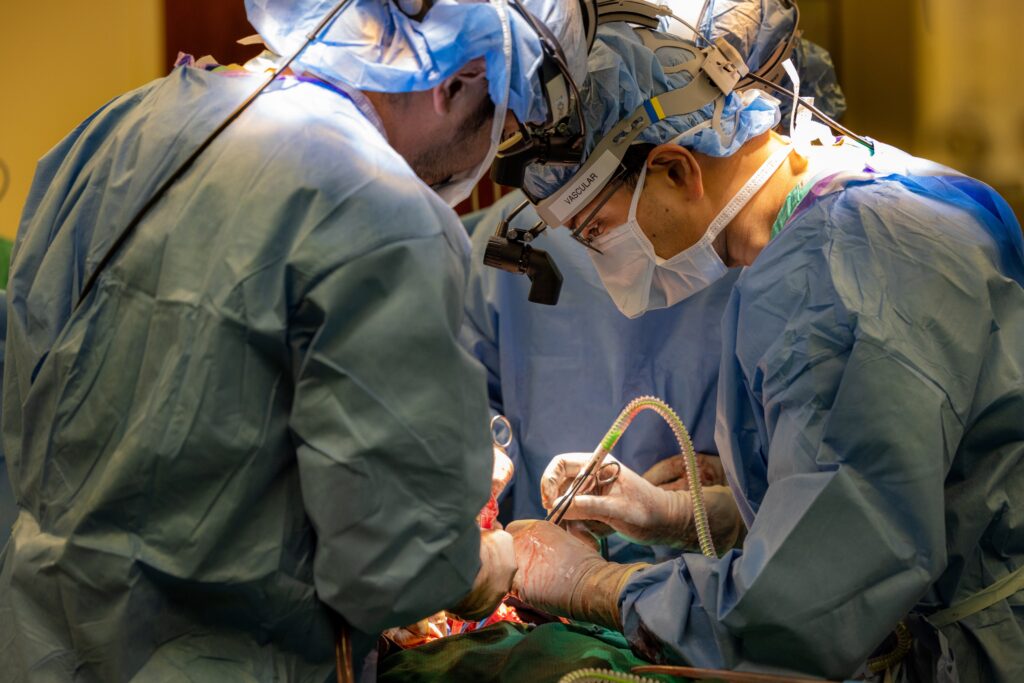
In a 12-hour surgery involving about 15 doctors, nurses and medical staff, Bharat removed both of the patient’s lungs and hooked him up to tubes leading to an artificial lung outside the body.
The device, which consisted of 25 parts, took in blood from the right side of heart, infused it with oxygen and pumped it back to left side of the heart, which then sent the blood out to the rest of the body.
Bharat said the device used on the patient has yet to be used a second time because doctors wanted to see how the patient fared in the long term. He added that the artificial lung cannot be tested in clinical trials because it would be unethical to randomize treatment for some dying patients and not for others.
He said that Northwestern intends to keep a registry that will allow researchers to track how well the device does in other cases.
“I think this is something that can go from a novelty to a way of approaching this stage of lung disease in patients,” said Marie Budev, medical director of the lung and heart-lung transplant program at Cleveland Clinic who was not involved in the work. “It opens a door for patients that might previously have been rejected for transplant.”
Budev stressed that the procedure is so complex that it will likely be an option only for highly advanced transplant centers with multidisciplinary teams.
“The patient would have 1,000 percent died without it,” Stephanie Chang, surgical director of lung transplantation for the NYU Langone Transplant Institute.
She called the work by the team at Northwestern “heroic,” but said the artificial lung device was more of a tweak on devices that have been used previously in a few rare cases, including one by doctors at the University Health Network, University of Toronto.
Bharat disagreed, saying the artificial lung he and his colleagues developed represents a “major advance toward a durable and long-term implantable total artificial lung system.”
In particular, he said, previous systems were modified versions of a device called ECMO (Extracorporeal Membrane Oxygenation) a temporary life-support machine that takes over the function of a patient’s failing heart an/or lungs.
The Northwestern artificial lung, he said, is able to restore stable blood flow even when pressure in the arteries changes and, unlike other methods, does not alter the heart chambers.
Work on artificial lungs has been progressing since the mid-2000s, when sheep were implanted with such devices. Before 2017, about 11 percent of lung transplant patients diedor were removed from the transplant list, but that number has dropped to about 4 percent.
The post An infection liquefied a man’s lungs. This invention kept him alive. appeared first on Washington Post.