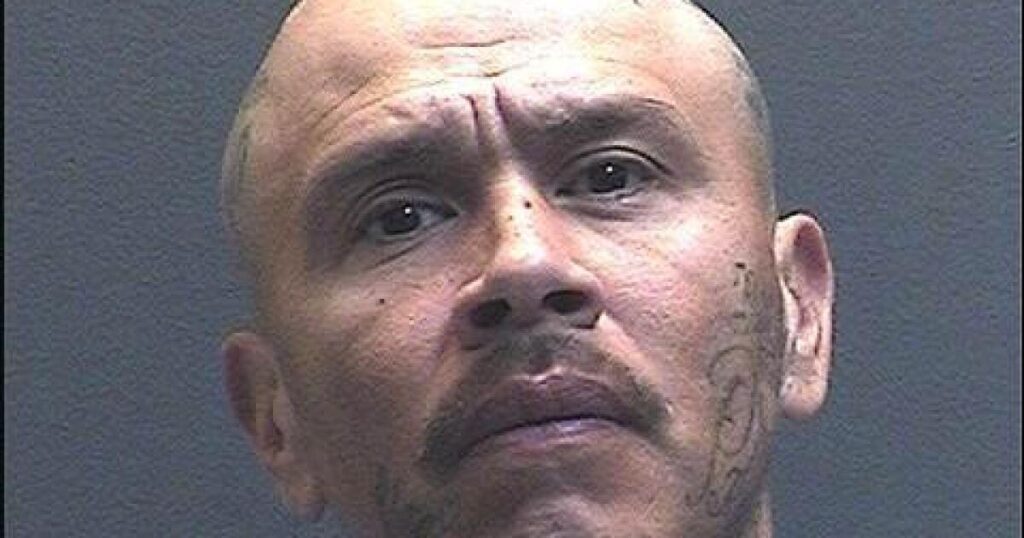
Even on his birthday, Andrew Reyna couldn’t turn down an order from the Mexican Mafia.
That’s according to a Long Beach Police Department detective who testified Wednesday about evidence that led authorities to charge Reyna and two others with the murder of Samuel Villalba.
Villalba, an Artesia native nicknamed “Negro,” was said to have been a made member of the Mexican Mafia, a prison syndicate that holds sway over many Latino gangs in Southern California. At the time of his death on Jan. 10, 2021, Villalba, 64, was living in a tent beneath a freeway overpass in Long Beach.
Prosecutors allege Reyna was ordered to kill Villalba, who’d been marked for death after getting into a dispute with another Mexican Mafia member.
At a preliminary hearing Wednesday, Det. Leticia Gamboa testified the message was relayed through David Oropeza, who like Reyna belonged to the Eastside Paramount gang.
Reyna’s lawyer, Theodore Batsakis, said his client denies killing Villalba but declined to comment further. Reyna and Oropeza have pleaded not guilty to charges of murder and conspiracy to commit murder.
Much of what authorities know about the homicide comes from Jairo Rodriguez Duque, who is also charged with Villalba’s murder.
Rodriguez’s attorney, Scott Sanders, told The Times that Rodriguez may have described what led up to Villalba’s killing but he didn’t take part in it.
“I want to be absolutely clear,” Sanders told The Times. “Jairo Rodriguez never said he participated in this murder. This is why we have trials, and we’re very much looking forward to proving Jairo Rodriguez did not do this murder.”
Arrested in June, Rodriguez told detectives that Oropeza invited him to a birthday party the day Villalba was killed, Gamboa testified. Rodriguez and Oropeza both worked at Homeboy Industries, a program that helps gang members and parolees find work, go to school and remove tattoos, among other services. Oropeza, 50, spent about a decade in prison for manslaughter, court records show.
It was Reyna’s 45th birthday, and Rodriguez said he and Oropeza were celebrating at Reyna’s house when Oropeza got a call. After speaking in a hushed tone, Gamboa testified, Oropeza hung up, turned to Reyna and said, “Go handle that.”
According to the detective, Oropeza told Reyna to take a “youngster” with him.
“I’m going to take this one here,” Reyna allegedly said, gesturing to Rodriguez, then 20.
With Reyna giving directions, Rodriguez said he drove to a residential area and parked. They walked behind a shopping center, hopped a fence and continued along a dirt path to a homeless camp. Rodriguez said Reyna slipped on a pair of gloves and handed him a mask, Gamboa testified.
Reyna started peering into tents, asking for someone, Rodriguez said.
After serving about 16 years in federal prison for racketeering, Villalba ended up living in a collection of tents along the railroad tracks that run beneath the 91 Freeway. He was addicted to heroin and suffering from cirrhosis, according to a search warrant affidavit and a coroner’s report. The affidavit said Villalba kept his tent “neat and organized.”
When Reyna looked inside Villalba’s tent, Gamboa testified, he said: “I found you.”
According to what Rodriguez told detectives, Reyna shot Villalba and told Rodriguez to run.
“What the f—?” Rodriguez asked Reyna as they drove away.
“Don’t worry about it,” Reyna replied, in Rodriguez’s telling. “He was a piece of s—. Don’t be a little b—.”
They returned to Reyna’s house, where Oropeza was waiting, Gamboa testified. According to the detective, Oropeza had texted Rodriguez just before the killing, asking him to pick up sodas on the way home.
“It’s done,” Reyna told Oropeza when they walked in, according to Rodriguez.
“Don’t worry,” Oropeza allegedly told Rodriguez. “Nothing’s going to happen to you.”
Gamboa testified that she canvassed the area where Villalba’s killers were seen fleeing on surveillance video. Near a fence they had clambered over, Gamboa said, she found a latex glove that contained Reyna’s DNA.
Oropeza’s attorney, Kevin McGurk, argued that prosecutors couldn’t prove his client agreed to murder Villalba. He didn’t provide the alleged killers a weapon, car, money or help evading arrest, he said. Oropeza may have known Villalba was going to get killed, McGurk said, but “knowledge, bad intentions, is not enough.”
Unpersuaded, Los Angeles County Superior Court Judge Laura Laesecke said she’d seen enough evidence for Oropeza to stand trial. Reyna and Rodriguez have yet to have their preliminary hearing.
The post Alleged assassin for Mexican Mafia spent birthday stalking victim, detective testifies appeared first on Los Angeles Times.