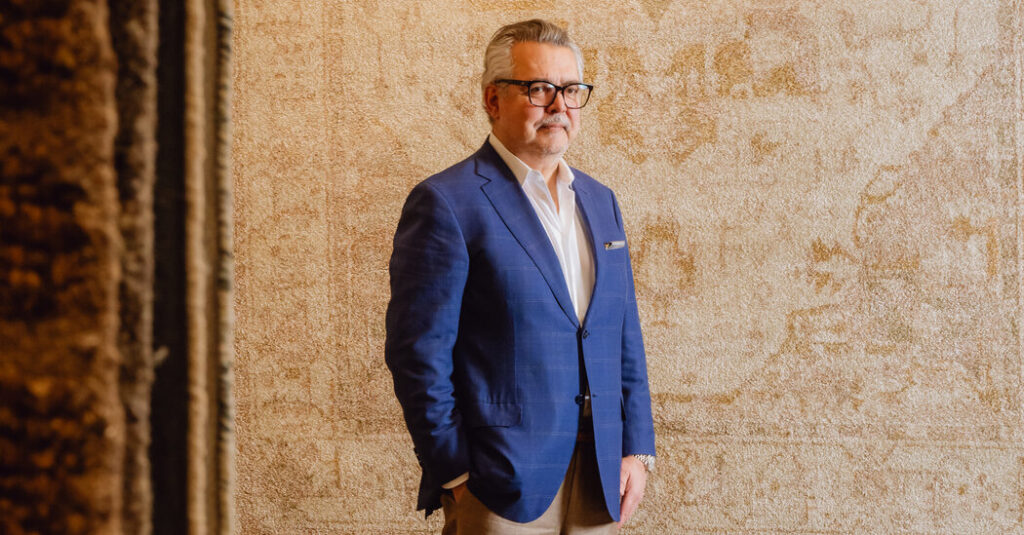
Even before President Trump unveiled his tariff policy last year, Loloi had started stockpiling.
The family-run rug and textile company, based in Dallas, wanted to have enough inventory to support ambitious growth plans for the years ahead. The possibility that Mr. Trump would exact stiff taxes on imports only reinforced the company’s push.
“We were bursting to the seams in our distribution centers,” said Amir Loloi, the company’s founder and chief executive.
The decision turned out to be prescient.
Starting in early April, Mr. Trump began imposing punishing tariffs on countries worldwide. Aiming to reset the balance of global trade, he also used tariffs as a cudgel to try to force some countries to bend to his will.
Caught in the morass were companies like Loloi, which imports all of its rugs. Suddenly, it was contending with double-digit tariffs on India, Turkey and every other country where its rugs are made.
Nearly a year later, the tariffs have left Loloi bruised. Its tariff bill swelled 80 percent last year compared with 2024. The company paused plans for some new items because tariffs made them too expensive.
A Supreme Court ruling on the legality of many of the tariffs, which is expected in the coming weeks, could introduce new unknowns.
Yet there is a sense at Loloi that the damage could have been worse. The company negotiated favorable deals with manufacturers in India that kept its costs from ballooning. It avoided steep price increases for customers, in part because of its cache of pre-tariff goods.
“We continue to sort of lick our wounds by acknowledging that we’re probably in a better position than most, or many, of our competitors,” said Steven Loloi, 40, a principal at Loloi and one of Mr. Loloi’s two sons.
Across the economy, the effects of Mr. Trump’s tariffs have been less significant than some economists had anticipated. Prices have gone up for some goods, including furniture and décor, but they have not skyrocketed. Some businesses have collapsed under the weight of higher cost of goods and supplies, but many others have sustained the additional import taxes without excessive pain.
Many systemic factors explain the muted impact, including a boom in construction and investment of artificial intelligence capacity that kept the economy afloat. Behind the scenes, companies like Loloi also made countless decisions that kept a lid on sticker prices.
In 2024, the home furnishing industry had a mantra, said Cyrus Loloi, 37, the other son, who is also a principal and Loloi’s chief marketing officer: “Survive to ’25 and then thrive.”
The heyday of the pandemic era, when demand for home goods exploded, had subsided. High interest rates were dampening home sales and renovations, dragging down the appetite for furniture and other items.
As 2025 began, Loloi’s challenges instead appeared to be multiplying. The Federal Reserve was proceeding cautiously with interest rate cuts amid persistent inflation, forestalling a stronger housing market. Mr. Trump was eager to enact the tariffs he had promised during his campaign.
“Just even the opportunity for this to happen was enough to sort of spook me,” Steven Loloi said.
Loloi did not have the flexibility of companies that shifted production to countries with lower tariffs, because many of its rugs require large technical looms or weaving expertise predominantly found in India.
Moving to domestic production was not an immediate option, either, because the United States did not have the required machinery and lacked specially trained weavers.
Still, the Lolois were cautiously optimistic about the year ahead. A marketing push, including collaborations with well-known interior designers such as Joanna Gaines and Amber Lewis, had made consumers more familiar with Loloi. What had begun as a modest rug company in 2004 had a work force of about 750, and Steven and Cyrus Loloi had just introduced a direct-to-consumer home furnishings brand, Joon Loloi.
As consumers became more deliberate about their spending, the Lolois felt their company was positioned to benefit. Initially, the tariffs were more of a threat than a catastrophe. Loloi had largely moved the production of less expensive, machine-made rugs out of China to Vietnam and Thailand, so a trade war with China was less concerning.
Then in August, just as many of the tariffs were set to snap into place, Mr. Trump announced that he would double tariffs on India, to 50 percent, to punish the country for buying oil from Russia.
The Lolois were shocked. India was one of the earliest countries to enter into a trade talks with the Trump administration, and the previously close relationship between Mr. Trump and India’s leader, Narendra Modi, had led many analysts to believe that an agreement might be concluded relatively quickly.
The next day, Amir Loloi, 66, and his product team flew to India to speak with the company’s manufacturing partners.
A central problem was that Loloi’s Indian rug production relied on a cottage industry of weavers who hand-knotted rugs often using techniques passed down through generations. If Loloi put orders on hold, it ran the risk that weavers would leave the industry for good, depleting an already dwindling supply of artisans and irreversibly harming Loloi’s partners.
Loloi agreed to keep orders flowing in exchange for moderate discounts from longstanding partners, Amir Loloi said. That offset some of the cost of the extra import taxes.
The company also had heaps of rugs that it had imported before the new tariffs to support its expansion. The backlog allowed it to delay some more heavily taxed shipments in the hope that countries would strike more favorable trade deals.
Loloi was generally able to limit price increases for its retail and design customers last year to between 3 and 17 percent, while taking a modest hit to its profit margin.
“If the tariffs are 50 percent, no one is passing along 50 percent,” Amir Loloi said.
Companies across the country are awaiting the Supreme Court’s decision about Mr. Trump’s tariffs. During arguments in November, justices appeared skeptical that the president could use emergency powers to impose sweeping tariffs. A decision against Mr. Trump could force his administration to pay back a portion of the $264 billion in tariffs it collected last year and ignite a rush for refunds, including by Loloi.
Loloi’s pre-tariff inventory, which helped carry it through a tough year, is running low. India and the United States have continued to discuss a trade agreement, but Mr. Trump said this month that any country doing business with Iran would pay another 25 percent tariff. That category would include India, though it is not clear his administration will enact those tariffs.
Even if the Supreme Court strikes down these tariffs, the Lolois believe, the Trump administration could try to impose higher duties in other ways.
The cost of tariffs remains daunting — it is enough to “make our eyes glaze over,” Steven Loloi said.
But the Lolois have become resigned to higher import taxes and are focusing on new quandaries. How can their company compete with ever cheaper rugs on e-commerce platforms? How will artificial intelligence change how people shop?
“One of the things that we’ve sort of had to hammer home over the last year-plus to our development team members is, ‘Let’s stop talking about what the first cost of the product is.’ Like, who cares anymore?” Steven Loloi said. “What is the post-tariff cost of this product? That’s what ultimately matters.”
Ana Swanson contributed reporting.
Sydney Ember is a Times business reporter, covering the U.S. economy and the labor market.
The post A Rug Maker Withstood One Year of Trump’s Tariffs. New Challenges Loom. appeared first on New York Times.