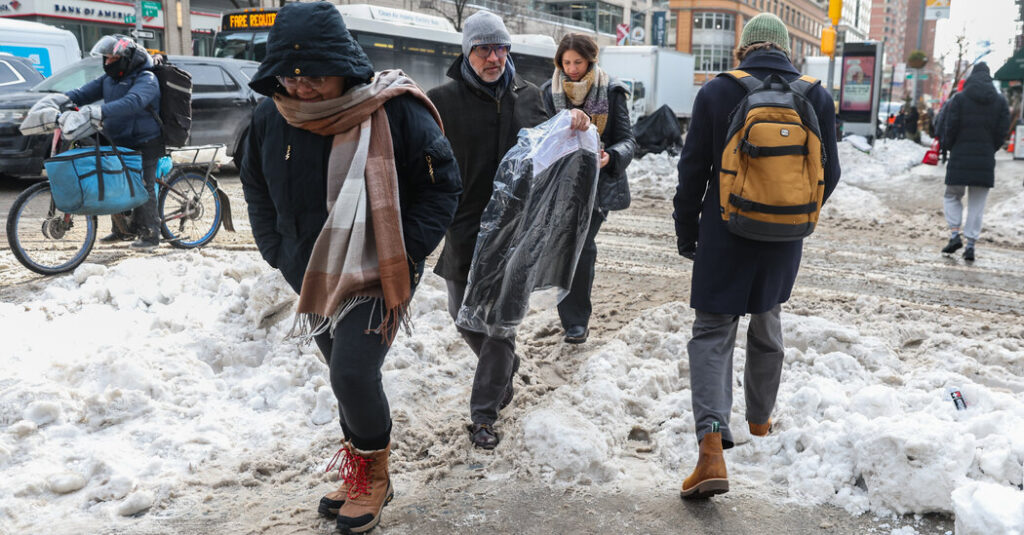
Three days have passed since New York City’s biggest snowstorm in years, but New Yorkers are still scaling heaping mounds of curbside snow and ice that have rendered some crosswalks, bike lanes and bus stops unusable.
Plows have cleared the streets by pushing snow off to the side, toward the sidewalks, and frigid temperatures have hardened much of it into lumps of ice. Cars and trucks are now able to move easily, but in many places pedestrians, cyclists and bus riders have been left to pay the price.
“Any bus stop, they didn’t clean it,” said Giselle Marcos, 45, who commutes by bus from Queens to her job as a nanny in Williamsburg, Brooklyn. “You have to wait for the bus literally in the road.”
At a basic level, the problem has been caused by a combination of huge amounts of snow and lingering freezing temperatures that have kept it from melting.
Examples can be seen all over the city. Tourists in Midtown Manhattan navigating narrow footpaths from sidewalk to crosswalk in single file, like mountaineers on a hazardous peak. Bus stop benches half buried in Queens. Delivery workers careering down bike lanes that look like slushy slalom courses. Wheelchair users and parents with strollers unable to leave their blocks.
Who is responsible for cleaning all this up? The answer, it turns out, is sort of everybody.
The city’s Sanitation Department is charged with clearing public streets, and has deployed thousands of workers across the city to salt, shovel and plow since the storm arrived on Sunday. Property owners are supposed to clear the sidewalks around their buildings and face fines between $100 and $350 for failing to do so.
Bus stops are supposed to be a group effort: Those with covered shelters are meant to be cleaned by contractors for the Transportation Department, while stops that are marked only by signs are the responsibility of the same property owners who are supposed to clear the sidewalk.
The Sanitation Department said its workers assist with shoveling the stops because many property owners do not do it, and that the workers shovel paths between sidewalks and streets to help people get on the bus. Vincent Gragnani, a spokesman for the department, said that work was “ongoing throughout the city.”
The Sanitation Department is also responsible for clearing pathways for pedestrians to enter crosswalks, Mr. Gragnani said. But it is not difficult to find intersections across the city where that has not happened.
Ms. Marcos, the nanny in Williamsburg, tried to take her 2-year-old charge to the local library on Wednesday, but gave up and took the child back home because all the paths to get there were impassable with a stroller.
“The city didn’t clean the corners,” she said. She said she thought the authorities did “not that good a job, to be honest.”
Nearby, Brian Gesiak, 38, had taken it upon himself to shovel the street corner after dropping off his son at pre-K.
“As the proud owner of a shovel, I figured I’d clear it up,” Mr. Gesiak said. He did not blame the city for leaving the crosswalks inaccessible, but said he wondered if the government lacked the money or the staffing to do the job.
“I don’t view this as anybody’s fault,” he said. “I just view it as snow.”
Christina Asbee, the program director at Disability Rights New York, a nonprofit group, said the situation across the city was particularly troublesome for disabled New Yorkers, for whom a pile of snow is “not just a challenge; it is a total barrier.”
“People who have a physical disability, especially if they use a wheelchair, in many cases they can’t leave their block or even exit their apartment buildings,” she said, which can keep them from getting to work or medical appointments. “People are just stuck inside until the snow melts or it gets cleared sufficiently.”
Daphne Frias, 28, an advocate for people with disabilities, said she had been stuck at home in West Harlem for days. Her family said it would be impossible for her to navigate the curbs with her wheelchair.
“My sister told me she had to climb into the street to get onto the bus to go to work,” Ms. Frias said. “The first thing she told me when she got home was, ‘You wouldn’t be able to go outside because there is so much snow.’”
In the Bronx, Ana Agramonte, 68, had been able to get outside with her walker, but teetered as she pushed it through an intersection clogged with snow and ice on Fordham Road. She said the city’s snow removal job had been “no good.”
The snowstorm has also caused problems with bike lanes. Mr. Gragnani said the department clears the lanes “at the same time, with the same priority, that we are clearing streets.”
But in many parts of the city on Wednesday, there was an obvious difference between the condition of bike lanes and the state of the street.
Mr. Gragnani said that was a matter of simple physics: Unlike bicycles, cars and trucks are heavy and generate heat. Once the streets are plowed, those vehicles help keep them clear.
On the Upper East Side of Manhattan, Kevin Ramos, 24, a delivery worker, said that bike lanes were clear on some of Manhattan’s broad avenues, but that he had not found clear lanes on any of the cross streets he’d encountered.
With certain bike lanes largely unusable, he said, delivery workers have had to either illegally ride on the sidewalk, swerving around pedestrians, or venture into the street, where they risk being hit by cars.
Speaking in Spanish, Mr. Ramos described the experience of riding a bike in the city this week as difficult and dangerous.
The Sanitation Department is aware of the complaints.
Mr. Gragnani said the department was addressing the condition of bike lanes “as needed,” and that it had kept 2,500 employees working 12-hour shifts to clear snow every day since the storm.
The department has also enlisted the help of roughly 500 emergency snow shovelers, with pay starting at $19.14 per hour, and is looking to hire more. On Tuesday, Mayor Zohran Mamdani appeared in a video, shovel in hand, to advertise the search.
Liam Stack is a Times reporter who covers the culture and politics of the New York City region.
The post Who’s Supposed to Clear the Snow From New York City’s Street Corners? appeared first on New York Times.