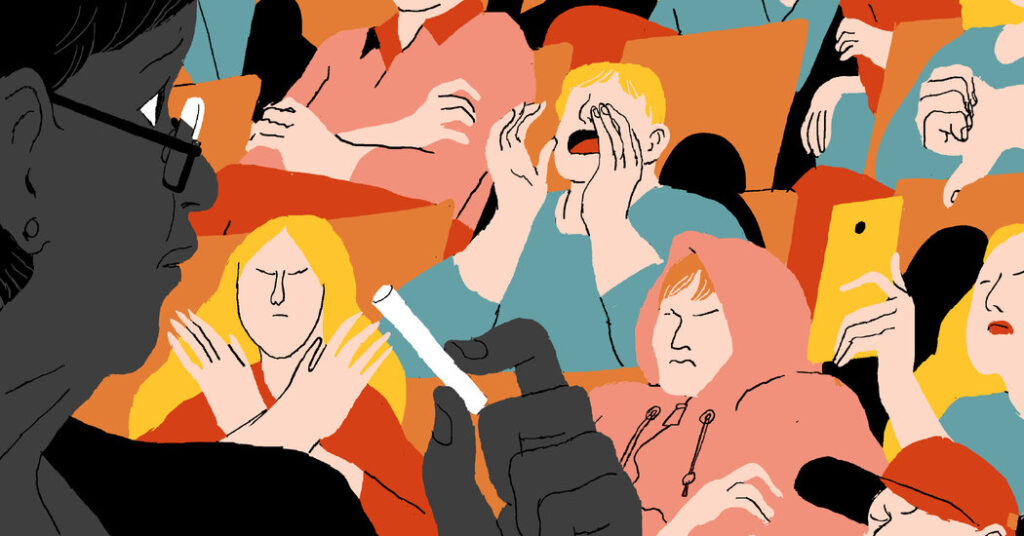
Last month, I wrote about a University of Oklahoma teaching assistant who was put on administrative leave for giving a student a zero on a psychology assignment.
The student, Samantha Fulnecky, turned in a biblically inflected rant that did not appear to be college-level work. When efforts to get the teaching assistant, Mel Curth, to immediately change the grade did not succeed, Fulnecky contacted the president of the university; the governor of Oklahoma; a conservative, anti-union organization; and the press to complain that she was a victim of religious discrimination.
I have an update for you, and it’s not good. Fulnecky, who had already had the failing grade removed, has become a right-wing media darling. Curth was fired, and another instructor from the University of Oklahoma was placed on leave for a related controversy.
Fulnecky’s rush to get political actors on her side, and to make her own grading dispute national news, did not happen in a vacuum. The Trump administration and sympathetic state legislators like those in Oklahoma, in their zeal to end what they believe is “woke” gender and racial ideology, have chilled academic freedom. Fulnecky’s personal quest has intersected with a broader, decades-long effort to turn Americans against higher education.
This is happening at the same time that campuses themselves are under immense enrollment pressures. Over the past 15 to 20 years, declining numbers of college-age Americans and a seemingly endless rise in tuition have brought about a shift in power. Students are now treated like customers who rarely have to hear information that upsets them — because schools need their money to survive. Even elite universities are not immune to financial woes.
College-level instructors, especially the ones without tenure who make up a vast majority of the higher ed teaching force in the United States, are increasingly vulnerable to the whims of students and administrators. This dynamic started long before President Trump’s second term, and weaponized complaints used to come more regularly from both left and right. But Trump cannily realized that colleges were in a weakened condition and has taken full advantage of their structural vulnerability to push his own agenda.
This month, Greg Lukianoff, the president and chief executive of the Foundation for Individual Rights and Expression, wrote a guest essay for Times Opinion about how a philosophy professor at Texas A&M was told that he must remove Plato from his syllabus — because the ancient Greek’s writing ran afoul of a university policy on teaching race and gender. Lukianoff argued that Texas A&M “is importing today’s culture war into the ancient agora — turning the modern academy into a parody of its ancient namesake, a place where discussion is replaced by prior restraint.”
After I wrote about the dust-up at the University of Oklahoma, I asked readers who are college professors to tell me whether they worried about getting in trouble, either for rigorous grading or for teaching controversial material. Over 200 educators wrote in, and the responses were beyond depressing. Some professors are shying away from material they previously taught confidently because they fear the loss of their livelihood — they are exercising that prior restraint that Lukianoff is worried about.
The professors are not just worried about complaints from right-wing students; some are concerned about social media or administrative backlash from their liberal students and peers, too. Javian Walter, who was a graduate teaching assistant in the art history department at the University of Illinois Chicago in 2023, told me about an incident where administrators at the school put a course on hold after students complained about the inclusion of a critical discussion of Dave Chappelle’s 2021 special “The Closer.”
But fears of right-wing backlash are much stronger now that the federal government is so heavily involved and the Trump administration distorts the truth so easily. Heather Voorhees, who teaches science communication at the University of Montana, told me about her class on health misinformation. In this class, which she taught as recently as the fall of 2024, she and her students discuss the scientific method, public health missteps and how to evaluate scientific studies. She hasn’t taught the class since because, she explained, “We have a governing body that has continually turned its back on traditional, vouched-for, well-done science in favor of whatever else they decide to promote.”
Voorhees emphasized that her university administration has always been supportive of her, and her students have been excellent and engaged. But she still works at a public university in Montana, where a Republican state senator tried to ban the teaching of scientific theories (as opposed to facts) in K-12 schools in 2023. That bill went nowhere, but it planted the seed of fear that something she teaches in the classroom — like germ theory — would be used against her. Voorhees describes the situation as “ludicrous.” She feels “scared to teach lessons about basic biology and science. I am scared to call out scammers, because some of those scammers are currently in control of the country.”
The Trump administration’s war on truth and historical standards is, of course, not limited to universities. We see that the administration is willing to say basically anything about what is happening in Minneapolis, despite what we can all see on multiple angles of video. On Thursday, the National Park Service removed an exhibit from Independence National Historical Park in Philadelphia about the enslaved people owned by George and Martha Washington because of an executive order “restoring truth and sanity to American history,” according to The Associated Press.
I usually try to inject a bit of hope at the end of my newsletters, but on this topic I have none. I keep searching for the word that encapsulates the justified paranoia of some of the teachers I spoke to: It only takes one vindictive student in a sea of good eggs to ruin an entire career, because teaching opportunities are contracting.
Professors are fighting an asymmetric battle against the tide of anti-intellectualism, illiberalism and bad-faith complaints, and will be for the foreseeable future.
End Notes
-
If you want to see something life-affirming — which we all need right now — I recommend “Mel Brooks: The 99 Year Old Man,” on HBO. Brooks’s comedies were a staple of my household growing up: I have watched “Blazing Saddles,” “The Producers” and “Young Frankenstein” so many times I can quote them from memory. Brooks has a wonderfully optimistic disposition and a fighting spirit. Before I saw this documentary, I had no idea he fought so valiantly in World War II.
Feel free to drop me a line about anything here.
The post When Conservative Politics Hit Cash-Starved Universities appeared first on New York Times.