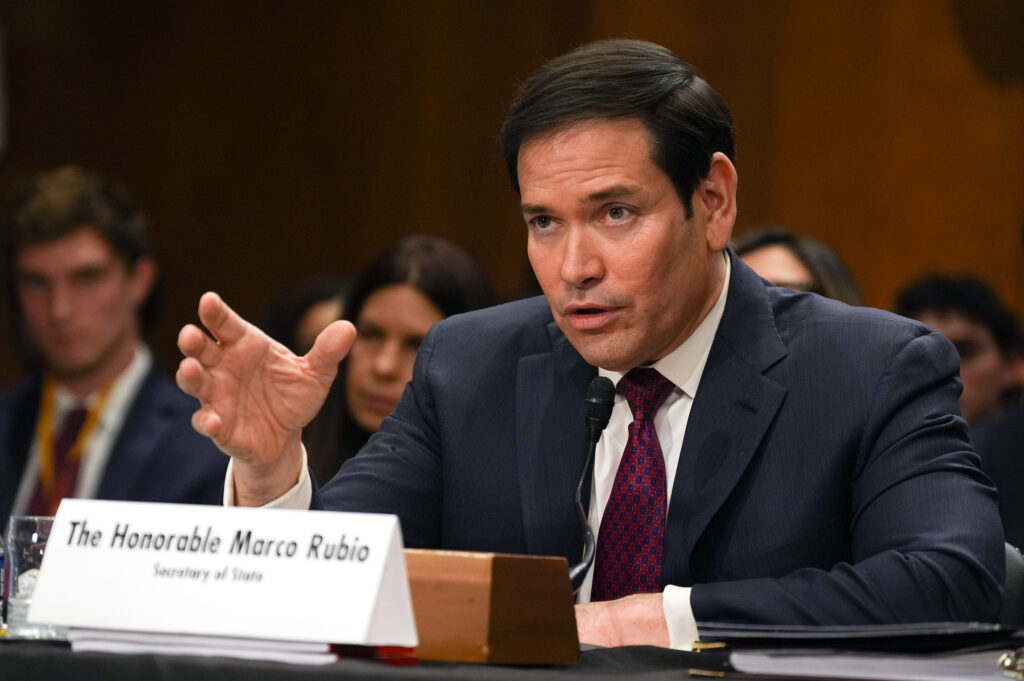
Secretary of State Marco Rubio said Wednesday that the United States was not in a “state of war” with Venezuela and that the Trump administration does not “intend” to take further military action there — tempering its previous threats to again use lethal force unless the interim government in Caracas grants Washington unfettered access to its oil industry and expels U.S. adversaries, including Russia, Iran and China.
Rubio’s comments came during a contentious hearing before the Senate Foreign Relations Committee, as lawmakers from both parties criticized the administration for withholding information from Congress ahead of the U.S. military’s deadly raid to apprehend Venezuelan President Nicolás Maduro.
Rubio, who also serves as the White House national security adviser, sought to reassure the committee that the administration would consult with Congress ahead of any sustained military action in the future, and he pushed back on accusations that he and other Trump officials had misled lawmakers before the stunning snatch-and-grab mission Jan. 3.
“We are not postured to — nor do we intend or expect to — have to take any military action in Venezuela at any time,” Rubio said, adding that the administration reserved the right to attack again if an “imminent threat” were to emerge.
The tension in Rubio’s remarks illustrates the tenuous position the Trump administration finds itself in as he and other top officials attempt to coerce the government in Caracas without entering into an open-ended military commitment.
The Trump administration has defended the raid to depose Maduro, who remains in U.S. custody pending trial on drugs and weapons charges, as a limited “law enforcement” action. Rubio employed that argument in recent weeks as he urged Republicans to withdraw their support for a symbolic war powers resolution that sought to block any further military action in Venezuela. Two senators ultimately did so, tanking the measure.
Sen. Todd Young (Indiana), one of those Republicans, said Rubio had assured him there would be no more “major” military operations in Venezuela without Congress’s prior approval. The other, Sen. Josh Hawley (Missouri), disclosed ahead of the Jan. 14 vote that Rubio had assuaged his concerns that the Trump administration could deploy “occupying forces” there, adding, “He said point-blank: We don’t want to do that.”
Rubio agreed to appear before the committee Wednesday in part to flip Young’s support on the resolution, the senator has said.
But removing the threat of military force could also discourage Delcy Rodríguez, Venezuela’s interim leader, from cooperating with U.S. demands on oil access and eventually transitioning the country’s government away from the Maduro regime.
“I worry that you are playing fast and loose with our nation’s military,” said Sen. Tammy Duckworth (D-Illinois), who had a combative exchange with Rubio over the administration’s deportation campaign, which has included direct flights to Venezuela.
The post Trump’s Venezuela plan does not foresee more military force, Rubio says appeared first on Washington Post.