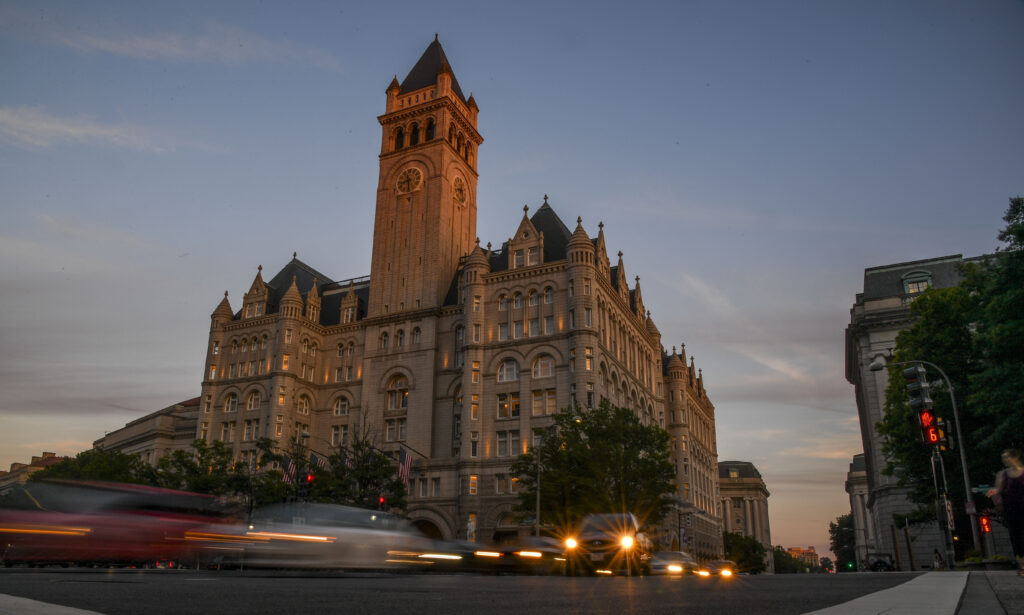
The Trump administration is preparing to sell the Old Post Office, a 19th-century landmark in the heart of D.C. that previously housed one of the president’s luxury hotels, according to records obtained by The Washington Post.
Officials are moving to sell the property to the bank that controls the long-term lease as “part of ongoing efforts to reduce the federal government’s footprint,” according to a letter sent to the city’s State Historic Preservation Officer last month.
On Pennsylvania Avenue between the White House and the Capitol, the building is now home to a Waldorf Astoria hotel. For many, though, it remains synonymous with the previous tenant: The Trump International Hotel, which opened nearly in lockstep with Trump’s 2016 election and served as a clubhouse of sorts during his first term. Lobbyists dined in the steakhouse. Supporters made pilgrimages to the bar. Foreign leaders rented rooms when they traveled to Washington. His company sold the lease rights in 2022.
The General Services Administration — the federal government’s real estate arm and owner of the Old Post Office building — hosted a meeting Jan. 15 to discuss the “the proposed disposal,” according to an invitation reviewed by The Post. The property was among hundreds the administration listed for sale last spring before abruptly reversing course hours later.
The Old Post Office is on the National Register of Historic Places and the city’s list of historical properties. Its 315-foot tower boasts an observation deck with sweeping views of the nation’s capital that has long been open to the public, with National Park Service rangers on hand to offer tours. The panorama includes the Washington Monument, Washington National Cathedral and planes landing at Reagan National Airport.
Lately, however, sightseers have arrived at the entrance to find it shuttered, a sign taped to the door reading: “Tower Temporarily Closed.”
The National Park Service issued a statement saying that it was no longer operating tours of the tower through an agreement with the GSA dating back to 1983. Park Service spokesman Mike Litterst said it’s up to the GSA to “determine next steps regarding the tower’s operations and public access.” The GSA did not respond to questions.
Under the lease conditions, lease holder BDT & MSD Partners has first rights to buy the building. The company declined to comment. The timing and proposed sale price are not immediately clear.
Hilton, which owns the Waldorf Astoria brand, has a long-term agreement in place to manage the hotel. Branding and operations would remain unchanged in connection with a sale, according to a person familiar with the matter who spoke on the condition of anonymity because they were not authorized to speak publicly. The new owner would also maintain public access to the tower in the event of a sale, the person said. Hilton declined to comment.
Spokespersons for D.C. Mayor Muriel E. Bowser (D) said city officials had been in touch with the GSA about ensuring the building remains protected and accessible to the public but declined to comment further.
Uncertainty lingers about the fate of the tower’s 10 bells — a gift to Congress from a British foundation to celebrate the bicentennial of American independence. They are rung by volunteers on federal holidays and other special occasions.
The GSA “intends to retain ownership” of both the statue of Benjamin Franklin located in front of the building and the vast sculpture in the atrium by American installation artist Robert Irwin, according to the letter sent by GSA Federal Preservation Officer Kristi Tunstall Williams outlining the proposal.
The effort to shed the Old Post Office comes as the Trump administration looks to off-load properties it has deemed no longer essential — a nationwide endeavor with particular resonance in D.C. given the vast federal footprint.
Meanwhile, the president has launched an effort to make his mark on the nation’s capital, wresting control of the Kennedy Center, deploying camouflage-clad troops, eyeing the construction of a statue garden near the Potomac River and a triumphal arch to mark the United States’ 250th anniversary. His demolition of the White House’s East Wing late last year to build a ballroom ignited nationwide alarm that the site would be torn down with no apparent oversight. Other historical buildings could soon face the wrecking ball.
Last March, the administration announced 443 federally owned properties were eligible to be sold, a shift in how the government manages its real estate portfolio that stunned regional officials and real estate experts. The list was pared down hours later, then taken down entirely that night. The resulting whiplash added to the confusion federal employees felt amid a barrage of staff cuts and policy changes as the White House set out to transform the sprawling bureaucracy.
The federal government has long known many of its properties are underused and in need of an upgrade, with politicians of both parties in agreement. And local officials have long expressed eagerness for the federal government to sell underused buildings, which yield no property taxes while in government hands.
But there are complex rules governing the disposal of federal property. Some are subject to historic preservation protections. GSA proposed a “preservation covenant” as part of the Old Post Office sale that would help ensure the long-term protection of the property.
In 2013, the Trump Organization signed a 60-year lease for the building, spending more than $200 million on renovations to transform it into the Trump International Hotel. The company retained ownership of the project throughout Trump’s first term, much to the vexation of watchdog groups and the government’s top ethics official. In 2017, attorneys general for Maryland and the District of Columbia sued the president, alleging that he violated anti-corruption clauses in the Constitution by accepting millions in benefits from foreign governments through his hotel. The Supreme Court ordered the dismissal of the litigation shortly after President Joe Biden took office, saying the issue had become moot.
Trump’s company sold its lease in 2022 for $375 million to a Miami-based investment firm, which turned the property into a Waldorf Astoria and later defaulted on debt. The lender, BDT & MSD Partners, foreclosed on the hotel and now controls the long-term lease.
Constructed in the late 19th century to serve as the U.S. Postal Department headquarters, the building has at least twice faced potential razing. Before public access to the tower shuttered, the rear entrance offered an exhibition explaining the building’s history and close calls with demolition, plus artifacts such as a vault door used in the original post office.
“Historic preservation is meant to be for the public benefit, for residents to have a greater understanding of this city,” said Rebecca Miller, executive director of the DC Preservation League. The nonprofit advocates for protecting historical sites throughout the city and was officially launched to save the Old Post Office decades ago.
Miller attended GSA’s January meeting and said she learned the deed transfer could occur around late spring.
The post Trump admin moves to sell Old Post Office, once home to Trump Hotel appeared first on Washington Post.