If recognition alone were capable of repairing harm, then the weeks surrounding the Tulsa Race Massacre’s 100th anniversary in 2021 might have begun to make the neighborhood of Greenwood whole. Oklahoma’s Republican and Democratic elected officials clamored to release public statements praising the commemoration. President Biden told an audience at Tulsa’s Greenwood Cultural Center, “For much too long, the history of what took place here was told in silence, cloaked in darkness.” Having grown up in Tulsa, I found the pageantry of the centennial—the opening of a history center on Greenwood Avenue, the news crews that covered the events, and the concerts—unfamiliar, yet, for the moment, welcome.
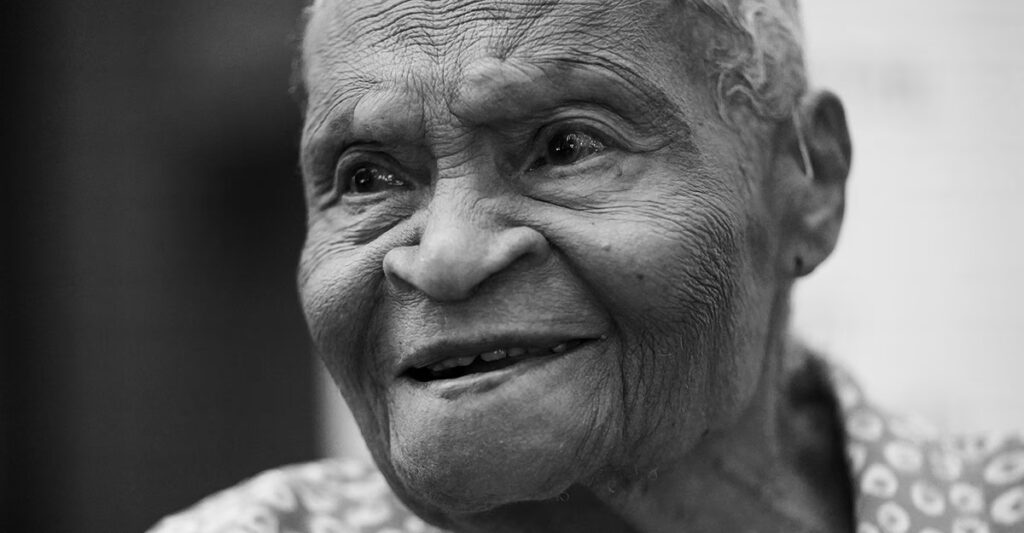
The problem was what happened before—and has happened since: running down the clock on justice. At the time of the centenary, there were three living survivors: Lessie Benningfield Randle, Hughes Van Ellis, and his sister, Viola Ford Fletcher. That year, they had shared eyewitness accounts of the massacre with Congress, articulating claims for justice and redress rooted in ongoing harm. The three didn’t appear before the House Judiciary Committee with the expectation that Congress would intervene. Today, Randle, who goes by “Mother Randle,” is still alive. But Van Ellis died two years ago and Fletcher, who went by “Mother Fletcher,” died in November. Congress never did get around to direct reparations, nor did any other government body—neither the city of Tulsa nor the state of Oklahoma, which the three had sued for compensation—and now it’s too late.
The massacre began at night on May 31, 1921. It would go on to claim some 300 people, leave some 10,000 homeless, and raze more than 1,000 residences and businesses. Telling her story to the congressional committee a century later, Fletcher spoke of the massacre in the present tense: “I still see Black men being shot, Black bodies lining the street. I still smell smoke and see fire. I still see Black businesses being burnt. I still hear airplanes flying overhead. I hear the screams. I live through the massacre every day. Our country may forget this history. I cannot. I will not.”
[Read: How the Tulsa Race Massacre caused decades of harm]
What the massacre destroyed, a century of disinvestment calcified. In Tulsa, dispossession unfolded not as a single event, but instead through the denial of insurance claims, the exclusion from public programs, the removal of homes through urban renewal, and decades of political pressure not to speak. Even a century later, Tulsa’s northern neighborhoods remained Blacker and poorer while the rest of Tulsa accumulated wealth. In parts of North Tulsa, home to Greenwood, the average life expectancy is approximately 10 years less than that of many parts of South Tulsa. And the data sour beyond these regional or neighborhood boundaries: Black infant mortality is three times greater than for white infants in Tulsa. Across Tulsa County, Black people, on average, live six fewer years and are twice as likely as their white peers to be unemployed.
Fletcher’s life would never be the same after the massacre. She told Congress that she lost the chance to study beyond the fourth grade. She spent most of her years as a domestic worker for white families, earning so little that even at 107, she told the committee, she could “barely afford everyday needs.” Her grandson said in a radio interview that for years, his grandmother would not let him utter the word “massacre.” According to him, Fletcher spent most of her life sleeping without lying down, fearing that she might, for some reason, need to make a quick escape. What many Americans saw as a historical event, she relived daily.
With Fletcher’s death, and the prospect of personal recompense answered, the question becomes what America will remember of that day. The country is well practiced in the art of forgetting. For much of my childhood, the massacre was not mentioned in my textbooks. I did not learn its scope in school. I learned about it only through references from elders and convoluted apologies by city leaders.
What I did not understand as a child is that this absence of public memory was not mere neglect. It was the profound callousness of a city ready to bury the past and then build on top of it. T. D. Evans, the mayor during the immediate aftermath of the massacre, instructed, “Let the negro settlement be placed farther to the north and east,” because displacement offered him the chance to potentially build a train depot and residential developments, as he hustled the city toward a future cleansed of the past.
But moving on from the past—without doing the hard work of repair—wasn’t just a matter of physical infrastructure. The legal system, too, played its part. In September 2020, Fletcher, Van Ellis, and Randle became plaintiffs in a civil case to redress the harms they had survived. By then, more than 100 Tulsa Race Massacre–related cases had already been dismissed on the reasoning that descendants didn’t have sufficient standing. To not repeat prior cases, the three pursued a public-nuisance claim, a legal strategy used to address ongoing harms that burden an entire community rather than a single past injury. The strategy—which Oklahoma had just tested in an opioid case, with early promising results—was designed not only to win damages but also to force the case into discovery, where the city’s role in allowing the violence would be made public. In their lawsuit, they claimed that the massacre could not be understood as an isolated incident but as one that kick-started ongoing suffering.
[Read: The neighborhood fighting not to be forgotten]
They still lost. The Tulsa County District Court dismissed the lawsuit in 2023, arguing that “simply being connected to a historical event does not provide a person with unlimited rights to seek compensation.” The survivors’ attorneys appealed to the state supreme court, hoping that the case might continue, only for the court to uphold the dismissal in June 2024.
As the legal process slowed, Fletcher’s persistence seemed to solidify. She intensified the pace at which she shared her story. She co-authored a book, Don’t Let Them Bury My Story, with her grandson Ike Howard, making her the oldest woman to publish a memoir. Fletcher and her brother Van Ellis obtained Ghanaian citizenship in 2023. Her story became not only a record of what she survived, but a call to others to take up the work that the courts said they could not.
Fletcher’s death shows us what’s at stake as 1921 recedes into historical memory. Without survivors to testify, the burden shifts to the rest of us to make the record whole and to insist that Tulsa’s story is not only an episode to be commemorated but a harm to be repaired. Randle, Ellis, and Fletcher received adulation for their courage to speak out about what they experienced. They became, late in life, the subject of national recognition, because that’s what America is good at—celebrating survivors of the harm the country allowed, not compensating for the misfortune it has caused. The best America could offer these three and the community they watched burn was an investment plan, funded by philanthropy, not policy. Tulsa Mayor Monroe Nichols proposed a $105 million private trust, called Road to Repair, aimed at ameliorating the long-term damage of the massacre through scholarships, housing, and general reinvestment in Tulsa’s Greenwood district. None of the victims or their descendants received any direct reparations from the city or state. But for now, Road to Repair is just a plan—not a repository of funds ready to be allocated—to raise $100 million from private donors. Perhaps that’s the best that Tulsa can do: rely on charity to deliver some semblance of justice when our governments abdicate that responsibility.
Fletcher’s witness was never and could never be only about what was done to her, or to her brother or to Randle. The survivors’ lives bore the undeniable impressions of a community’s injury. Waiting her out, or her brother before her, does not end the obligation to repair. Greenwood is still there, and it has never seen justice.
The post Running Down the Clock on Justice appeared first on The Atlantic.