In 1964, the Scottish psychiatrist R.D. Laing described an encounter with a girl in a mental hospital. She believed, he wrote, that “the atom bomb was inside her.” Laing couldn’t help comparing this delusion with the madness of the civilization that had created the bomb in the first place: “The statesmen of the world who boast and threaten that they have doomsday weapons,” he wrote, “are far more dangerous, and far more estranged from ‘reality’ than many of the people on whom the label ‘psychotic’ is affixed.” Taken literally, this notion was a bit ridiculous, but also hard to dismiss: Weren’t societies that secured stability through the doctrine of mutually assured destruction exhibiting some form of insanity?
That question, so pressing throughout the Cold War, was forgotten after the foundering of the Soviet Union in 1991. It’s not clear why, given that thousands of nuclear missiles remained on ready alert around the globe. The apocalyptic dread that had haunted TV, films and novels for decades quickly dissipated, even as civilization’s suicidal arrangement remained essentially unchanged. A little bad luck is still all that separates us from a thermonuclear exchange that extinguishes much of life on Earth.
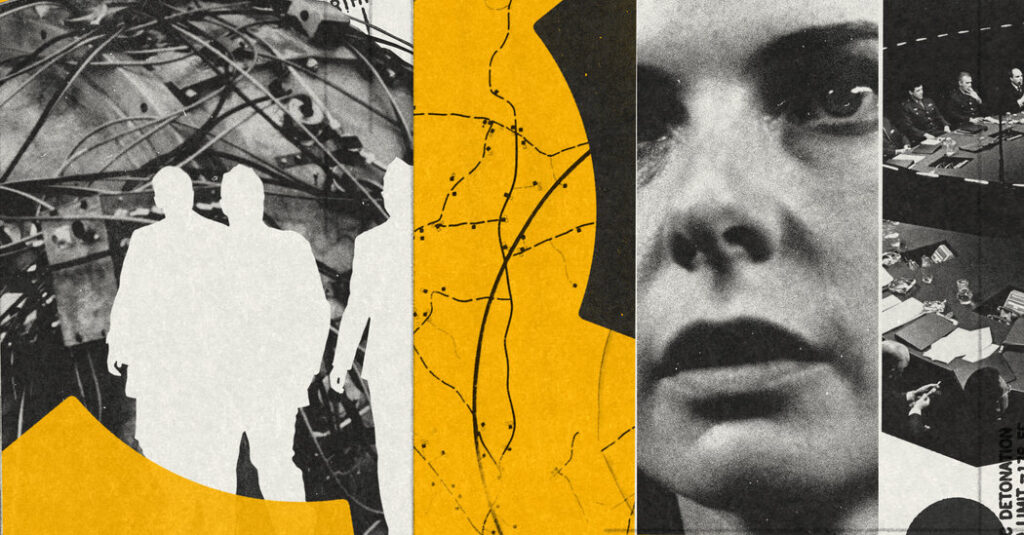
Judging by the receptions of a few recent films and streaming series, the American public is beginning to remember our situation. Christopher Nolan’s celebrated 2023 biopic “Oppenheimer,” Kathryn Bigelow’s “A House of Dynamite,” Apple TV’s postapocalyptic series “Silo” — all attest to the re-emergence of a preoccupation with nuclear war last seen in the cinema of the 1980s. These newer media can access a deeper historical perspective than old movies like “The Day After” or “Threads,” so we might expect them to find a modicum of hope in their re-examination of nuclear war. But I’m unhappy to report that the intervening decades have made our apocalyptic narratives only more fatalistic. Maybe this shouldn’t surprise us, since we are thousands of moves into a game that can be won, as 1983’s “WarGames” had it, only by refusing to play.
Nolan’s “Oppenheimer,” for instance, follows its title character through the quantum revolution in physics, the Manhattan Project and the aftermath of the bombings of Hiroshima and Nagasaki, before turning to his political failures in preventing the nuclear arms race between the United States and the Soviet Union. Yet by contrasting Oppenheimer’s rueful idealism against the careerism and pragmatism of his peers and political enemies, the film illustrates how the institutional behemoth assembled around the Manhattan Project justified the production of ever more cataclysmic devices.
The president cannot believe this binary quandary: ‘This is insanity, OK?’
Time and again, Nolan shows us government officials, military officers and scientists feeling as if their hands are being forced by the absolute stakes of nuclear war. Which nation would they wish to develop the atomic bomb first — the United States or Nazi Germany? Would they prefer the nuclear bombing of two Japanese cities (which killed about 200,000 people) or a bloodier ground invasion (which could have killed millions)? Would they want to live in a world where the Soviets possessed ICBMs and fusion bombs while the U.S. did not? As Oppenheimer says of the first dilemma: “We have no choice.”
This deprivation of moral agency underlies his premonition that the nuclear arms race will escalate until the “unthinkable” occurs. If we truly have no choice, then we are merely dominoes falling through history. Early in the film, Oppenheimer and Einstein worry that detonating an atomic bomb might start an atmospheric chain reaction that could destroy the world. “I believe we did,” Oppenheimer confesses at the film’s conclusion. He is not referring to an atmospheric event but to an unstoppable historic sequence that was already underway.
Bigelow’s “A House of Dynamite,” from last year, works perfectly as a dramatization of the hour in which this chain reaction goes supercritical. The film examines the U.S. government’s response to a plausible emergency — the detection of an ICBM crossing the Pacific — from a series of locations: the White House Situation Room; a U.S. Strategic Command outpost in Omaha; and Marine One, as it helicopters the president to an undisclosed location. The viewer witnesses what amounts to a governmental panic attack, intensifying as the ICBM is projected to detonate over Chicago. We see the wide white eyes of the characters as they reconsider the unthinkability of nuclear war.
Older films about nuclear war often likened their subject to a game. Bigelow and the screenwriter Noah Oppenheim are fascinated by how this metaphor has crept back into reality. The president is evacuated from a photo op where he was lecturing young basketball players about the affinities between sport and life. A secretary glances nervously at the “nuclear football” containing the president’s launch codes. The enormous global display at a Strategic Command Hub is named “The Big Board,” and an N.S.A. expert describes North Korea’s possible motivation for attacking by saying: “If you’re losing a board game, you might as well topple it.”
As they obey emergency procedures set in place decades ago, the characters of “Dynamite” do appear to be trapped within some calamitous game — one in which the president must choose between indiscriminate retaliation, described by a national security adviser as “suicide,” or a restraint that amounts to “surrender.” The president cannot believe this binary quandary: “This is insanity, OK?” The response he gets from a general (“No, sir, this is reality”) is not a correction; it’s a clarification. Yes, the situation is unquestionably insane, but decades of steely-eyed rationalization have made it inescapably real.
After a missile-defense system fails to neutralize the ICBM, a terrified soldier at Fort Greely in Alaska turns to his superior and says, “We did everything right.” His dismay comes from realizing that the rules of this game are not the laws of history. It’s too late for the characters of “Dynamite” or “Oppenheimer” to do anything but yearn for the moral considerations that might have allowed humanity to deter or abolish the weapons that doom it.
The characters in Graham Yost’s TV series “Silo” only ever glimpse that moral agency. An adaptation of Hugh Howey’s trilogy of novels, “Silo” depicts a small society living within a subterranean bunker after environmental catastrophe and explosions render the surface of the planet uninhabitable. The story follows an engineer, Juliette Nichols, as she learns that the remnants of human civilization have regressed into totalitarian rule. One of the show’s few intriguing suggestions arises in its second season, when we learn that a second silo (there are many) destroyed itself through a rebellion that is now repeating itself, almost event for event, in Nichols’s own. Yet again, we find that the ruin of a society is programmed into the way it maintains stability.
The 1980s experiment in educating the public about nuclear war through cinema failed. By the mid-90s, the dread that defined the Cold War had largely left the American mind. In the decades since, the iconography of nuclear war has been so thoroughly metabolized by our pop culture, from airport novels to video games, that a mushroom cloud, once a secular symbol of doom, seems familiar, almost kitschy. At the same time, Americans are encouraged to “catastrophize,” to borrow another psychological term, virtually every dilemma we perceive, rendering us incapable of discriminating between mountains and molehills, threats and illusions. I suspect that these cultural features will prove a challenge for our new cautionary tales about nuclear war: What good is raising an alarm when all the world’s sirens are already wailing?
Trevor Quirk is a writer living in Asheville, N.C. He last wrote for the magazine about the eye-opening ways that Hurricane Helene changed the flow of information through the western half of the state.
Source photographs for illustration above: Apple TV; Melinda Sue Gordon/Universal Pictures; Corbis/Getty Images; Everett Collection; Courtesy of the Mississippi Department of Archives and History.
The post Nuclear Anxiety, That Staple of 1980s Cinema, Is Back appeared first on New York Times.