On Saturday, the same day that federal agents shot and killed Alex Pretti on a Minneapolis street, the Justice Department sent a letter to Minnesota Governor Tim Walz. The letter did not have anything to say about the violence caused by the Department of Homeland Security’s presence in the state. Nor did it offer Minnesota any assistance in the investigation of Pretti’s death or that of Renee Good’s just over two weeks earlier. Instead, Attorney General Pam Bondi complained that Walz had “refused to support” DHS, insisted that the state cooperate more fully with ICE, and demanded that the governor hand over its voter rolls and records on Medicaid and food-stamp recipients. Walz had “better support President Trump,” Bondi declared on Fox News.
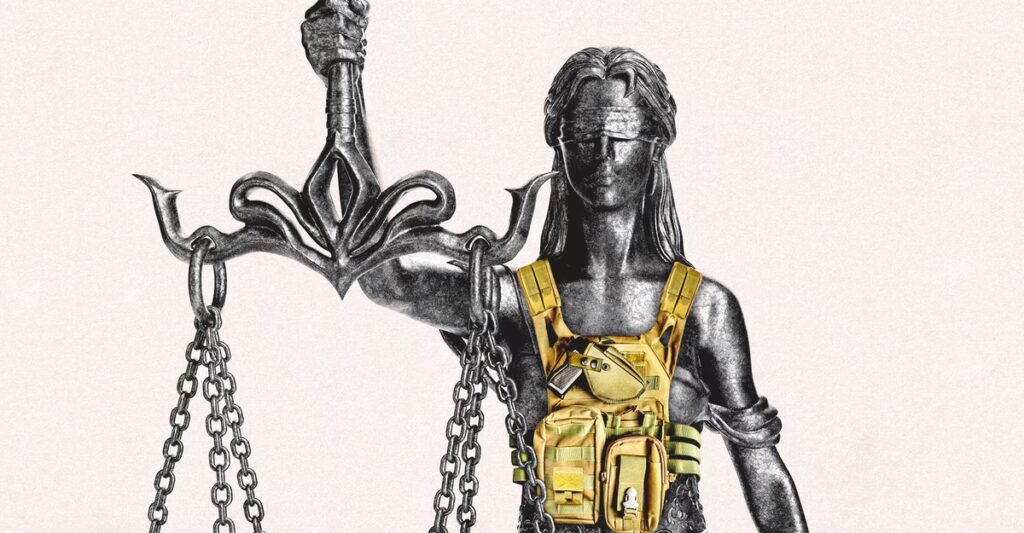
This abusive behavior by DHS has stood out in the chaos of Operation Metro Surge. But the Justice Department has done its part, too. It has shielded federal agents from accountability, launched needless criminal investigations into Minnesota officials and residents, and pumped out propaganda to aid the far-right press in justifying ICE’s tactics. The president has always treated DOJ like his own personal law firm. Now the department is acting like DHS’s law firm as well.
DOJ first undertook the role of ICE defender in Minneapolis in the days after Good’s death, on January 7. Video captured by the phones of both bystanders and the ICE agent Jonathan Ross showed Ross firing into Good’s car repeatedly, killing her and sending her car barreling down the icy street. In prior administrations, a death at the hands of a federal officer would have been cause for the Justice Department to begin a probe into potential wrongdoing by law enforcement. But this time, Deputy Attorney General Todd Blanche announced, “There is currently no basis for a criminal civil rights investigation.” Though federal and local investigators typically collaborate in the aftermath of shootings by law enforcement, the FBI blocked state and local governments from accessing evidence. When a journalist asked Trump about this development, he explained that Minnesota officials should not be allowed to look at evidence, because they are “crooked.”
[Adam Serwer: Minnesota proved MAGA wrong]
Most galling, instead of probing Ross’s actions, the Justice Department decided to investigate the woman he killed. According to MS NOW, FBI agents in Minnesota drafted a search warrant for Good’s car to examine the path of the bullets fired by Ross, intending to carry out a civil-rights probe. But Blanche’s office demanded that they alter the warrant for use in an investigation of whether Good had assaulted Ross. (A magistrate judge denied the request on the grounds that Good was dead.) The New York Times reported that DOJ also considered launching a criminal probe into Good’s widow, Becca Good, who was with Renee that morning. Six prosecutors in the U.S. Attorney’s Office for the District of Minnesota resigned in protest of the department’s handling of the case, along with an FBI agent who’d sought to open a civil-rights investigation but was rebuffed. Several attorneys in the Justice Department’s Civil Rights Division have since resigned as well.
After Blanche accused Walz and Minneapolis Mayor Jacob Frey of “encouraging violence against law enforcement,” DOJ sent out subpoenas to Walz, Frey, the mayor of St. Paul, the Minnesota attorney general, and the chief local prosecutor in Minneapolis as part of an ill-defined criminal investigation that seems chiefly designed to intimidate. This use of the Justice Department for political strong-arming has been unheard of since Watergate.
The department has also busied itself in Minneapolis with prosecuting residents opposed to what federal officials are doing in their city and immigrants trying to flee their pursuers, a tactic seen in other cities targeted for immigration enforcement. In Minnesota, DOJ has apparently run into a small challenge: Because so many attorneys there resigned over the handling of the Good case, the Justice Department has had to ask prosecutors from elsewhere in the Midwest to travel to the state to help out. Some of the cases filed so far do seem to describe potential assaults on officers, such as a pair of incidents in which two women are alleged to have bitten the fingers of the Border Patrol agents who were restraining them. Still, the Justice Department’s choice to focus on charging protesters, while enabling the violence by law enforcement that may have provoked them, is a telling indicator of its priorities.
Among the prosecutions of protesters, perhaps the strangest story involves a desperate quest by DOJ to bring criminal charges against the former CNN news personality Don Lemon. On January 18, Lemon documented a demonstration at a Southern Baptist church in St. Paul by a group of activists, who accused a church pastor of also serving as the acting director of the local ICE field office. Just days later, federal law enforcement arrested three of the lead protesters. But prosecutors were unable to convince a magistrate judge to let them charge Lemon along with the other protesters. Instead of taking the hint and giving up, however, the Justice Department repeatedly tried—and failed—to bully judges into allowing them to bring the case. On Monday, the department indicated that it had dropped its effort to force the court to reconsider, but Lemon may not be in the clear. “We’re going to pursue this to the ends of the earth,” promised the Civil Rights Division leader Harmeet Dhillon.
DOJ’s obsession with pursuing charges over a single protest might seem puzzling, especially because this protest did not obviously break any laws or move beyond the bounds of protected speech under the First Amendment. As with the finger-biting cases, which featured prominently on Fox News, directing prosecutorial resources toward protesters who disrupted a church service helped amplify the administration’s portrayal of Minneapolis as a battle between godly crusaders for justice and pathetic yet demonic leftist agitators. The White House published a digitally altered photo of one of the defendants, Nekima Levy Armstrong, that both changed her stoic expression to a tearful one and darkened her skin. (Levy Armstrong is Black.)
This was the context in which Bondi sent her bullying letter to Walz on Saturday. “Accountability is coming.  ,” she posted on X alongside a clip of her brandishing the letter on Fox News. Her post included no mention of Alex Pretti, who had died that morning.
[George Packer: What should Americans do now?]
After Pretti’s death, the Justice Department once again helped block off the scene from state and local investigators. This time, though, Minnesota and Hennepin County sued, and succeeded in convincing a judge to rapidly issue a temporary restraining order barring the federal government from “destroying or altering evidence.” The judge—Eric Tostrud, a Trump appointee—convened another hearing on the matter on Monday, the same day that another Minnesota federal judge questioned a DOJ lawyer over Bondi’s letter during a hearing in a separate case. The state had pointed to the letter as evidence of the federal government’s effort to bully Minnesota into carrying out Trump’s will. At one point, Judge Katherine Menendez asked, “Is the executive trying to enforce a goal through force that it cannot enforce through the courts?”
Menendez has yet to rule. On Monday evening, Bondi celebrated on X that DOJ had successfully convinced the U.S. Court of Appeals for the Eighth Circuit to pause a district court’s order barring federal agents in Minneapolis from harassing protestors. Still, the ground has shifted under the Justice Department’s feet in the days since Pretti’s death. Greg Bovino, the preening Border Patrol chief who wandered around Minneapolis posing for photos and lobbing tear gas at protesters, left the city on Tuesday, seemingly pushed out by the administration. With public anger mounting toward the White House’s deportation campaign, it’s not clear whether DOJ will continue its aggressive approach or back down.
Whatever DOJ chooses, though, any chance of it conducting independent investigations into the killings of Good and Pretti seems to have vanished. In response to the events in Minnesota, Democratic members of Congress have called for the resignation of Homeland Security Secretary Kristi Noem and the public’s disapproval of ICE has surged. Any real reckoning must address the rot at the heart of the Department of Homeland Security. But it will have to address the rot in the Department of Justice, too.
The post ICE’s Number One Ally appeared first on The Atlantic.