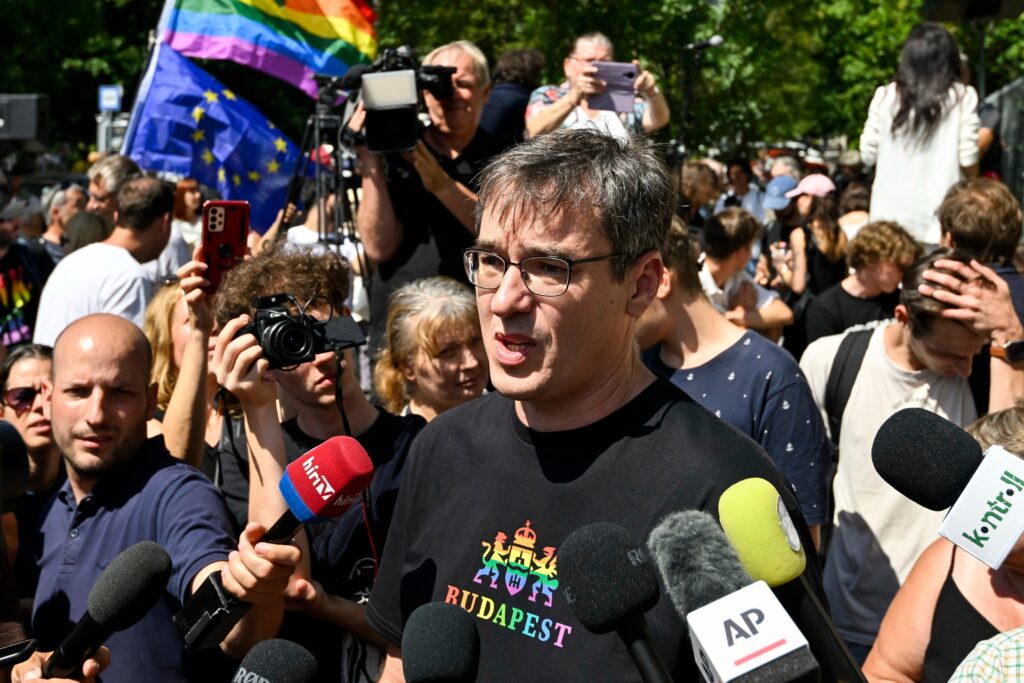
Hungarian prosecutors on Wednesday leveled charges against Budapest Mayor Gergely Karácsony for permitting an LGBTQ+ pride march to go ahead last year despite a ban imposed by Prime Minister Viktor Orban.
The legal action comes seven months after a historically large crowd defied Orban and turned the event in a mass rebuke of the authoritarian regime.
District prosecutors said they were asking a court to impose a fine against Karácsony for granting a municipal parade permit despite the ban. The standoff between Orban’s government and the mayor — a Green party politician and leading voice of the opposition — highlights widening political and cultural fault lines just months before national elections in April.
“It seems that this is the price to be paid in this country if we stand up for our own freedom and that of others,” Karácsony said in a statement posted Wednesday on his official Facebook page.
Orban, a self-described “illiberal” Christian conservative, is a fan of President Donald Trump and launched a crackdown on gay expression as part of a broader escalation against opposition politicians, journalists and judges. Orban described it as a “spring cleaning” that he credited to Trump’s return to power.
Over the objections of the European Union, of which Hungary is a member, Orban’s allies in parliament amended a statute barring the “promotion” of homosexuality to include the Pride parade, a yearly event in Budapest, the Hungarian capital, since 1995.
Hungarian police were given authority to block such gatherings and empowered to use facial recognition technology to identify and penalize participants.
Orban’s government defended the measures as necessary to protect children’s “physical, moral and psychological development,” arguing that the visibility of LGBTQ+ identities to minors contradicts traditional family values. Critics at home and abroad described the efforts as a thinly veiled repression of civil liberties and a broader assault on democratic norms.
Karácsony sidestepped the ban by declaring the Pride march to be a municipal event not needing police approval. Planners proceeded despite official threats to prosecute organizers and fine participants.
Police lined the route with officers and set up banks of cameras at key intersections. The one permit national authorities granted that day was for conservative groups to stage a counterprotest along the route.
In the end, the Pride parade was the biggest in the city’s history and widely seen as an expression of ire against Orban’s authoritarian tactics. Participants carried rainbow flags, signs mocking the prime minister and messages demanding greater freedoms and dignity.
Politicians across Europe, including members of the European Parliament, joined the march in solidarity with Hungary’s LGBTQ+ community and civil society. Police largely stood down, at one point diverting the sea of demonstrators to prevent a collision with counterprotesters.
Hungarian authorities declined to detain or arrest any participants at the event, even after many gathered to mockingly mug for the facial recognition cameras. Police said weeks later that they had no plans to pursue ordinary marchers, easing fears of an after-the-fact crackdown.
But authorities subsequently opened an investigation into organizers, including Karácsony. He was questioned by the National Bureau of Investigation in August and has insisted his actions were lawful and consistent with Budapest’s charter.
Wednesday’s charges against the mayor come as Orban, nearly 16 years into his second stint as prime minister, faces a serious challenge in the April general election.
Orban’s governing Fidesz party, long dominant in Hungarian politics, now faces its most formidable opposition in years from the Tisza party, a center-right coalition led by former Fidesz insider Péter Magyar.
According to recent polling, Tisza holds a nine to 12 point lead over Fidesz among decided voters.
Political analysts said charging Karácsony now — after months in which prosecutors initially signaled charges were unlikely — may be a calculated effort by Orban’s camp to appeal to the prime minister’s conservative base.
Targeting Pride and LGBTQ+ issues has been a consistent theme of Orban’s appeals to rural and socially conservative voters. By contrast, the mass turnout in Budapest and other urban centers has energized opposition movements and highlighted divisions between urban liberal voters and rural constituencies.
Hungary’s political dynamic mirrors the United States.
Orban has aligned himself closely with Trump’s brand of populist conservatism and is a MAGA darling. Budapest will host a major Conservative Political Action Conference (CPAC) gathering in March, just weeks before the election. The European CPAC event has drawn major American conservative luminaries in the past, including video appearances by Trump. Organizers have not ruled out a personal appearance by Trump or Vice President JD Vance this year.
The post Hungary announces charges against Budapest mayor over Pride events appeared first on Washington Post.