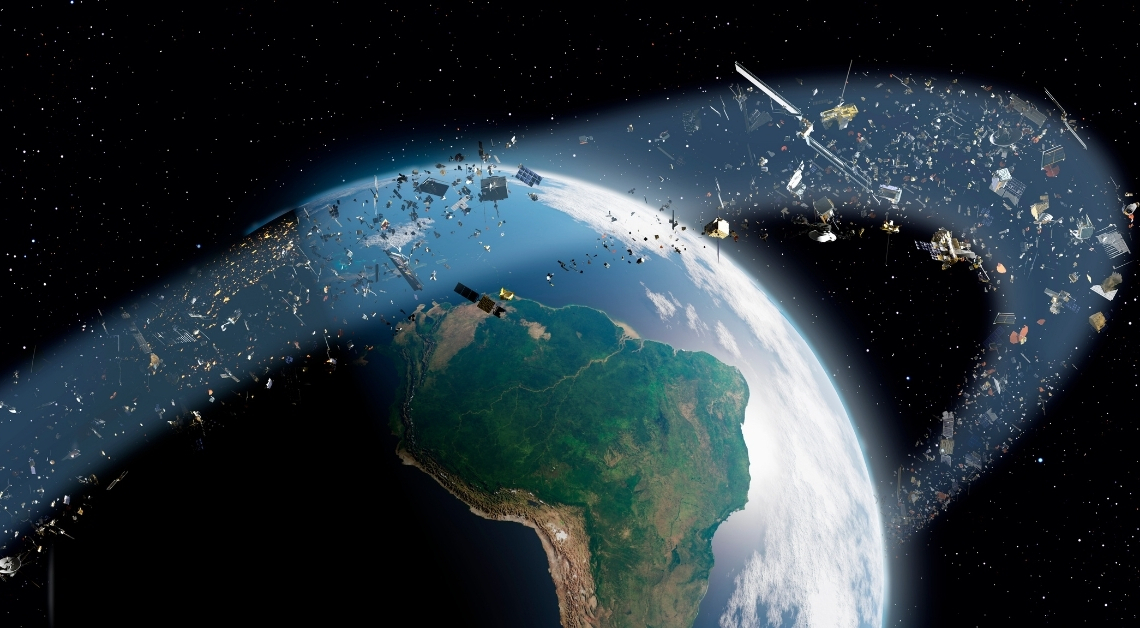
Our atmosphere is loaded with space junk. And every once in a while, it comes plummeting down to Earth in a rain of fire.
Tracking it used to be nearly impossible. All scientists could do was keep an eye on it and provide a rough estimate of where it might land. Now, a team of researchers might figure out a way to watch it more closely, by not watching it at all—but by listening to space debris slam into the atmosphere using the same instruments we use to study earthquakes.
In a new study published in Science, planetary scientist Benjamin Fernando and engineer Constantinos Charalambous showed that seismic sensors can detect the sonic booms produced when space junk reenters Earth’s atmosphere at extreme speeds. Sonic booms are extremely loud, very not subtle shockwaves, technically referred to as Mach cones, that ripple through the air and hit the ground hard enough for seismometers to notice them.
Scientists Are Using Earthquake Sensors to Detect Space Junk Falling Back to Earth
The team tested their idea on the April 2024 reentry of China’s Shenzhou-15 orbital module, which came down over Southern California. Using data from public seismic networks in California and Nevada, they reconstructed the object’s final moments in detail, gathering info on its speed (around Mach 25 to 30), altitude range, descent angle, and when it broke apart midair.
Early in the fall, the sensors detected a large boom. Later, that signal splintered into a series of smaller ones, perfectly aligning with eyewitness reports of the module’s fragmentation as it broke apart in the atmosphere.
Advancements like this will become increasingly necessary as governments and corporations continue to launch dozens of satellites into Earth’s atmosphere every year, only adding to a problem that is already out of control. Most of it burns up harmlessly, but not all of it does. Some objects that plummeted from orbit were big enough to threaten planes midflight while others dropped massive chunks of metal onto Kenyan villages.
Eventually, we’re going to have to figure out how to stop uncontrolled reentries. Repurposing existing seismic networks could be one of many tools to track it in the meantime.
The post How Scientists Use Earthquake Sensors to Track Space Junk Crashing to Earth appeared first on VICE.