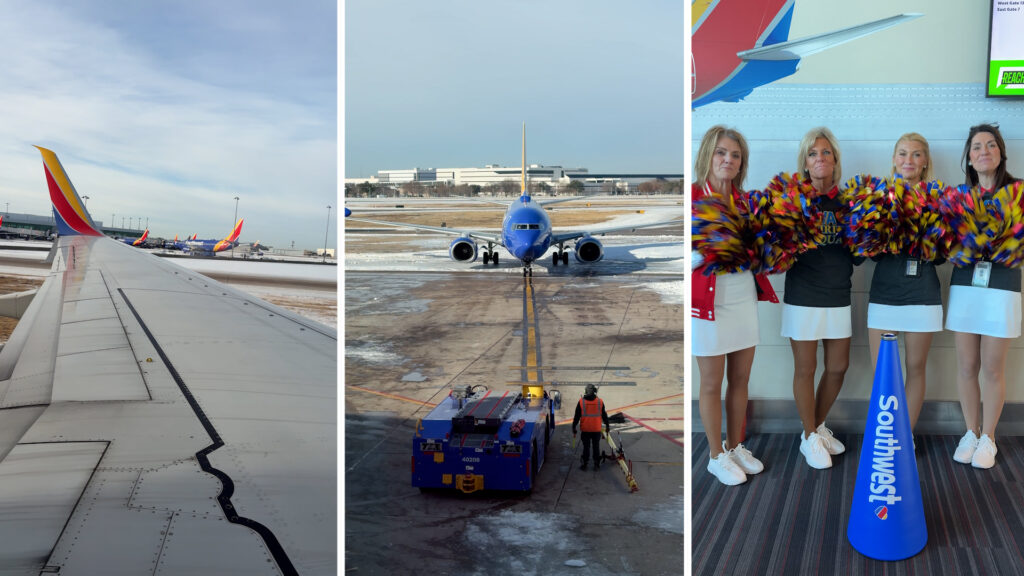
DALLAS — In gleaming white skirts and sneakers, a group of off-duty Southwest Airlines flight attendants lined up near a boarding gate at Dallas Love Field — not with roller bags, but pompoms. They had gathered Tuesday to celebrate a milestone in company history.
“Assigned seats! What a treat! Southwest spirit can’t be beat!” the cheerleaders beamed.
As they repeated their message, a gate agent performed a chant of his own.
“Group seven! Group seven!”
It was the first day that Southwest assigned seats, ending a more than 50-year policy that allowed passengers to pick their seat as they boarded.
Instead of lining up in the old assigned boarding positions, passengers were called in eight numbered groups, plus some VIPs, ranging in hierarchy from A-List Preferred to Basic fares. Tuesday also marked the launch of different fare bundles and seat types, including “Extra Legroom,” “Preferred” and “Standard.”
The change from open seating, which has been years in the making, quickly drew strong reactions.
“I got on the plane this morning, I was so frustrated,” longtime Southwest customer Alec Robinson said.
Preboarding passengers on his flight filled up the overhead bins at the front of the plane, not near their seats, causing a slowdown as later groups hunted for space.
“I was like, ‘I’m never flying Southwest again,’ and I’ve got three more flights,” said Robinson, who is based in Denver.
But a few gates over, Mari Ortiz said she was glad to see open seating go.
“Especially if you travel with older people and kids, it was ridiculous,” said Ortiz, who lives in San Juan, Puerto Rico.
She recalled a Southwest flight to Orlando when she was traveling as a group of three moms and a dozen kids. Some passengers wouldn’t move to make room for the parents to sit with the children.
“It was stupid not being able to sit with your family and having kids everywhere,” she said. “It was a mess.”
Whether travelers see it as another example of Southwest selling out, or an overdue fix, it’s indisputably the end of an era.
Full rows on a mostly empty flight
Some airports have already removed the signature boarding position columns that used to be bolted into the ground at Southwest gates.
But at Reagan National Airport, the columns still stood like a Southwest Stonehenge. Their former markings, from the premiere A1-A15 to the dregs of C50-C61, were now blank.
To see the new seating model first hand, I grabbed the first flight of the day from Washington to Dallas on Tuesday morning. As passengers struggled to keep their eyes open before dawn, airline staff were chipper.
“Yay, our first day of assigned seating!” a gate agent said over a loudspeaker in National’s Terminal 1.
Over the loudspeaker, airline staff asked travelers not to gather at the gate until their boarding group was called, and that priority boarding was available for purchase through an agent or the Southwest app.
The process began on time at 5:30 a.m., starting with preboarding for customers with disabilities and families with children under 2. Active-duty members of the U.S. military were invited to board next in the “Priority Boarding Group,” which included people who paid for early boarding. Then came the eight groups that depend on fare type and loyalty status.
I had not bought a premium fare and do not have a Southwest credit card, but I was still called with Group 4. Maybe because I’ve been a Rapid Rewards member for years, but I couldn’t say for sure.
To avoid extra fees, I did not select a seat when I bought my ticket. When it was time to check in online, I could move seats for free. It looked like I had my own row, so I kept my automatic assignment.
But shortly after I buckled into 17A, my row filled up. So did the row across the aisle. We craned our necks to survey the plane; it was mostly empty.
The flight attendant tried to move us using the new computer system before takeoff, but the program was glitching. I wasn’t showing up in the system at all, and the other seats were incorrectly marked full.
“Once I figure out how to work it, I will move you guys,” the flight attendant said, apologizing. “It’s not working how it’s supposed to.”
It took 20 minutes of tinkering with the new software, but the flight attendant was able to spread us throughout the cabin — according to our fare. There were no free upgrades to the mostly-empty More Legroom seats. I got my own row after all.
My flight home to D.C. felt more typical. The plane was packed to the gills, complete with crying babies and fussy passengers.
“Boarding took, like, 45 minutes,” my row neighbor lamented.
“Gonna be a long flight,” another replied.
If boarding was delayed because of assigned seating, I didn’t mind. If it hadn’t been for my designated window seat, I probably would have been doomed to a middle seat because of my middling status.
Race to check in first ‘was a cult’
Southwest first announced its assigned seating intentions in 2024.
In an earnings call that year, CEO Robert E. Jordan said company research showed 80 percent of customers, and 86 percent of potential customers, preferred assigned seats over their open model.
“Further, when a customer defects from Southwest to one of our competitors, our open seating policy is cited as the number one reason why,” Jordan continued.
To Mike Boyd, aviation consultant and president of Boyd Group International, Southwest’s open seating made more sense in the early days of the airline when flights were short and rarely full.
“When you’re getting on an airplane flying from Dallas to Lubbock, that’s one thing,” Boyd said. “But now that they’re offering long haul flights like Hawaii, I don’t want to potluck my seat if I’m going all the way to Honolulu.”
Also unlike the early days of the airline — which took its first flight in 1971 from Dallas Love Field — a large number of Southwest customers now travel with connecting flights. Boyd said oftentimes, this does not bode well for your seating prospects.
“When you get to Chicago Midway, and it’s a 45-minute connection, you’re sitting in the middle seat going to L.A.,” he said.
But open seating persisted, and it had fans and critics. Some people complained passengers abused the system, holding seats for phantom travel companions, and enabled the “jetway Jesus” grift in which some travelers allegedly fake wheelchair requirements to get priority boarding.
Others improved their chances of getting a good spot through the frequent-flier program, or gaming Southwest’s unique boarding process.
“It was a cult,” Boyd said. “At midnight before the day of your flight, everybody’s online trying to get a higher boarding number … that’s over with now.”
Jordan, the Southwest CEO, has said that offering premium seating options was a significant opportunity “to monetize the cabin more effectively.”
Last year, the airline also started charging bag fees, got rid of a refund system that accommodated plus-size passengers and tightened its flexible flight change policy.
The latter went into effect last year, “and I still don’t really understand it,” Jessica Ray, who’s been a Southwest customer since childhood, said in a phone interview. “It’s confusing and it’s very clearly like them trying to entice you to buy a higher fare for more money, of course — which is what every other airline does.”
Robert Mann, president of aviation consulting firm R.W. Mann & Co., said it’s industry standard for airlines to “rely on a lot of different revenue sources,” from branded credit cards to charging for ancillary services such as seat selection. The changes at Southwest “just makes them more like the other guys,” he said.
While the new fees and belt-tightening may turn off longtime loyalists like Ray, Mann said it’s a necessary evolution.
Now that they’re competing with other legacy airlines, “the generation in which Southwest was quirky, different and low-cost is long ago,” he said.
Still, Mann said the airline’s continued success will ultimately come down to one factor.
“Do you run the airline reliably?” he said. “Because that’s what causes the customers to come back or not.”
The post Flying with Southwest on the first day of assigned seats appeared first on Washington Post.