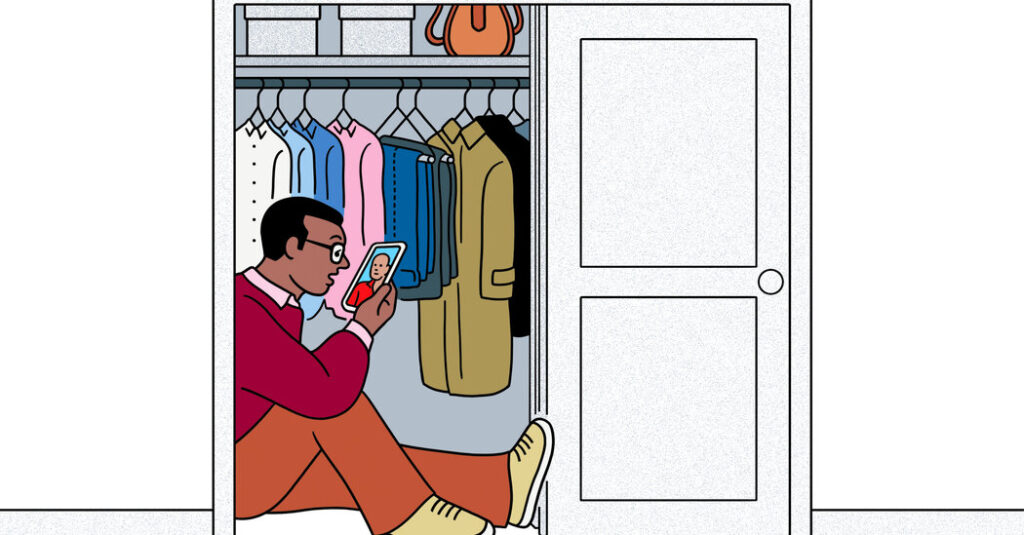
I am part of a faith community that does not affirm same-sex relationships, and I plan to continue following that teaching even though I am bisexual. I do not know many others in the same situation.
A few years ago, while exploring my sexuality online, I came across a man from the same faith community on a dating app. I am not sure if he noticed me, and I quickly blocked him. He is now engaged to a woman.
I have thought about reaching out, but I am unsure how to do so without making it feel intrusive. At the same time, it would mean a lot to have someone I could relate to in this area (and possibly he might feel the same). Would it be appropriate to make contact, or would that cross a line? — Name Withheld
From the Ethicist:
My sense is that the implicit norms associated with such apps do not amount to “contact me whenever and wherever you wish.” Probably they tilt toward “don’t act like you know me if you see me at Costco.” There’s a difference between facilitating intimacy and conferring acquaintance. If you tell this person you recognize him from the app, however benign your intentions, he may feel exposed, vulnerable and dependent on your discretion. In a community that frowns on same-sex relationships, you would have it in your power to out them, even if doing so would require outing yourself too. That could make him uneasy.
You should also ask yourself why you want to be in touch. Given that the other person is engaged, he is most likely committed, as you are, to abstaining from same-sex relationships. So think about what, exactly, you’re hoping to discuss and hoping to gain. The adults in your community are already familiar with the problem of sexual attraction to people with whom sex would be impermissible — for example, because they’re married to someone else. You don’t need a bisexual interlocutor to discuss forbidden desires, then, and discussing erotic temptation is not necessarily a good way of managing it.
Another possibility, of course, is that you’re looking for someone who understands what it’s like to keep an aspect of yourself hidden in a community you value. In that case, it’s probably better if others have explicitly consented to be in the conversation, as with online groups where people opt in to discuss these tensions. Or perhaps you’re simply seeking relief from whatever loneliness or strain you may be experiencing. If so, that need might be better met by conversations with a trusted friend or a therapist rather than through contact that risks creating new entanglements. And if what you want from this interlocutor is an affirmation of your identity as a bisexual? I’d simply note that all of us have many identities that we could make something of but choose not to. If I were a bisexual member of a community that disapproved of same-sex sexual relations and I accepted that disapproval, I would hesitate to affirm a bisexual identity.
Still, there is another way a conversation with this person might go. It might lead you both to discuss whether your community is right not to affirm same-sex relationships and whether you are right to adhere to that teaching. Even if your only aim is connection, you could be creating conditions under which doubt, temptation or defection reasonably arise. Whatever you decide to do, you should be mindful of this possibility.
A Bonus Question
A neighbor of mine has been collecting state disability benefits since the summer for a non-work-related injury. Six months later, he is still not working. I know the nature of the injury, and the only “treatment” prescribed is rest. Surgery is not needed. His family openly jokes that this period is a “paid vacation,” and he seems unrestricted in his activities. I have personally witnessed him playing sports, and his family has mentioned multiple golfing trips. His job is physical but not particularly strenuous.
Because I — and many other people in my state — pay into the disability fund that supports benefits like these, I’m wrestling with whether I have an ethical obligation to report what seems like misuse of a public benefit. On the other hand, I’m aware that medical situations can be more complicated than they appear from the outside, and I don’t want to be intrusive or unfair.
Am I ethically obligated to report this, or should I simply mind my own business? — Name Withheld
From the Ethicist:
I agree that we’re collectively worse off when our fellow citizens abuse entitlement systems that we all help pay for. But you don’t know enough to be sure that this person is abusing the system. What you’ve seen and heard establishes only that they can do some things some of the time.
It also matters that you’re not just a fellow citizen; you’re a neighbor. You know about his situation because this family has shared it with you. The norm of not snitching on your neighbors is worth something: It preserves some measure of the trust that makes our ordinary residential existence livable. There would need to be a strong argument for breaching that norm, and here the stakes for you are quite limited. Your moral distaste for what you imagine is happening isn’t sufficient.
“Mind your own business” can sound like the counsel of cowardice. But when you don’t have all the facts, and the facts you have been given were supplied in a neighborly spirit, there’s serious reason to pause before volunteering as an informal government enforcement officer. What you are free to do is to tell him that you’re worried that he’s abusing a system you help support. Of course, you may not want to pay the social costs of doing so.
Readers Respond
The previous question was from a reader who had given his wife permission to have an affair, and wondered whether he was obligated to console her now that the relationship had ended. He wrote:
I have been married for many years, and I still love and care deeply about my partner. Over the past year, she had an affair, and I knew about it from the beginning. She said that she needed it, that it gave her vitality, that she enjoyed a sexual freedom she had longed for and that she felt it was wrong to do this in secret and without my consent. I agreed; what she said made sense to me, and she convincingly assured me this was no threat to our relationship. At the same time, I always suffered when she was away with her affair partner and could not find a way to take this easily. She recently decided to break it off because the overall emotional burden for both of us was too great. But while she is grieving about it, I feel relieved. … My question is: Should I feel sorry for my wife? — Name Withheld
In his response, the Ethicist noted:
We don’t have voluntary control over our emotional responses, at least not in any straightforward way. You’re glad; she’s sad. And neither of you can simply choose to feel otherwise. … But while your sense of relief is unsurprising — and while you can’t simply resolve to feel otherwise — maybe you could help her deal with her loss out of gratitude for her belated acknowledgment of your needs? Solace is one of the gifts of marital love. And consoling someone you love when they’re in pain doesn’t require that you share that pain. Still, these distinctions may be elusive in practice. And so it may be worth your both talking this all through with a counselor. Neither of you will ever be able to adjust your feelings on demand, but it could help to give them somewhere to go, in a way that helps you stay connected.
(Reread the full question and answer here.)
⬥
As two people who have been married and nonmonogamous for nearly 20 years, we empathize with the letter writer’s emotions; nursing a partner through a situation like this is an enduring challenge of nonmonogamy. However, we’re perplexed by his apparent lack of curiosity on the topic of his own emotions, and by his framing of consolation as a “job.” Most partnerships include emotional labor that one partner doesn’t enjoy for its own sake but recognizes as something the other partner can reasonably expect. We would encourage the letter writer to be open and generous with his comfort, knowing that the ways in which he shows up (or fails to show up) in this moment will become part of the permanent emotional record of his marriage. — Megan & Paul
⬥
You are hurting because your wife broke the boundaries that were naturally constructed when you married. You both vowed to honor them; she did not. Even worse, she tried to justify it. Telling you about needing an affair wasn’t a sacrifice on her part, it was an attempt to justify something she knew, on some level, was wrong. She is blessed to have such an understanding spouse as you, and that should be comfort enough. — Teresa
⬥
Amid the sorrow and disconnect here, the letter writer and his wife also have much to celebrate and congratulate themselves on achieving. A wife felt the need for an outside relationship, and she didn’t lie or obfuscate: She told her husband and they came to an amicable, if difficult, understanding. When she saw it impacting their marriage, she reluctantly ended it. These are two people who care deeply about each other and understand that they can’t be everything to each other. But what they are is more important than any other relationship in their lives. They may have had to suffer to come to this realization, but surely it will be a comfort to each of them to know they can trust and rely on the other when needed. — Laurence
⬥
This experiment would be deeply challenging for most couples, and the one thing that is paramount is that they start talking honestly with each other. I’m sure it took great courage for the letter writer’s wife to ask what she did, but he needs to be upfront about what it cost him and how he feels now. At a deeper level, his wife needs to start looking at what is happening inside her that she felt a need for this. What is she not getting in her marriage, and why? I was once in her shoes and did the same thing. For me, it was because my marriage had ossified my growth; our relationship had frozen us somehow. Are these two stuck as well? This has nothing to do with how much you love each other; sometimes people just need space to complete a development phase. Although my marriage ended, five years later we got back together, this time as very different people. — Nathaniel
⬥
If the letter writer’s wife is grieving the affair, it seems that the feelings that led her to begin it are not satisfied and probably will not be now that she has returned to the marriage. So the question may be: Can you live with this arrangement again? It may be better to let her go, until she has satisfied whatever she is looking for. And then, if she wants to start again, that is for both of you to decide. Splitting up is painful, but night after night with her being with her lover might also be impossible to endure. — James
The post Can I Tell a Member of My Church That I Recognize Him from a Dating App? appeared first on New York Times.