It was the luckiest smoke break of Oleksandr Pysmenny’s life.
On Tuesday, as the train he was riding on traveled through the Kharkiv region of eastern Ukraine, Mr. Pysmenny, 27, got out of the bed in his compartment and went to a corridor for a cigarette. He then heard the sound of a diving Russian drone, followed by an explosion.
It had hit his carriage. The doors back to it were blocked. He climbed outside, ran around the burning car and climbed back in to try to help his friends. He picked up the bloodied wife of one of his friends and carried her away from the train.
“A Russian drone can kill you faster than smoking,” Mr. Pysmenny’s wife, Maria Shtern, 25, wrote on social media. She was not on the train that was attacked.
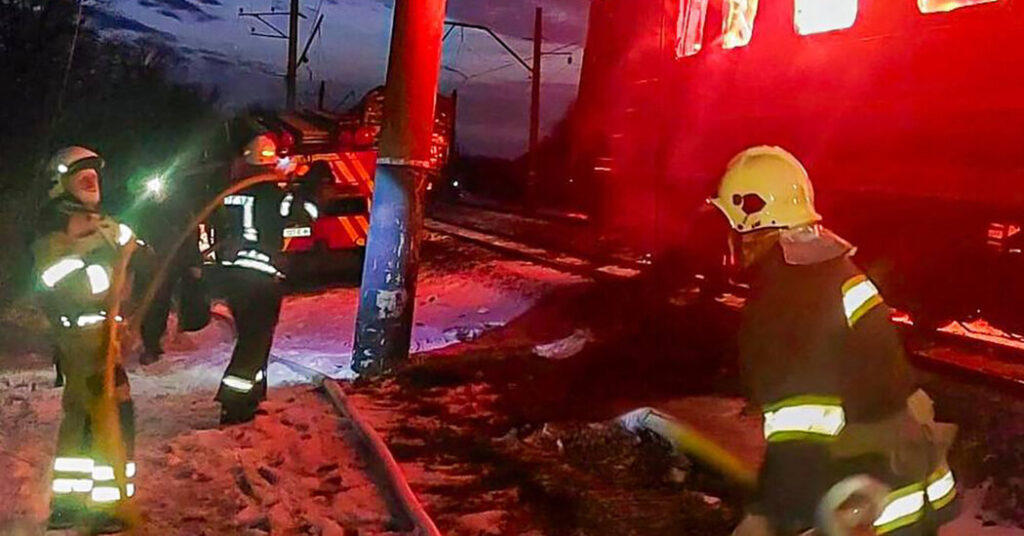
The Ukrainian Railways train, which was carrying more than 200 passengers, was attacked by three drones. Five people were killed in the strike, the latest in Russia’s monthslong campaign against the Ukrainian rail infrastructure.
After the attack, the burning carriages were disconnected and the remaining 10 cars continued the journey. The train, with 147 passengers still on board, arrived at the next station after a five-hour delay. There, passengers were provided with food by World Central Kitchen.
Of the three drones, one struck a carriage with 18 people on board, and the other two landed nearby.
“Russia must be held accountable for what it does,” President Volodymyr Zelensky said in his evening address to the Ukrainian people. “And this means responsibility not only for strikes against our people, against our lives, but for the very ability to carry out such strikes.”
Trains have been a critical part of Ukraine’s logistics during the war. They are used to evacuate civilians from frontline areas. With the country’s airports closed, they connect Ukrainians to Europe. They also deliver goods as Russian strikes close maritime routes in the Black Sea.
In recent months, Russia has intensified its attacks on Ukraine’s rail infrastructure. In December, a strike hit a key junction station in Fastiv, in the Kyiv region, that connects the capital with western Ukraine and Europe. Train stations in Sumy, Kharkiv and Kherson have also been hit.
After the attack on the train on Tuesday, Ms. Shtern said that Mr. Pysmenny, a police officer who also does tasks on the front line, had helped get his colleagues out of the burning train. They were in stable condition in a hospital, she added. Mr. Pysmenny did not feel well after the strike and went to a hospital for a checkup, though he was not injured in the attack.
“He was so lucky,” Ms. Shtern said.
Mr. Pysmenny recalled carrying his friend’s wife away from the train. “I saw my friend’s wife walking toward me; she was covered in blood,” he said. As they hid under trees, they heard another drone flying over their heads.
Maria Varenikova covers Ukraine and its war with Russia.
The post After Russian Strike Kills Five, Train Sheds Burned Cars and Carries On appeared first on New York Times.