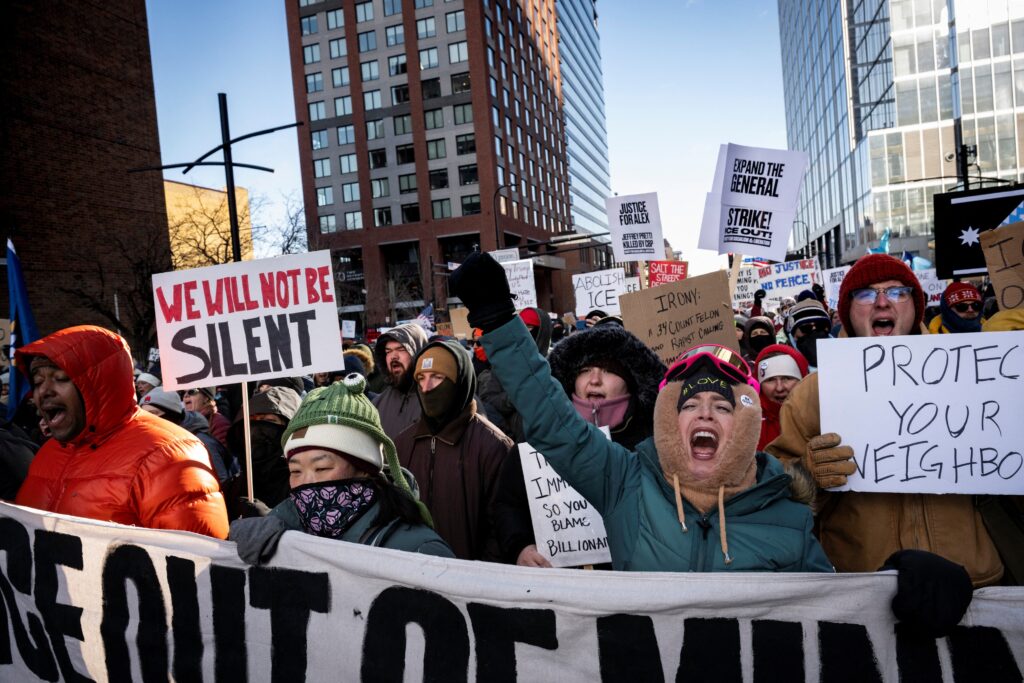
A thoughtful high school student in Texas reached out to me last Friday with questions about the country and the precarious state it’s in — questions many adults are quietly asking themselves, too. The week’s headlines had been dominated by stories of instability: a renewed threat to seize Greenland and, at home, talk of sending the military into Minneapolis after a federal agent fatally shot Renée Good. Given the moment, and my column last week warning that “the republic won’t snap back after Trump,” the student was curious how ordinary people could improve government and wondered what could be done to help those most affected.
The news did not wait for me to respond. The next day, a federal agent in Minneapolis fatally shot Alex Pretti, an intensive care nurse for the Department of Veterans Affairs. Then on Sunday, a historic winter storm swept across the country, causing more than a million people to lose power. By that afternoon, my silence to her email felt like its own reply — an unacceptable one. And in times like these, it’s better to say something than to stay quiet.
My answers did not inspire. Improving government is difficult. It demands a steady, plodding persistence over time, from within the halls of power as well as from ordinary people pushing from the outside. I listed what good citizens do to pressure their government. They petition elected officials. They exercise their right to free speech by protesting. They organize and practice mutual aid and civic engagement. All these actions are essential to democracy, but they can feel slow and inadequate amid turmoil and chaos. And each of them seems a poor match for the strong arm of the law, for what sociologist Max Weber famously described as a nation’s “monopoly of the legitimate use of physical force.”
After a second thought, I deleted the point about the state’s exclusive license to violence — a vain attempt to soften a truth already ugly enough.
Creating change from within government is harder still and requires even more patience. Voting in better leaders is a simple fix yet difficult to realize. Elections happen only once in a while, and the winners decide whether they keep their promises. Flawed party primaries and a broken campaign finance system reward candidates who are good at raising money and currying favor with power, the very ones least likely to reform government to be more responsive to ordinary people. Though voting is critical to better government and enduring change, crises don’t wait for Election Day — and even if they did, most high-schoolers couldn’t participate anyway.
It was a boring, civically astute reply devoid of any spirit. In response to urgency, it offered structure and process, assigning a lecture to a student in search of real homework. She was especially interested in answers for those who aren’t in government and aren’t active in their communities. Having nothing else, I reached for a first principle: The best thing every one of us can do to make the country stronger is to be better neighbors.
Answering her question about who is most affected and how to help them wasn’t any easier. The week’s news was proof of what happens when the government fuels chaos and imbalance rather than order and stability; we are all affected. But the heaviest burden always falls on those at the pointy end of the government’s authority — whether they are the targets or they put themselves in harm’s way.
In moments of crisis, how the law is enforced is the most immediate and addressable concern, so the best way to help is to insist on government accountability, humane treatment and due process. Longer term, policy reforms are necessary so that government does less harm and is held more accountable. Democracies are filled with people who help shield those exposed to its sharpest edges. And in healthy societies, model citizens are the ordinary ones who help and protect others.
It was another response that seemed to fall short of the moment, but I fired off the reply nonetheless. My frustration was less about not having better answers and more about exasperation that another generation has to ask the same questions about state power and equal protection that previous generations did. It felt like handing over unfinished business with insufficient guidance on how to make things better now. Would any of this have stopped Renée Good and Alex Pretti from being killed? If the adults don’t know, who does?
In hindsight, though, my response was a welcome to the fray. Process and structure, protest and activism, urgency and patience — it’s how democracy is done here. Young people deserve honesty about the work we are handing them — the problems left unresolved, the ugly truths, the perseverance required to change systems that you inherited.
I wish I’d said just one more thing: If you want to know how to be a good neighbor, here’s what to do. In a generation or two, when a high school student asks what you did that January when armed federal agents were declared immuned for killing citizens, what answer would you be proud to give? My advice: Do that.
The post A student asked how to improve government. My reply was disappointing. appeared first on Washington Post.