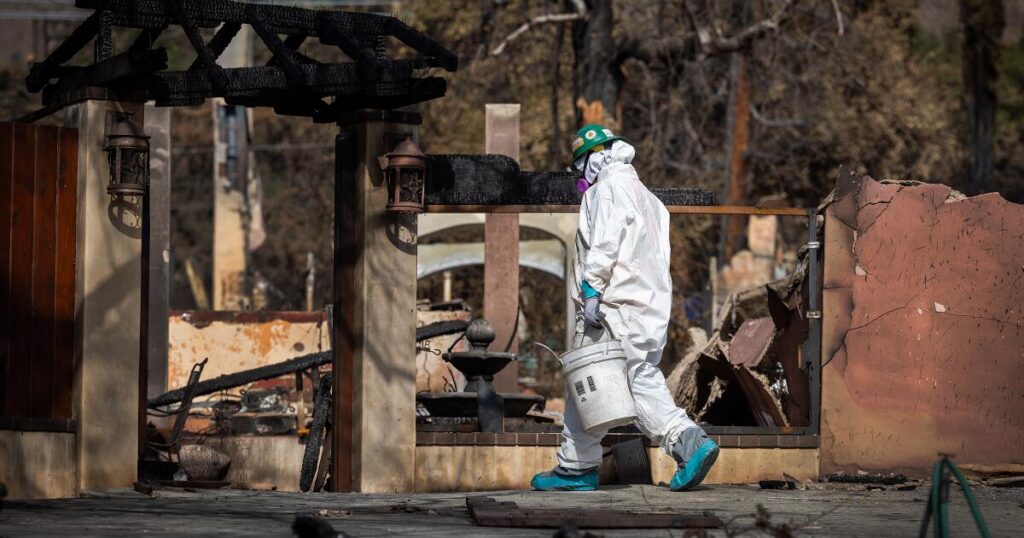
The patchwork efforts to identify and safely remove contamination left by the 2025 Eaton and Palisades fires has been akin to the Wild West.
Experts have given conflicting guidance on best practices. Shortly after the fires, the federal government suddenly refused to adhere to California’s decades-old post-fire soil-testing policy; California later considered following suit.
Meanwhile, insurance companies have resisted remediation practices widely recommended by scientists for still-standing homes.
A new bill introduced this week by state Assemblymember John Harabedian (D-Pasadena) aims to change that by creating statewide science-based standards for the testing and removal of contamination deposited by wildfires — specifically within still-standing homes, workplaces and schools, and in the soil around those structures.
“In a state where we’ve had a number of different wildfires that have happened in urban and suburban areas, I was shocked that we didn’t have a black-and-white standard and protocol that would lay out a uniform post-fire safety standard for when a home is habitable again,” Harabedian said.
The bill, AB 1642, would task the state’s Department of Toxic Substances Control with creating standards by July 1, 2027. The standards would only serve as guidance — not requirements — but even that would be helpful, advocates say.
“Guidance, advisories — those are extremely helpful for families that are trying to return home safely,” said Nicole Maccalla, who leads data science efforts with Eaton Fire Residents United, a grassroots organization addressing contamination in still-standing homes. “Right now, there’s nothing … which means that insurance companies are the decision-makers. And they don’t necessarily prioritize human health. They’re running a business.”
Maccalla supports tasking DTSC with determining what levels of contamination pose an unacceptable health risk, though she does want the state to convene independent experts including physicians, exposure scientists and remediation professionals to address the best testing procedures and cleanup techniques.
Harabedian said the details are still being worked out.
“What’s clear from my standpoint, is, let’s let the public health experts and the science and the scientists actually dictate what the proper standards and protocol is,” Harabedian said. “Not bureaucrats and definitely not insurance companies.”
For many residents with still-standing homes that were blanketed in toxic soot and ash, clear guidance on how to restore their homes to safe conditions would be a much welcome relief.
Insurance companies, environmental health academics, and professionals focused on addressing indoor environmental hazards have all disagreed on the necessary steps to restore homes, creating confusion for survivors.
Insurance companies and survivors have routinely fought over who is responsible for the costs of contamination testing. Residents have also said their insurers have pushed back on paying for the replacement of assets like mattresses that can absorb contamination, and any restoration work beyond a deep clean, such as replacing contaminated wall insulation.
Scientists and remediation professionals have clashed over which contaminants homeowners ought to test for after a fire. Just last week, researchers hotly debated the thoroughness of the contamination testing at Palisades Charter High School’s campus. The school district decided it was safe for students to return; in-person classes began Tuesday.
Harabedian hopes the new guidelines could solidify the state’s long-standing policy to conduct comprehensive, post-fire soil testing.
Not long after the federal government refused to adhere to the state’s soil testing policy, Nancy Ward, the former director of the California Governor’s Office of Emergency Services, had privately contemplated ending state funding for post-fire soil testing as well, according to an internal memo obtained by The Times.
“That debate, internally, should have never happened,” Harabedian said. “Obviously, if we have statewide standards that say, ‘This is what you do in this situation,’ then there is no debate.”
The post A push to end a fractured approach to post-fire contamination removal appeared first on Los Angeles Times.