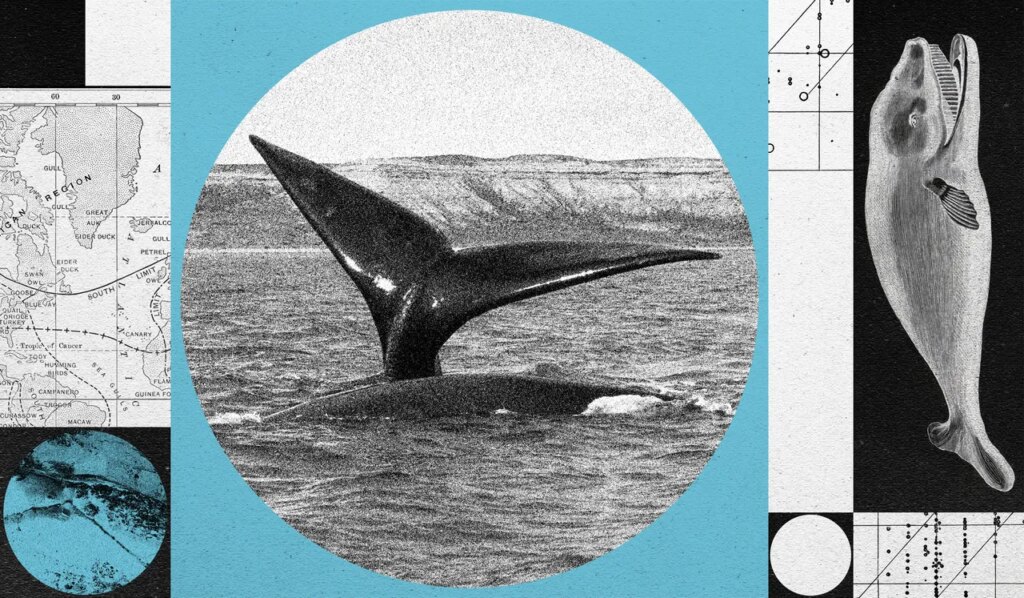
After nearly two decades, the baby whale came back—as a mother, with a baby of its own. Julie Albert, director of the Right Whale Sighting Network at Blue World Research Institute, a nonprofit, first laid eyes on the North Atlantic right whale known as Callosity Back in 2007 when it was still just a calf, swimming off the coast of Florida.
Immediately, she says, the whale stood out. Like other North Atlantic right whales, it had callosities—patches of thick, white, rough tissue on its skin. But unlike any other known right whale, this one had those markings on its back.
“That’s how she got her name,” says Albert. “She’s definitely an individual.” Then, on New Year’s Eve 2025, Callosity Back returned to Florida. A call came through from the Florida Fish and Wildlife Conservation Commission to say that an unidentified whale and her calf had been spotted off the state’s central-eastern coast. Albert describes how she and her colleagues raced to the pool deck behind a nearby beachside hotel to get a better view and soon realized it was Callosity Back.
“I’ve been waiting 19 years to see this mother,” says Albert. The whale observers—joined occasionally by hotel guests—watched the mother and calf pair swimming for hours, until darkness finally fell.
Callosity Back’s calf is just one of 21 right whale babies documented at the time of writing during the current calving season, which spans from mid-November to mid-April. It is unusual to see so many of these whales born so early in a single season. Researchers counted only 11 last year, for example.
In 2024, just 384 North Atlantic right whales were left in the wild in total, according to an estimate published last October. The species used to number in the many thousands, before commercial whaling almost wiped out these animals during the 18th and 19th centuries. North Atlantic right whales have never recovered and are now on the brink of extinction.
The baby boom is good news, says Albert. But it doesn’t change the overall picture for these animals, which remain in great jeopardy. A series of collisions with vessels, or entanglements with fishing gear, could easily kill enough North Atlantic right whales to flip the species’ fortunes the other way again, as happened in 2017, when 18 right whales died during a period of just six months. That year also saw the tragic death of whale rescuer Joe Howlett, who was killed after cutting fishing lines off a North Atlantic right whale in the Gulf of St. Lawrence.
The people who monitor and protect right whales, and who know these animals’ stories in great detail, will tell you that a flurry of calves, while wonderful in itself, by no means guarantees the species’ long-term survival. But right whales are still worth fighting for, conservationists say, because their tiny population could yet swell again—if it gets the chance.
Callosity Back was born a survivor. Her mother is one of only two North Atlantic right whales ever documented to have given birth in chilly northeastern waters, far from the usual calving grounds off the Carolinas, Georgia, and Florida. (Right whale calves are born without blubber, meaning that exposure to cold water in the first weeks of life could kill them.)
Right now, researchers are continually watching for newborn right whales, and have been surprised by the 21 new arrivals. “In the 1980s and 1990s we only got over 18 maybe a couple of times, just to give that some context,” says Phil Hamilton, senior scientist at the New England Aquarium. “I’m hopeful that number might go up.”
Multiple females that have given birth in the past, but not during the last three years, are currently present in the calving grounds, so it’s possible there will be an even higher tally of calves by the time spring arrives. Still, high variation from year to year is to be expected in such a small population of animals, stresses Hamilton, and it would be wise to consider the long-term population trend—which since 2010 or so has largely been downwards.
There is, though, other good news to consider: No North Atlantic right whale deaths were recorded during 2025, says Hamilton, though there were some injuries. In December, for instance, a male right whale called Division was spotted entangled in fishing gear—long lines wrapped around its head and mouth, even cutting into the animal’s blowhole. Rescuers were able to cut some of the gear away, but it’s possible sea lice will infect the wounds that the lines had already made in Division’s skin, says Tonya Wimmer, director of conservation and co-executive director of the Marine Animal Response Society, a charity in Canada. “He’s getting thinner, so it’s not a good picture for him,” she says.
North Atlantic right whale observers constantly monitor the health of individual whales, follow their journeys along the eastern coast of North America as sightings are reported, and chalk up each new calf that appears. The New England Aquarium North Atlantic Right Whale Catalog contains millions of records, including photographs and written contributions documenting right whale sightings over the course of decades. Calves, in particular, always generate plenty of interest. “A new-born calf is very adorable to those of us who like right whales,” says Hamilton. “You get to see them nursing on the mothers, or lying on the mother’s back.”
Hamilton and his colleagues are even working on a system to use photogrammetry—stitching photos together to make a 3D model of something—in order to measure the size and shape of female whales so they can tell when one is pregnant. It’s possible to make a similar assessment with the naked eye if the whale is far enough along, and pregnancy tests can also be done by analyzing hormones in the animals’ feces.
But getting so close to these whales brings with it an emotional burden. “It wasn’t until I started the job that I heard the phrase ‘compassion fatigue’ in the right whale community,” says Albert. “It’s gut-wrenching sometimes. They don’t have a happy story.”
Joel Cohen, a wildlife photographer and volunteer for the Right Whale Sighting Network, knows that hopeful news during the calving season is sometimes cruelly overtaken by what happens next. In late December 2022, he took the first photographs of a right whale calf born to a mother called Pilgrim, after it was spotted along Canaveral National Seashore. “A couple of weeks later we got amazing drone video of mom and calf,” he recalls. Cohen and colleagues were even able to tell that it was a female calf when it rolled itself over Pilgrim’s back.
Roughly one year later, Pilgrim’s calf came back to Florida as a juvenile. “She spent many hours, very close to shore, entertaining many people that got to see her,” says Cohen. But just nine days after that appearance, terrible news arrived. An aerial survey team caught sight of a North Atlantic right whale carcass off the coast of Georgia. “She was hit by a vessel,” says Cohen. He and Albert attended the necropsy, at which scientists found fractures to the young whale’s skull, among other injuries. “I still feel the loss, and I still am processing it,” he says.
Cohen, who lives by the beach, adds that ever since the death of Pilgrim’s calf, he has occasionally experienced nightmares. “I wake up, open the blinds, and there’s a mom and calf dead on the beach,” he says. “It is an emotional toll.”
But there are reasons beyond the recent calving success to be at least a little optimistic about the future. Wimmer praises significant regulatory interventions in Canada to protect right whales, for example. “They’ve implemented dynamic fishing management—if whales are spotted, fishers will be pulled out of an area,” she explains.
Gliders—torpedo-shaped, ocean-going devices—have increasingly helped to track the presence of whales in relation to shipping in recent years. This is part of efforts to reduce vessel strikes. Conservationists say that if ships and leisure craft slow down in areas frequented by right whales, and if people keep their distance from the animals when sighted, then that will help their chances of survival.
“We want everyone to see the whales, but you gotta do that from land,” says Cohen. The Right Whale Sighting Network has a hotline people can call to report potential occurrences of North Atlantic right whales off the Florida coast. Despite the devastation of losing Pilgrim’s calf two years ago, Cohen says he’s more confident than ever that North Atlantic right whales can recover as a species. He’s aware of individual whales that have lost calves, for example, but then gone on to birth new ones just a few years later.
“You see this resilience,” he says, explaining why he is so dedicated to fighting for these whales. “That makes you want to fight even more.”
The post A North Atlantic Right Whale Baby Boom Is On—but the Species Remains at Risk appeared first on Wired.