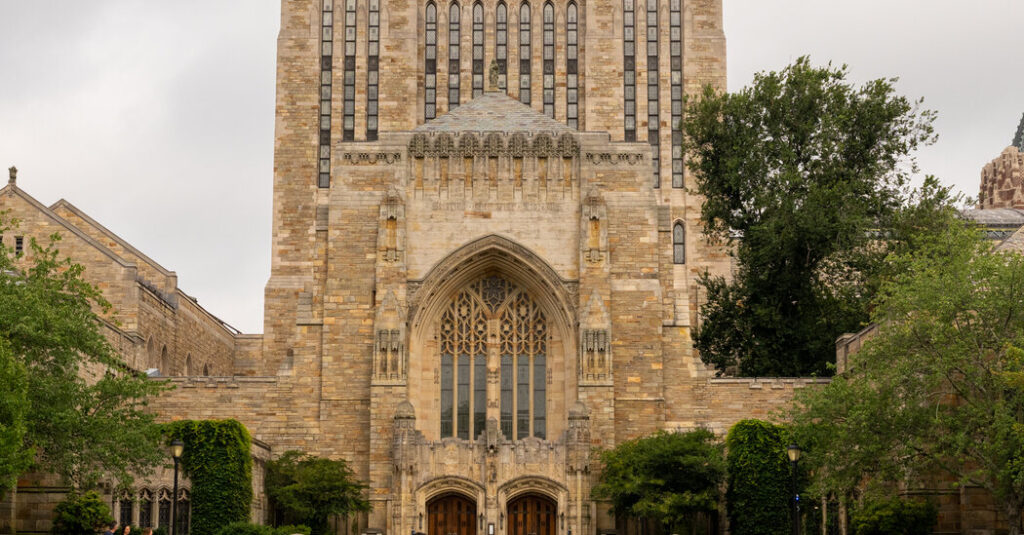
Yale University said on Tuesday that tuition would be waived for newly admitted undergraduate students from families with annual incomes below $100,000, and that tuition would be waived for those earning below $200,000. The change takes effect for the class that will enroll in the fall.
The move enters Yale into an arms race of elite institutions offering increasingly attractive financial aid packages to students from low- and middle-income families. At Yale, the full-price cost to attend is now more than $90,000 a year.
Yale’s new policy essentially matches the deal offered by Harvard last year, which followed similar announcements by the University of Pennsylvania, the Massachusetts Institute of Technology and others.
The beefed-up financial aid follows the Supreme Court’s 2023 decision limiting what universities may do to recruit racially diverse student bodies. The schools hope to continue to attract diverse applicants by stepping up financial aid, since race and income are often correlated.
The effort to make attendance more affordable at some of the nation’s highest-rated universities also comes at a time when public trust in higher education has declined.
Richard Kahlenberg, director of the American Identity Project at the Progressive Policy Institute, said the effort was good not just for the country but also for Yale, because it will allow students from different walks of life to attend, increasing the range of viewpoints on campus as well as the range of backgrounds.
“Economic diversity can bring racial diversity in a way that’s perfectly legal,” he said. “So after the Supreme Court struck down the use of race, institutions like Yale had to find different ways to get racial diversity.”
Under the new policy, which was first reported by The Wall Street Journal, Yale said that students from 80 percent of households in the United States would qualify for free tuition, and students from almost half the nation’s households would be eligible for an entirely free Yale education.
For the lowest-income students, the offerings at Yale, Harvard and some other schools include free housing and meal plans, allowances for travel to and from campus, medical insurance and “start-up” grants for students to use to buy books and supplies.
Previously, the upper limit for household income to qualify for no-cost attendance at Yale was $75,000 a year.
Jeremiah Quinlan, Yale’s dean of undergraduate admission and financial aid, said the new plan is an investment in affordability.
“With this announcement, we reiterate and reinforce Yale’s commitment to ensuring that cost will never be a barrier between promising students and a Yale College education,” he said.
Stephanie Saul reports on colleges and universities, with a recent focus on the dramatic changes in college admissions and the debate around diversity, equity and inclusion in higher education.
The post Yale Offers Free Tuition to Families With Incomes Under $200,000 appeared first on New York Times.