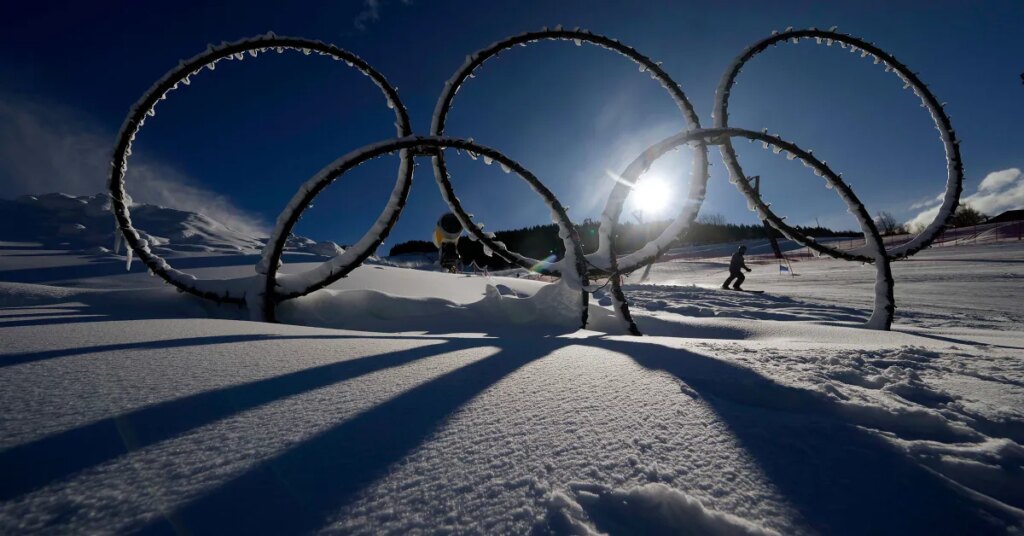
Canceled competitions due to warm weather and lack of snow. Skiing in slush. Postponed training sessions for freestyle athletes who need to perfect their risky tricks. Climate change is wreaking havoc on winter sports, so much so that the president of the world skiing and snowboarding governing body has called it an “existential threat”to the sports he oversees. Human-induced global warming is estimated to have cost the U.S. ski industry more than $5 billion in the first two decades of this century. “You have to be blind,” says Canadian aerial skier Marion Thénault, “to not notice it.”
[time-brightcove not-tgx=”true”]
So now the Winter Olympics themselves are at the mercy of rising temperatures. According to a 2024 study commissioned by the International Olympic Committee that appeared in the journal Current Issues in Tourism, under a high-emissions future, 56% of 93 potential Winter Olympic host sites around the world would not be considered climate reliable by the 2050s; 71% of the sites could not host the Games by the 2080s. The authors write that under a more likely medium-emissions future, 46% of the locations would be untenable by the 2050s, while 55% would be out of play by the 2080s. The Paralympics, which take place closer to the spring in March, are at even greater risk of losing potential hosts.
Read More: ‘I Don’t Believe in Limits.’ How Eileen Gu Became Freestyle Skiing’s Biggest Star
“Climate change is ultimately going to change the geography of where we can host the Winter Olympics,” says Daniel Scott, professor from the University of Waterloo’s Department of Geography and Environmental Management, and one of study’s co-authors. The good news: even in a worst-case, high-emissions scenario, nearly 27 places in Europe, North America, and Asia should be able to host the Games in 50 years. The Winter Olympics will almost certainly survive, in this century at least.
Warmer weather also shouldn’t impact the 2026 Olympics. Northern Italy, in February, can be quite frigid—average temperatures in Cortina D’Ampezzo, where women’s alpine skiing is taking place, range from a high of about 30℉ to a low of around 12℉ in February. “In relative terms, it’s a lower risk compared to other locations,” says Robert Steiger, a professor at the University of Innsbruck and co-author of the Current Issues in Tourism article.
But it’s hardly a guarantee. According to a new analysis from the nonprofit Climate Central, Cortina’s temperatures have warmed 6.4℉ since the last time the town hosted an Olympics, in 1956, resulting to 41 fewer freezing days annually. Gus Schumacher, an American cross-country skier who trained at the Olympic venue last winter, says, “it was pretty horrible there. Super icy one day and pretty slushy the next. Not ideal.” Two years ago, Thénault went to Livigno to test that Olympic venue. “There was no snow, and conditions were so, so bad,” she says. But a World Cup event in March 2025 was snow-packed and idyllic. “We just don’t know what we’re going to get,” says Thénault. “We’re rolling the dice.”
Read More: Inside Lindsey Vonn’s Unprecedented Attempt at an Olympic Comeback
Milano Cortina stakeholders have taken steps to mitigate the environmental impact of these Games. Renewable energy will be used at nearly all competition venues. Only two venues were built from scratch; the other 11 are either existing or temporary facilities. In Livigno, a “snow farm”preserves snow from the previous winter under a geothermal cover and layer of sawdust, lessening the need to rely on energy-consuming artificial-snow machines. Organizers are encouraging fans and Olympic officials to use trains, rather than private cars, to travel from Milan to the far-flung mountain regions of Cortina d’Ampezzo, Livigno, and other locations. They have also set a goal of recovering or recycling 100% of food leftovers from the Games, to help reduce emissions. “It’s costly,” says Diana Bianchedi, chief strategy planning and legacy officer for the Milano Cortina 2026 organizing committee. “But at the end, the event will be more sustainable. It’s our responsibility.”
Some athletes are doing their part. Thénault, who won bronze in Beijing, works with an engineering firm to track her carbon footprint. Thanks to measures like riding a bike to training instead of driving, and taking as few short flights around Europe and North America as possible—using a carpool or bus instead—data showed that Thénault, who is studying aerospace engineering at Concordia University in Montreal, reduced her footprint by 27% last season. She’s worked with the organizers of the World Cup aerials competition in Quebec, where she lives, to offer shuttle services to fans so they wouldn’t have to rely on their cars, to provide vegetarian options at the concession stands to limit meat consumption, and mostly eliminate the use of single-use plastic during the event. “People are reluctant to change,” says Thénault, an athlete alliance member of Protect Our Winters Canada, a climate-advocacy organization. “But I think being solution-oriented is very important so that we can move forward.”
Olympic athletes have a powerful platform. “Use your gold medal and get in the door and say, ‘Hey, I’m passionate about this,’” says Jessie Diggins, the American cross-country skier who, in what will be her last Olympics, seeks to win the first individual cross-country gold in the country’s history. “I want to tell you why it’s important to me that, hopefully, I get to ski with my grandkids one day.”
The post ‘We’re Rolling the Dice.’ What Climate Change Means for the Winter Olympics appeared first on TIME.