The number of Russian and Ukrainian troops killed, wounded or missing during nearly four years of war is on track to reach two million by this spring, according to a new study, a stunning toll as Russia’s assault on its neighbor grinds on.
The study, to be published on Tuesday by the Center for Strategic and International Studies in Washington, said that nearly 1.2 million Russian troops and close to 600,000 Ukrainian troops had been killed or wounded or were missing. That would put the overall casualty figure for both countries combined at almost 1.8 million.
For the entirety of the war, casualty figures have been difficult to ascertain because Russia is believed to routinely undercount its dead and injured, and Ukraine does not disclose official figures. The study relied on American and British government estimates, among other sources.
The figures present a grim accounting of Russia’s anemic progress in Ukraine, with Russian troops proceeding in some places at around 50 to 230 feet a day.
Since January 2024, Russia has seized 1.5 percent of Ukrainian territory, according to the Center for Strategic and International Studies, and occupies about 20 percent of the country.
As frigid winter temperatures have slowed troops on both sides, Russia has made grinding progress through the Luhansk and Donetsk regions of eastern Ukraine, as troops continue to try to gain full control of the area.
Tactics on both sides have changed. Because of the constant presence of drones overhead, Russia has partially scuttled major heavy armor movements in favor of small groups of soldiers on motorcycles or on foot to try to infiltrate Ukrainian lines, in the hope that they are less noticeable to drones. Ukrainian drone officers, for their part, monitor footsteps and tire tracks in the snow, looking for Russian troops.
The latest accounting of casualties came after talks among Russian, Ukrainian and American officials — the first between all three countries — ended on Saturday on a rare positive note.
President Volodymyr Zelensky of Ukraine said that the negotiations had made headway and that Ukraine was ready to hold further meetings. A Kremlin spokesman, Dmitri S. Peskov, said the talks would resume next week.
The United States and Ukraine have reached an agreement on much of a peace plan that has been revised several times. But whether Russia will agree to any part of the plan remains unclear.
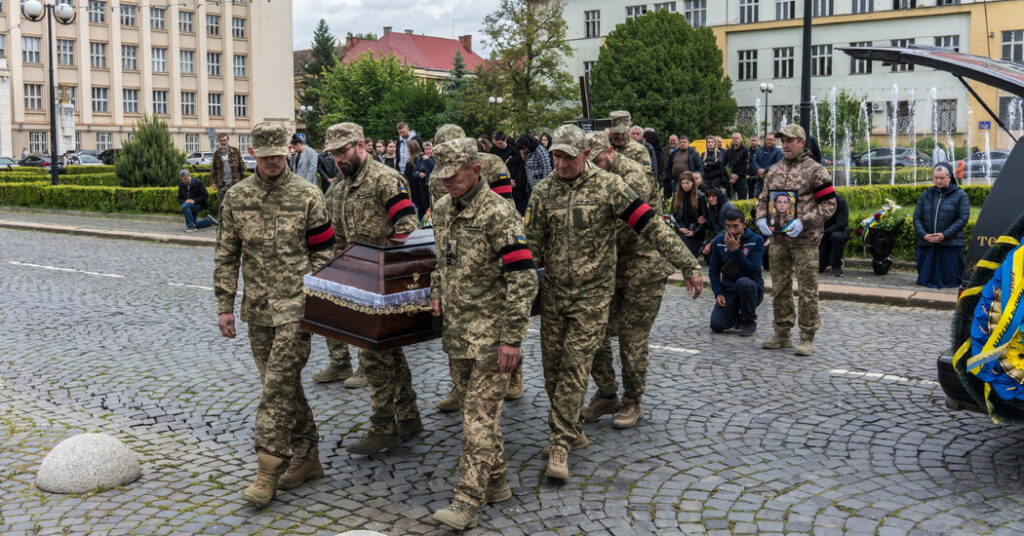
Meanwhile, the death toll continues to climb. The center put the number of Russian troop deaths at close to 325,000 since President Vladimir V. Putin ordered the invasion in February 2022.
“No major power has suffered anywhere near these numbers of casualties or fatalities since World War II,” the study said.
There were roughly 415,000 Russian deaths and injuries in 2025 alone, with an average of nearly 35,000 per month. Last week, President Trump said that nearly 26,000 soldiers were dying in Ukraine every month.
The study estimated that 100,000 to 140,000 Ukrainian troops had been killed since the war began.
Russians outnumber Ukrainians on the battlefield almost three to one, and Russia has a larger population from which to replenish its ranks. Ukraine is losing a larger share of its smaller army.
Russia has maintained its troop levels despite the high casualties by carrying out its first draft since World War II and by enlisting prisoners and debtors. It has also paid bonuses to new recruits.
As many as 15,000 North Korean troops have fought alongside the Russians, primarily in Russia’s western Kursk region after Ukraine captured territory there. South Korean intelligence officials and analysts have said that at least hundreds of North Korean troops are believed to have been killed in the war.
The war has also been a drag on Russia’s economy, according to Seth G. Jones, one of the authors of the study. Russia’s war economy is “under mounting strain,” the study said, “with manufacturing declining, slowing growth to 0.6 percent in 2025, and no globally competitive technology firms to help drive long-term productivity.”
The high casualty figures, slow pace of Russia’s territorial gains and economic losses are a clear indication that Russia is diminished, Mr. Jones said.
“Russia’s poor battlefield performance in Ukraine and declining economic productivity indicates that Russia is in serious decline as a major power,” he said in an email. “While Russia still possesses nuclear weapons and a large military, it is no longer a great power in most military, economic, or science and technology categories.”
Helene Cooper is a Pentagon correspondent for The Times. She was previously an editor, diplomatic correspondent and White House correspondent.
The post Troop Casualties in Ukraine War Near 2 Million, Study Finds appeared first on New York Times.