Relatives of two Trinidadian men the U.S. military apparently killed in a boat strike filed a wrongful-death lawsuit on Tuesday, bringing the first legal challenge in an American court to President Trump’s policy of targeting vessels suspected of smuggling drugs at sea.
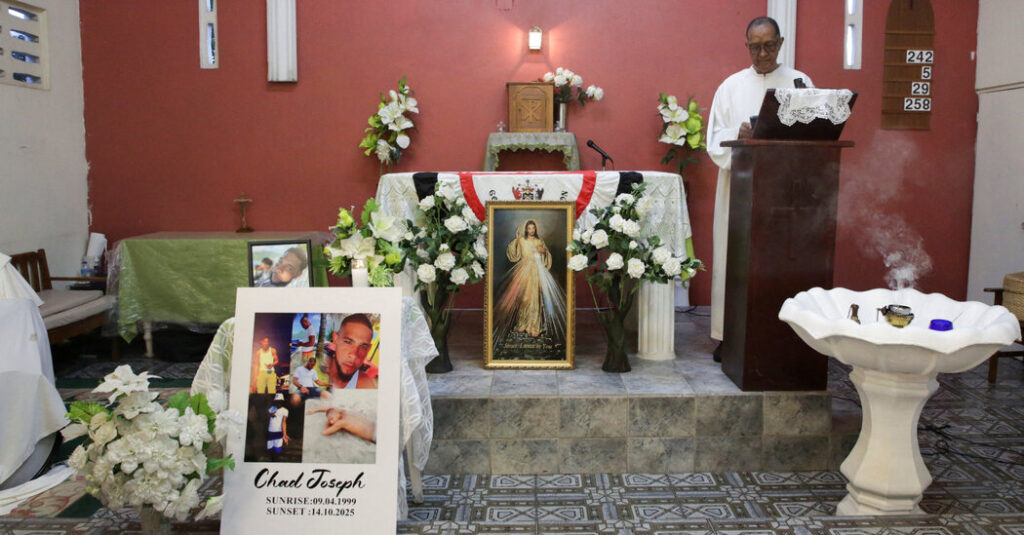
The lawsuit was filed in Federal District Court in Boston by the mother of one of the men, Chad Joseph, and the sister of the other, Rishi Samaroo. It said they vanished after telling their families they were about to take a boat home from Venezuela in mid-October. Mr. Trump announced on Oct. 14 that the military had attacked such a boat and killed six people.
“These premeditated and intentional killings lack any plausible legal justification,” the complaint said. “Thus, they were simply murders, ordered by individuals at the highest levels of government and obeyed by military officers in the chain of command.”
The lawsuit, brought by the American Civil Liberties Union and the Center for Constitutional Rights, names the U.S. government as a defendant, rather than trying to hold any particular official accountable as an individual. It seeks monetary damages in an amount to be determined at trial.
The White House and the Justice Department did not immediately respond to a request for comment.
The strike was the fifth of 36 such attacks to date, killing at least 126 people. The Trump administration has claimed the killings are lawful — and not murders — because Mr. Trump “determined” that there is a formal state of armed conflict with a secret list of 24 drug cartels and gangs he has deemed terrorists.
Outside experts in laws governing the use of lethal force broadly dispute that theory. Congress has not authorized any such armed conflict, and the administration has not explained how trafficking drugs amounts to the kind of armed attack on the United States that can give rise to one.
There are generally steep hurdles to suing the U.S. government, especially for noncitizens abroad who are not covered by the Constitution. But the lawyers for the Trinidadians pointed to two statutes about offenses at sea, so-called admiralty law, and argued that the provisions opened the door to judicial review of whether the killings were lawful.
The lawsuit invoked the Suits in Admiralty Act of 1920, which waived governmental immunity for lawsuits over alleged offenses at sea, and the Deaths on the High Seas Act of 1920, which created a cause of action for lawsuits brought by close relatives of people who were wrongfully killed.
The complaint also invokes the Alien Tort Statute, a 1789 law that allows foreign nationals to sue in U.S. court over violations of international human rights law. This part of the case argues that “the customary international law norm prohibiting extrajudicial killing is well-defined and universally recognized.”
The Justice Department’s Office of Legal Counsel has issued a classified memo that is said to approve the boat strikes as lawful based on accepting Mr. Trump’s assertion that there is an armed conflict with various drug cartels and criminal gangs. The memo says the presumed drugs aboard such vessels are a lawful military target, according to people who have read it, based on the idea that cartels could use the proceeds to fund their purported warfare.
The lawsuit denies that there is a legal state of armed conflict, regardless of what Mr. Trump asserts he has “determined,” while also arguing that even if there were one, the killings would still be unlawful attacks and war crimes.
“These killings were wrongful because they took place outside of armed conflict and in circumstances in which Mr. Joseph and Mr. Samaroo were not engaged in activities that presented a concrete, specific and imminent threat of death or serious physical injury, and where there were means other than lethal force that could have reasonably been employed to neutralize any such threat,” it argued.
It added: “Alternatively, even if the United States’ lethal strike against Mr. Joseph and Mr. Samaroo occurred during an armed conflict — which it did not — the strike was a wrongful act because it constituted an intentional killing of civilians who were not members of an organized armed group engaged in an armed conflict with the United States and were not directly participating in military hostilities against the United States,” which would make it a war crime.
In mounting a formal challenge to the policy, the case joins a complaint against Defense Secretary Pete Hegseth filed in early December before the Inter-American Commission on Human Rights, an arm of the Organization of American States that investigates human rights abuses in the Western Hemisphere. It was filed by the family of a Colombian man apparently killed in a boat attack on Sept. 15, Alejandro Carranza.
But the United States has not ratified any of the inter-American human rights conventions and does not consider the commission’s findings to be binding. By contrast, the new lawsuit puts the legal dispute before the federal judiciary.
The two rights groups handling the lawsuit were also involved in litigation over a decade ago on behalf of the relatives of two American citizens killed in drone strikes in Yemen. Those citizens were Anwar al-Awlaki, a member of Al Qaeda’s Yemen branch who was deliberately targeted, and his 16-year-old son, Abdulrahman al-Awlaki, who was killed when the United States was targeting someone else.
The Obama administration offered an array of defenses, including invoking the state secrets privilege and arguing that targeting decisions in the congressionally authorized military conflict against Al Qaeda was a “political question” that courts had no ability to second-guess. A Federal District Court judge dismissed the case in 2014, finding that lawsuits against national security officials focused on constitutional rights had not been permitted under such circumstances.
The Trinidadian lawsuit is different. The relatives of the men who were killed are suing the government as a whole, not specific national security officials. It relies on congressional statutes permitting such lawsuits, not judicial doctrine over when constitutional rights can be vindicated in court. There is no congressional authorization for any armed conflict. And the Trump administration has not sought to hide the attack, instead boasting of it.
Brett Max Kaufman, an A.C.L.U. lawyer on the case who also worked on the failed attempt to obtain judicial review of the Awlaki killings, acknowledged the difficulty of persuading courts to review government killings abroad but expressed optimism.
“The maritime claims we’re bringing here are straightforwardly available through acts of Congress, and the government has already boasted of its culpability for killing these men,” he said. “The government’s ordinary playbook to short-circuit judicial review in these kinds of cases should be thrown out the window.”
Charlie Savage writes about national security and legal policy for The Times.
The post Trinidadian Families File Wrongful Death Lawsuit Over Boat Strike by U.S. Military appeared first on New York Times.