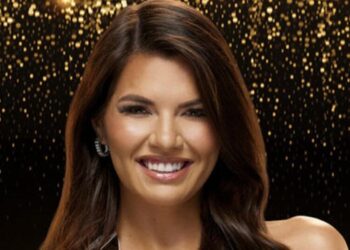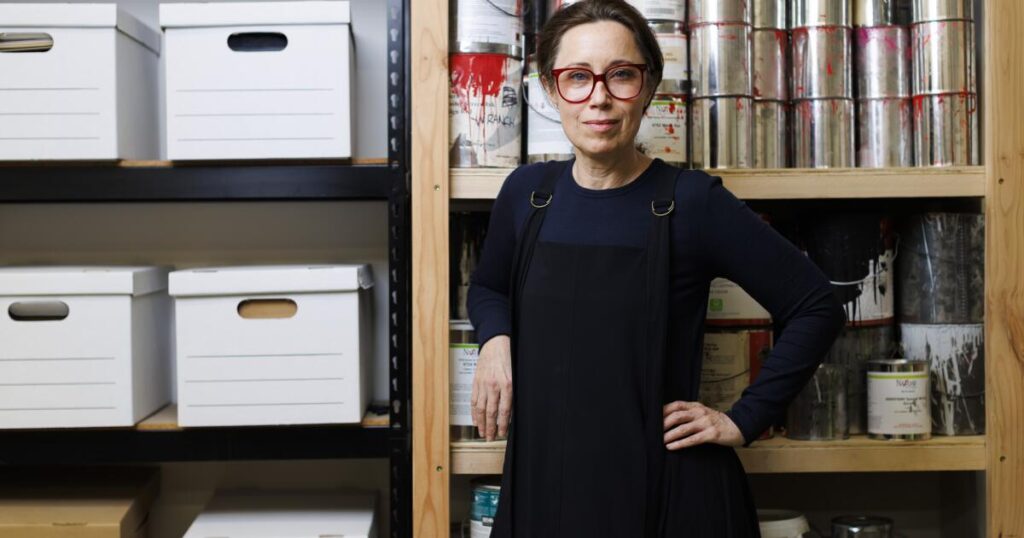
When artist Kathryn Andrews lost her home in the Palisades fire, it was not the first time. Five years earlier, her house in Juniper Hills burned to the ground in the Bobcat fire.
That level of loss can destroy a person, or it can build them stronger. In Andrews’ case, the latter came to pass. Instead of retreating into isolation, she turned her attention outward — toward service.
A month after the Palisades fire, Andrews — along with four other Los Angeles-based female artists and art workers — founded Grief & Hope. The mutual aid fund aimed to provide direct support to artists and cultural workers displaced by the disaster, as quickly as possible. The volunteer-run effort raised $1.74 million, which was distributed to nearly 300 people across Los Angeles County.
The premise was simple, yet novel, among disaster-relief initiatives. Aid was not merit-based or contingent on tax returns. Applicants needed only to demonstrate their proximity to the fires and their connection to the arts.
“We weren’t qualified to determine someone else’s need,” Andrews said in a recent interview. “The scale of loss is just too large, and it shows up in ways you can’t always quantify.”
The model offered proof that a kinder system could exist alongside the more stringent, rules-based relief funds that sometimes missed the mark, Andrews said.
The money raised, however, was modest against the cost of rebuilding a life. Andrews knows this fact all too well.
On the night of Jan. 7, 2025, Andrews heard about the Palisades fire from a friend who spotted plumes of smoke encroaching on Tahitian Terrace, a historic neighborhood of mobile homes in Pacific Palisades where Andrews had been living for close to a year. Andrews only had time to grab her passport and her two gray Bedlington terriers, Cooper and Coco, before she fled.
Everything else, including her art collection with works by Peter Shire, Jim Shaw, Rashid Johnson and Lesley Vance, was lost to the flames.
“So many of them were tokens of friendships that can’t ever be replaced,” Andrews said. “Artists have since given me works, which has been very touching, but the situation has changed my attachment to things, now that I see how transient they can be.”
Andrews moved four times before settling into her current home in West Hollywood. The instability made it nearly impossible to create new work.
“When I make art, I have to take risks of all kinds, creatively, emotionally, financially,” she said. “And when you’re in a chaotic state, and you’re dealing with so much loss, it’s very hard to subject yourself to more risk.”
Managing the logistics of displacement is further complicated by endless paperwork, insurance claims, Federal Emergency Management Agency forms and the exhaustion of grief.
“It’s not something that happens, then it’s over, and you’re back to normal,” she said. “It transforms you and makes you double-think a lot.”
Much of the public discourse surrounding disasters such as last year’s fires focuses on blame, but Andrews considers that framing incomplete.
“We’re all caught inside systems built around us by big business and government, systems that we don’t understand, let alone control,” she said. “And in our daily lives, we participate in them. We contribute to what will ultimately lead to our own destruction, whether that’s over-consumption or climate change.”
The only choice, as Andrews sees it, is to take accountability, reclaim agency and collectively reimagine how to live.
I first met Andrews at her downtown studio on the top floor of the Reef building in South L.A. a few days after the anniversary of the Palisades fire. Moveable partitions divide the massive space: the front houses the Judith Center, the gender equality nonprofit that Andrews launched in 2024, while the back serves as her office, studio and archive. Shelves filled with colorful books line the walls. Cooper and Coco greet me at the door, then settle beside Andrews.
In a fuchsia sweater, flowy cheetah-print skirt, and cobalt-colored glasses that accentuate her blue eyes, Andrews projects a surprising equanimity considering all she’s endured in the last five years. Still, as we begin to talk, I come to understand another aspect of her resilience.
Along with her work as an artist and advocate, Andrews is also a therapist. The advent of the COVID-19 pandemic, combined with the loss of her first place in September, 2020, catalyzed Andrews’ decision to go back to school—but the pivot followed a lifelong interest in cycles of trauma and violence. Andrews graduated Antioch University in 2023 and has been practicing ever since.
“We’re so caught up in our lives and the systems we make for ourselves,” Andrews said. “When everything’s gone, you have this opportunity to question why you did certain things, and why you held onto others. You can invite in the new.”
For her, that meant reassessing what she most valued, and stepping back from the near-constant rotation of museum and gallery exhibitions. She turned her attention toward two of her most deeply held interests, which had sharpened in focus after the Palisades fire: community-oriented work, and the pervasive problem of sexism in American culture.
She began taking action against the latter in 2024 when she founded the Judith Center, which hosts exhibitions, public conversations, book clubs and poetry readings that examine how sexism operates across interconnected systems in the arts, politics, science, education and technology. Upcoming programming includes a conversation with the legendary performance artist Barbara T. Smith, and a panel led by a Ukrainian curator on war photography.
Similar concerns animate Andrews’ sculpture practice, which she’s returned to now that her life has regained equilibrium. For more than two decades, she’s examined the ways objects and images shape our perception of ourselves and others.
In recent works, she cast the Oscar statuette as a phallic symbol of gendered authority and exclusion; embedded half a million dollars in U.S. currency inside a stainless steel sculpture shaped like breasts; and exhibited the names of every woman who has run for president and lost in site-specific installations, most recently at the Institute of Contemporary Art Los Angeles in 2024.
Her art-making, organizing work and therapy practice are all connected and striving toward the same goal, Andrews said.
When I asked her what that might be, she laughed and said, “Sanity.”
“I think everything I’m doing is really about questioning the way we individually and collectively see things,” she said.
A year out from the Palisades fire, when people talk about restoration and returning to the way things were, Andrews points them in the opposite direction, toward addressing the challenges ahead. The fires, the floods, the cascading disasters, aren’t aberrations we’ll overcome and move past, but rather the conditions under which we now live, she said.
“We need a greater collective sense of these ongoing calamities as the new normal,” she said.
The question now is not how to rebuild what was lost, but what new models of art and community might emerge in their place.
The post This artist lost two homes to L.A. fires in five years, then raised $1.74 million to help others recover appeared first on Los Angeles Times.