Two days into the government shutdown in October, Ellen Mei, who administered SNAP benefits at the United States Department of Agriculture, appeared on MSNBC. Mei, who was also president of her union chapter, warned viewers that millions of Americans might struggle to access food assistance, a problem exacerbated by staff reductions earlier in the year. She was promptly notified she would be fired. She told me she is fighting the decision with the help of a union lawyer, in part to rally her co-workers. “I don’t know if morale can go that much lower,” she said. “Especially after we lost half the people in our office. There’s so little hope left. I’m trying to show that we’re not taking this.”
Since the start of his second term, Trump has cut the federal work force by more than 300,000 people. In March, he signed an executive order stripping more than a million federal workers of their collective-bargaining rights. The order invoked a provision of the 1978 Civil Service Reform Act that exempts the government from extending bargaining rights to workers at agencies whose “primary function” is national security. It affected more than 30 agencies and agency subdivisions, including the Food and Drug Administration and the U.S.D.A. — but not, paradoxically, many workers actively involved in national security, such as Border Patrol agents, whose union endorsed Trump in the 2024 election.
A week before the shutdown, Russell Vought, the head of the Office of Management and Budget, urged federal agencies “to use this opportunity” to further dismantle the federal work force. Soon Trump was threatening to withhold back pay from furloughed federal employees, in defiance of a 2019 law he signed in his first administration. “I would say it depends on who we’re talking about,” he told reporters. “There are some people that really don’t deserve to be taken care of.”
As they had all year, federal labor unions were struggling to find a way to respond. The federal government is the largest employer in the country, with more than two million civilian workers, who might perform coastal restoration, ensure food safety or administer Social Security benefits. The American Federation of Government Employees, or A.F.G.E., the largest federal labor union, relied on tactics it had used for decades: lobbying and filing lawsuits.
‘I would say it depends on who we’re talking about,’ Trump told reporters. ‘There are some people that really don’t deserve to be taken care of.’
But for a growing rank-and-file movement of mostly younger union members, which works across agencies and is known as the Federal Unionists Network (FUN), the shutdown presented an unusual opportunity. Like the progressive upstarts challenging the old-guard leadership of the Democratic Party, FUN is pushing the national unions to fight the Trump administration more vigorously.
With the shutdown, FUN saw a chance to show that the fate of federal workers is inexorably bound up with the public’s welfare. The group hoped to capitalize on the outcry over cuts to government jobs and services that have had an impact on blue and red states alike. (More than 80 percent of federal employees live outside the Washington metropolitan area.) Members held rallies to encourage Senate Democrats to keep up their filibuster as lawmakers sought to pressure the administration to extend Affordable Care Act subsidies. FUN also staged actions to draw attention to the services under threat, drawing on a labor strategy known as “bargaining for the common good.” At a food drive outside the U.S.D.A., more than 100 federal workers donated some 1,600 pounds of food and $20,000 for food banks.
But as the shutdown wore on, Everett Kelley, A.F.G.E.’s president, had become increasingly worried that it was federal workers who needed those donations. In late October, he woke up to reports of federal employees standing in a food-bank line. Not long after, he volunteered to serve food at a church mission in Maryland. “I saw little children of federal employees coming through this line,” Kelley told me. To him, it was as if federal employees were being held hostage by both parties for their own ends. On Oct. 27, Kelley effectively called on Democrats to end their filibuster.
To FUN members, A.F.G.E.’s willingness to capitulate was emblematic of the problems with Kelley’s approach: a narrow focus on the short-term hardships of its members at the expense of the larger political battle. “I get why any union would be hesitant to embrace this kind of fight, especially in the face of an administration that has shown it is completely willing to pursue aggressive political and legal retaliation,” Chris Dols, FUN’s co-founder, told me. “That’s why it has to come from below. That’s our entire project. How do we give voice to federal unionists who are willing to take some risks that the unions aren’t willing to?”
Two days before the shutdown ended, Kelley lashed out at FUN during a meeting of the A.F.L.-C.I.O. executive council, which comprises more than 50 leaders from its affiliated unions, suggesting that the group’s continued support of the Democratic filibuster was undermining A.F.G.E. “He didn’t go into great detail, but it was intense,” one union president recalled, speaking on the condition of anonymity in order to talk candidly about an internal meeting. At the time, the Department of Transportation was canceling a significant percentage of flights across the country because of a shortage of air traffic controllers, and pressure was building on the administration. The union president shared FUN’s position and speculated that many others on the council did, too. “It was just at the point of maximum pressure,” he said, noting that polling showed the public blamed Republicans more than Democrats for the shutdown.
‘I felt like my voice had been taken away.’
Kelley credited A.F.G.E. for kick-starting the process that reopened the government. But to Dols and other members of FUN, the union merely provided Democrats with cover to justify giving in. Kelley told me that members who wanted the filibuster to continue were “few and far between.” But many A.F.G.E. workers I spoke with felt betrayed by his decision. Mae apGovannon, a member of A.F.G.E. and a FUN activist who reviews disability claims at the Department of Veterans Affairs, was enraged. “I felt like my voice had been taken away,” they said.
The shutdown — and the response to it — exposed the underlying weakness of federal unions, which have been largely moribund for decades. Before Trump’s second term, many federal workers rarely thought about their unions, if they belonged to them at all. In 2023, only a quarter of eligible federal workers were union members. (Federal unions are “open shop,” meaning no one is required to belong or pay dues, even though the union is legally obligated to represent all the workers in their bargaining unit.) And since 1962, when federal workers were first granted collective-bargaining rights, they have been explicitly prohibited from striking, significantly reducing their leverage in negotiations.
Trump didn’t just end collective-bargaining rights; he also eliminated automatic payroll deductions of dues, depriving unions of much-needed funds to contest the administration’s policies. In August, A.F.G.E. was forced to lay off 30 percent of its staff as money dried up. “A.F.G.E. punches below our weight because we have failed to organize members appropriately for a long time,” says Dave Casserly, an A.F.G.E. member and an attorney for the Department of Labor, who emphasized he was speaking in his personal capacity and not for the department. “The union was sold to them as if it were selling them their job insurance. So, once we’re not providing that anymore, they have no reason to be a member of the union.”
Trump’s executive order was “the biggest act of union-busting in U.S. history,” Joseph McCartin, a labor historian at Georgetown University, told me. Roughly 80 percent of unionized federal workers lost their bargaining rights. McCartin views it as far more radical than when Ronald Reagan broke the air traffic controllers union following its 1981 strike. “The Reagan administration never tried to uproot collective bargaining root and branch,” he says. “It never challenged the idea that collective bargaining had a place in government.”
Federal workers already had the fewest collective-bargaining rights of any unionized employees. They are not only barred from striking; they are not even allowed to assert the right to strike. Nor can they bargain for higher wages or benefits. “The crisis is that federal workers have ended up with a system that most other union members would not accept to begin with,” says David Kusnet, a former staff member of the American Federation of State, County and Municipal Employees, one of the country’s largest public-employee unions.
‘Federal workers have ended up with a system that most other union members would not accept to begin with.’
In many countries, labor unrest has often served as a political counterweight. A wave of public-employee strikes in France, in 1995, essentially shut down the country for weeks, forcing the conservative government to abandon several proposed cuts to the welfare state. And in 2024, South Korea’s second-largest union called for a general strike in the wake of the president’s declaration of martial law, a move that helped persuade him to back down.
“If we could strike — I’m not implying anything — I think it would make a big difference,” Kelley, the president of A.F.G.E., told me. Federal workers have struck before, notably in 1970, when 200,000 postal workers staged a wildcat strike that won them higher wages and the right, unprecedented for employees of the federal government, to bargain for wages and benefits. But the legacy of the 1981 air traffic controllers strike, and the Reagan administration’s harsh reprisal, continues to cast a pall on the labor movement. (In 1980, there were 187 major strikes; in 2024, there were 31.)
Liz Shuler, the president of the A.F.L.-C.I.O., who represents 15 million private- and public-sector workers, told me that internal data shows workers are not ready for a general strike. “We are not there,” she said. “There’s a lot of deep education and mobilization that’s happening within our unions to get us ready for a moment where we might need to strategically call for a one-day strike or a strike in a particular industry.”
‘If we could strike — I’m not implying anything — I think that it would make a big difference.’
McCartin says that Shuler and other labor leaders have been too risk-averse, given the stakes. “I would say that labor leaders, for the most part, have drawn the wrong lessons from PATCO,” he said, referring to the air traffic controllers’ strike. “One of the lessons that they seem to have drawn is that any confrontation with a sitting president in which federal workers are at issue is going to go badly for the union movement, and that any use of collective action leaves it vulnerable to what happened to PATCO. I think they have failed to understand the difference in the context between the current moment and that time. And they have an all-or-nothing approach: We can’t strike, therefore, what can we do except turn to the courts? I think that there was a lack of a plan, of doing something in between.” He noted that in 2019, Trump ended a monthlong government shutdown after 10 air traffic controllers called in sick.
McCartin believes that the more recent shutdown revealed deep stagnancy in the federal labor movement. There was, he said, “a failure to rise to the moment, but a failure that was long, long in the making. The preparations needed to be happening over a period of years.”
Chris Dols, of FUN, says one reason for that failure is structural. “One of the biggest weaknesses of the federal sector is how carved up we are,” he told me. FUN was founded in 2023 to build a federal labor movement that could operate across agencies and unions. Dols, who until recently was president of a U.S. Army Corps of Engineers local, explained that the corps, for instance, has units that are part of A.F.G.E., while others are represented by the National Federation of Federal Employees (N.F.F.E.), and still others are in the International Federation of Professional and Technical Engineers. They needed to be able to speak — and act — as a group.
Federal unions have also gained renewed support from many of their members in the wake of Trump’s attacks. By February of last year, A.F.G.E. was the fastest growing union in the country; its membership was at an all-time high, though still significantly less than half of the eligible workers. (Many union locals with activist leaders have higher participation.) Since Trump banned the automatic collection of dues, more than half of A.F.G.E. workers have chosen to continue paying those fees through alternate means.
‘There will be something called the A.F.L.-C.I.O. after Donald Trump leaves office, but will it be only a shadow of what it once was?’
The situation mirrors a larger paradox for labor: Unions have almost never been more popular (nearly 70 percent of the public approves of unions, according to a recent Gallup poll) and have never been weaker (union membership is at an all-time low and falling lower). In 2024, only 9.9 percent of all private- and public-sector workers belonged to a union, a figure that may fall to barely 9 percent once Trump’s executive order is reflected in the numbers from the Bureau of Labor Statistics.
“We’re at a dangerous point,” McCartin says. “Unions will survive this era. And they will survive, even, in some form, in parts of the federal government. But whether the union movement survives as a significant force in our country, whether it survives as a pillar of upholding a democratic political culture, as it has for most of the 20th and into the 21st century, remains to be seen. There will be something called the A.F.L.-C.I.O. after Donald Trump leaves office, but will it be only a shadow of what it once was? I think that, unfortunately, is a scary possibility.”
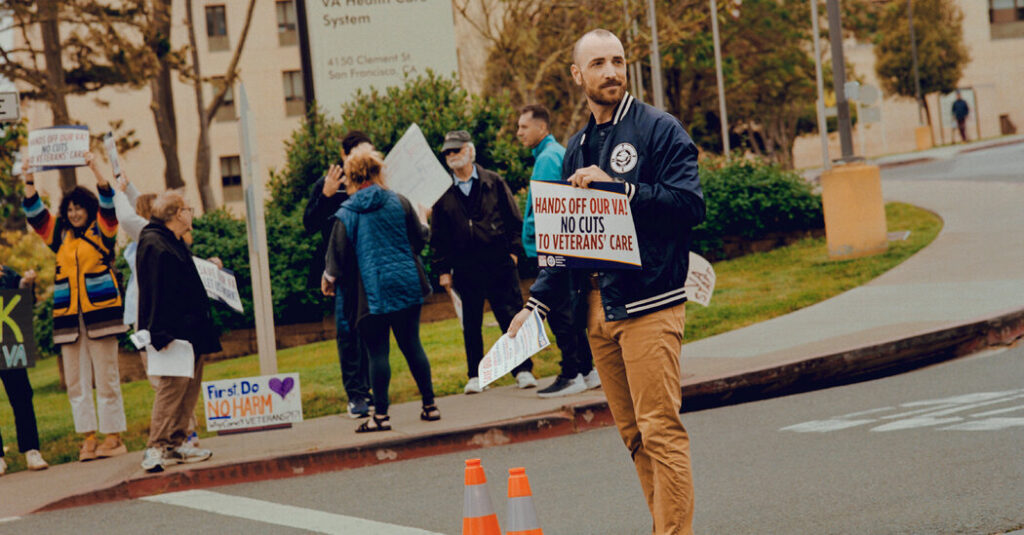
Mark Smith, a FUN co-founder, is president of the union local that represents health care workers at the San Francisco V.A. Health Care System. The V.A., which has the largest civilian work force of any federal agency, has been among the hardest hit by Trump’s executive order: It lost nearly 400,000 union members, around 2.6 percent of the country’s entire unionized work force. Many of the members in his local, Smith told me, opposed Everett Kelley’s call to end the filibuster. “People were pretty heartbroken by that,” he said. He was also disappointed by Randy Erwin, president of the N.F.F.E., of which his union is a part. Erwin gave a fiery speech denouncing Trump’s threat to withhold pay as unconstitutional, only to later fail to connect the plight of federal workers to broader political issues. For Smith, the fate of the V.A.’s workers and the wider public were deeply entwined, even if neither group was fully aware of it.
Smith has been working to drive home this point since the day after Trump’s second inauguration, holding emergency labor-education meetings for his members, many of whom had no idea what a union even was. When I met him last spring, he was frantically setting up a picket at the San Francisco V.A. Medical Center. Several dozen workers, vets and citizens had gathered, holding signs that read: “Save Our V.A., Let Us Work.”
Smith wasn’t always a labor activist. “I grew up conservative,” he told me. “It’s funny now that I’m the president of the union, because I didn’t know what a union was. If I had known, I probably would have thought, Oh, those lazy union workers.” Smith was raised in Alberta, Canada, on his father’s cattle ranch, in a region dominated by the energy industry. (His mother is from upstate New York; he is a dual citizen.) As a child, he had “antisocial” tendencies, which got him into numerous hockey brawls and, at times, trouble with the police. “I was a mediocre player, more of a fighter,” he said. He held up a clenched fist, which had a sunken knuckle. “My mom tells me: ‘Oh, union president — you’ve found a prosocial outlet for your antisocial streak.’”
‘People aren’t just sad they might lose their jobs. They’re pissed.’
Smith has a wiry frame, a shaved head and a close-cropped beard. A tattoo on his right arm shows a stick and a bag, memorializing his “hobo days,” several years in his 20s that he spent hitchhiking across Canada, Mexico and the United States. Interspersed with his travels were dozens of jobs: roofer, sewage-truck swamper, concrete pourer, oil rig roughneck. Eventually he went back to school to become an occupational therapist.
For the first seven years that Smith worked at the V.A., he was not involved with the union. “My conditions were good, basically,” he said. “I didn’t really see the union as a tool.” But during the pandemic, staffing and equipment shortages became more acute, with damaging consequences for both workers and patients. That motivated Smith to run for union steward. “Labor was all I talked about for a while,” he said. “My girlfriend told me: ‘You’ve got some real convert energy now.’”
Not long after, Smith joined with Dols and others to create FUN. Both were soon galvanized by the prospect of Trump’s re-election. “Our unions weren’t even talking about it,” Smith said. The group remained tiny, a loose-knit collective of roughly 200 people, until Trump’s victory. It has since grown to a network of 20,000 people and garnered the support of powerful labor leaders like Liz Shuler, of the A.F.L.-C.I.O. (who has spoken at FUN events); Sara Nelson, the president of the flight attendants union; and Shawn Fain, the president of the United Auto Workers. Last February, FUN staged its first mass mobilization, a Save Our Services Day of Action in 35 cities across the country, which included speeches by Representative Alexandria Ocasio-Cortez and Zohran Mamdani, then a long-shot mayoral candidate, in Manhattan’s Foley Square.
Smith is one of roughly 100 FUN activists who lead a union local. Last spring, 60 percent of eligible workers were members of Smith’s local, a much higher rate than for most federal unions. “There’s an old labor saying: ‘The best organizer is a bad boss,’” Smith told me. “People aren’t just sad they might lose their jobs. They’re pissed.”
Trump’s executive order was held up for some agencies by litigation until early August, when an appellate court in San Francisco lifted a lower court’s injunction. One rationale the court gave was that the order was motivated by national security, not by “retaliatory animus,” as plaintiffs had argued — even though the White House’s own fact sheet claimed that canceling collective-bargaining rights was necessary because the affected unions were “hostile” to Trump’s agenda.
A few days later, the secretary of the V.A., Doug Collins, terminated the agency’s contracts with five of its major unions, including Smith’s. Smith then received notice that the local’s office had to be cleared out immediately. He had filed his first grievance there, for a group of workers who hadn’t been paid properly for on-call duty over several years. He got them a few hundred thousand dollars in back pay. Without a union contract, such a victory would be almost impossible.
Smith told me that he spent the day trying to convince bewildered colleagues they still had a union. “The last six months have felt like psychological warfare,” he said, stressing that he was speaking only in his personal capacity and not on behalf of the V.A. “There’s lots of confusion, there’s lots of fear. Everyone is feeling a little bit hopeless and wondering if this is ever going to end.” But, he emphasized, a union was more than a contract; his union existed for 45 years before it won collective-bargaining rights. “This feels like the fight of this generation,” he said.
When I spoke to Smith again recently, he admitted how difficult that fight had become. “People are dropping off in dues, the longer that we go without collective-bargaining rights,” he said. “It’s a slow drip.” Smith worries that as V.A. membership in the N.F.F.E. dwindles, other workers, whose economic motivations align more closely with Trump’s agenda, have gained power. Workers at Geo Group, a private-prison company that has received billions of dollars in contracts to expand and maintain ICE facilities, now comprise one of the fastest growing sections of the N.F.F.E. (Some federal unions include both public- and private-sector locals.) In an editorial in the Bergen Record, N.F.F.E.’s president, Randy Erwin, defended the reopening of an ICE detention facility in Newark and criticized those who had protested outside it as “misguided.”
On Aug. 28, Trump released his Labor Day proclamation, calling the American worker “the living embodiment of the American Dream.” Just moments before, he had signed an executive order that stripped half a dozen more agencies of their collective-bargaining rights. Still, Smith and Dols saw signs of hope for labor, even in some unlikely places. In early December, the House passed the Protect America’s Workforce Act, a bipartisan bill that would restore collective-bargaining rights to federal employees. Twenty Republicans voted in favor of the act, perhaps the clearest sign yet of a backlash against the decimation of federal labor rights, though it’s unlikely to pass the Senate.
‘This administration has been shutting down the government piece by piece all year long. And those are permanent shutdowns.’
“I’ve always believed in collective bargaining,” Mike Lawler, a Republican congressman from New York and a co-sponsor of the bill, told me. “I fundamentally believe that when the government enters into an agreement, you have to uphold that agreement. You can’t just wipe it away with the stroke of a pen.” Representative Rob Bresnahan, a Republican who also supported the bill, told me that for him his “North Star is always Northeastern Pennsylvania.” He emphasized that his district is home to 10,000 federal workers — who are employed at a V.A. hospital, an army depot and a federal prison, among other places. “When it came down to the Protect America’s Workforce Act, I thought about my friends, my family, my neighbors. And I thought about my district. So for me it was the prudent thing to do.”
Around the same time, Gov. Spencer Cox of Utah, a Republican, signed a bill repealing one of the most restrictive labor laws in the country, which banned collective bargaining for the state’s public workers. Cox signed the bill into law earlier in 2025, but teachers, firefighters and police officers spearheaded a successful referendum campaign to repeal it, pushing the state legislature and Cox to do so preemptively.
The Trump administration, however, has continued to double down. In October, it made indefinite a federal hiring freeze in place since January of last year. Two months later, The Washington Post reported that the V.A. would be cutting as many as 35,000 unfilled health care positions. A spokesman told The Post that the jobs were being eliminated because they were “no longer needed” and had been empty for more than a year. He left unmentioned the severe staffing shortages of doctors and nurses documented by the V.A.’s inspector general in August. (Collins later called The Post’s story “fake news.”)
The budget deal that ended the shutdown lasted only through January. Congressional Democratic leaders, however, were showing little appetite for another shutdown, with House members agreeing to a new spending package even as the administration was threatening to cut off all funding to states with so-called sanctuary cities. But after the killing of Alex Pretti, a V.A. nurse and an A.F.G.E. member, by Border Patrol agents in Minneapolis, many Senate Democrats said they would not vote for any deal that included additional money for the Department of Homeland Security. FUN, Dols told me, would support a shutdown over funding for D.H.S. given what was at stake. Whether or not a shutdown happens, entire agencies — the U.S. Agency for International Development, the Consumer Financial Protection Bureau — have already been effectively dismantled. “This administration has been shutting down the government piece by piece all year long,” Dols said. “And those are permanent shutdowns.”
For Dols, the Republican support of the collective-bargaining bill suggests the tide might be turning. “There are cracks in the Republican MAGA coalition, even if we need a lot more,” he said. But there were cracks in the unity of federal unions, too. In mid-January, FUN staged a rally outside the Senate building, cosponsored by all the major federal unions, to push the Senate to restore collective-bargaining rights. The day before, A.F.G.E. pulled out. Dols downplayed the defection. No one else dropped out, and hundreds of workers from across the federal sector — even dozens of A.F.G.E. members — showed up. More important than the rally, there were at least 100 new organizing drives of nonunionized employees across the federal sector last year. “The federal labor movement has been a sleeping giant for a long time,” Dols said. “Trump woke it up.”
The post ‘The Biggest Act of Union-Busting in U.S. History’: Trump’s War on Federal Workers appeared first on New York Times.