UNTIL THE LAST GUN IS SILENT: A Story of Patriotism, the Vietnam War, and the Fight to Save America’s Soul, by Matthew F. Delmont
Opponents of America’s past wars often fare poorly in the eyes of historians. In Ken Burns’s “American Revolution” documentary, the Loyalists — those who stayed true to Britain during the War of Independence — receive respectful but piteous treatment, cast as tragically blind to the era’s radical egalitarianism. The America Firsters of the World War II era get pilloried as (at best) indifferent to Hitler’s evil. And where the Civil War was once commonly viewed as an avoidable mistake of a “blundering generation” of leaders, most historians now deem it an “irrepressible conflict” whose horrible carnage was necessary to eradicate slavery and create a more just society.
The biggest exception is Vietnam. Over many decades, rich chronicles of the anti-Vietnam War movement — including major works by the independent scholars Nancy Zaroulis and Gerald Sullivan, and the historians Charles Chatfield and Charles DeBenedetti — have consistently decried the war and valorized its detractors. Popular accounts of the era celebrate acts of protest as much as or more than tales of battlefield heroism.
In “Until the Last Gun Is Silent” the Dartmouth College historian Matthew F. Delmont follows this trend, intertwining accounts of two notable Black Americans from the period: the civil rights and peace activist Coretta Scott King and the Vietnam veteran Dwight “Skip” Johnson, a Medal of Honor recipient. Though Delmont’s reasons for pairing these two particular figures (who never met) aren’t entirely clear, their disparate stories underscore the variousness of the era’s African American experience.
The anti-Vietnam War campaign has long been recognized for its racial dimensions. Although early books about it treated Black peace activism mainly as a secondary concern, over the past several decades researchers, including Simon Hall and James Westheider, have delved into African Americans’ relationship to the war, emphasizing its special toll on Black soldiers and the emergence of a distinctly Black antiwar critique centered on racial justice.
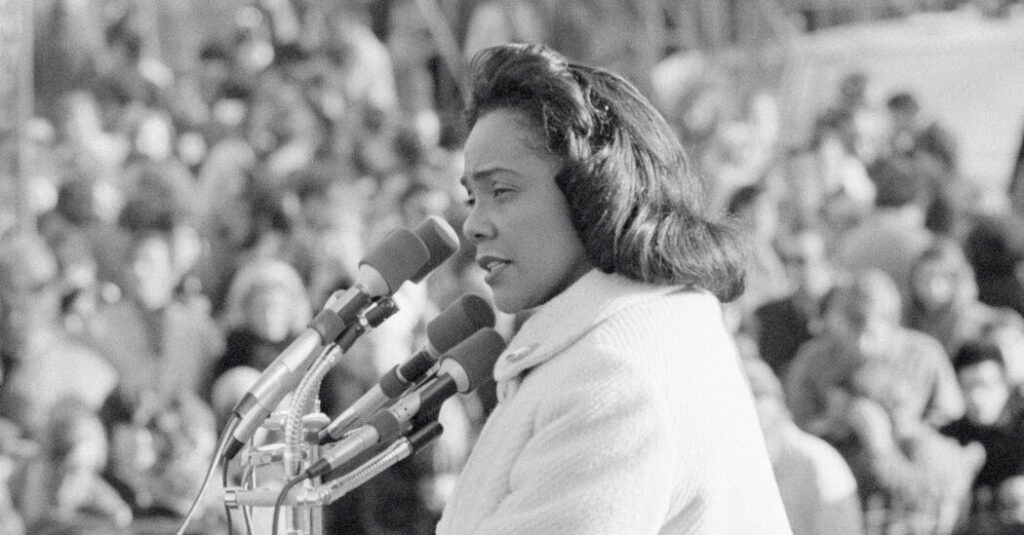
Delmont builds on this foundation while aiming to reach a popular audience through richly drawn portraits of his subjects. King’s story, though hardly unknown, is usually told in the context of the career of her husband, Martin Luther King Jr. Delmont, in contrast, spotlights her work as an independent activist. (Once asked if he had “educated” Coretta in political action, Martin replied, “I think at many points she educated me.”)
Resentful of being “made to sound like an attachment to a vacuum cleaner,” as Coretta once put it, she spoke out full-throatedly against escalation in Indochina even as her husband, not wanting to jeopardize support for civil rights, muted his criticisms. From the mid-1960s onward, she lobbied White House officials, headlined antiwar rallies and after Martin’s assassination emerged, in the words of the journalist Ethel Payne, as “the hottest political commodity on the market today.”
Skip Johnson grew up in the Jeffries Housing Projects of postwar Detroit in the 1950s and he was raised by a single mother after his Jamaican stepfather was deported in 1956. Drafted in June 1966, Johnson hoped to follow in the footsteps of men like his young congressman, John Conyers, for whom military duty had been a gateway to a better life — even though at the time many antiwar critics, including Conyers, were already calling the war unjust and arguing that the burdens of service were falling unfairly on African Americans.
A year and a half later, near Dak To in South Vietnam’s Central Highlands, Johnson’s regiment was ambushed on a road called Highway 14, leading to close-range firefights in which he rescued a comrade from a burning tank and fended off attackers until helicopter gunships arrived. For his courage, President Lyndon Johnson awarded Skip the Medal of Honor.
After his tour, Skip Johnson married his high school sweetheart, Katrina May, bought a house in Detroit and started a family. He recruited for the military, using his story to inspire urban youth to enlist. Yet increasingly his efforts met with pushback, much of it harsh; one student wrote to The Michigan Chronicle, an African American paper, that Johnson was “being used to make an evil war appear good, glamorous, heroic and palatable to the Black community.”
As the months wore on and tragedies in Vietnam piled up, Johnson grew debilitated by his wartime trauma. After the My Lai massacre was reported in 1969, he sometimes woke up at night screaming and even vomiting. Skip told military psychiatrists that he felt betrayed by the Army and hurt by the attacks from antiwar radicals. He missed speaking dates, lapsed on his mortgage and bills, and spiraled downward. In April 1971, unable to pay a hospital fee, he drew a gun on a grocery store owner who then shot and killed him. “I think he went into that store as a form of suicide,” Katrina later reflected.
Delmont rounds out King’s and Johnson’s stories by situating them in their historical moment. He notes that Black men served and suffered casualties in Vietnam at higher rates than white men. Interestingly, they also re-enlisted at much higher rates. Young Black men were more likely than white men to believe that a military career would lead to a better life, but they were also less likely to benefit from student deferments.
Delmont also calls attention to Defense Secretary Robert McNamara’s “Project 100,000,” which sought to “rehabilitate the nation’s subterranean poor” by expanding service to disadvantaged youths who had failed the Armed Forces Qualification Test. Almost 40 percent of the new recruits were Black. All this fed arguments that the prosecution of the war and the racism embedded in America’s governing institutions were linked.
Rendered in fluent, jargon-free prose, “Until the Last Gun Is Silent” is an easy if not always captivating read. At times the spare style crowds out Delmont’s own voice and sensibility, giving the narrative the feel of a classroom lesson more than a dramatic tale.
“Coretta fought for the things that she believed would make life better for average citizens — jobs, education, health care, housing and food,” he writes at one point. “The Vietnam War drew precious resources away from these needs, which is why she opposed it with every fiber of her being.” Even scenes that cry out for emotional immediacy, like Johnson’s battle on Highway 14 or Coretta’s reaction to her husband’s murder, project a certain flatness.
Despite this veneer of simplicity, however, Delmont shows a grasp of the ironies and nuances of history. If his verdict on the war is uncomplicated, he nonetheless appreciates the dilemmas and challenges it presented, from Skip Johnson’s attraction to the honor and opportunity furnished by service even in an unpopular conflict to Coretta Scott King’s recognition of the military’s vital role in providing jobs for African American men. In retrospect, the folly of American involvement in Vietnam may be perfectly clear, but the choices the war posed for Black Americans were anything but.
UNTIL THE LAST GUN IS SILENT: A Story of Patriotism, the Vietnam War, and the Fight to Save America’s Soul | By Matthew F. Delmont | Viking | 346 pp. | $32
The post The Battle That Raged Under the Vietnam War appeared first on New York Times.